


This Career Pivot Playbook features Ana Calin, a former corporate marketing director and the writer behind How We Grow, a newsletter built on one idea most creators miss…
Revenue does not come from more content. It comes from conversion.
She did not leave because she lacked success. She had a high-flying corporate career. On paper, everything worked. The roles. The travel. The reputation.
Then burnout forced a decision…
Keep building a career that paid well but felt empty. Or build something she owned.
What she did next is the playbook.
Inside, Ana breaks down how she went from writing for free to building a system that turns readers into paying customers. She explains why most newsletters fail to make money, even with good content, and what to fix first.
She is clear on pricing, selling, and why even if your newsletter has a small, committed audience, it can outperform a large passive one.
She also shares what nearly made her stop, what changed everything, and how she built systems that keep working without her being online.
If your content is good but your income does not reflect it, this one is for you.
✨About Career Pivot Playbooks
A public archive of modern career blueprints…
Most careers no longer follow a straight line.
People pivot gradually.
They extend their work beyond institutions.
They combine roles, platforms, and income streams.
Career Pivot Playbooks is a weekly series curated by Katharine Gallagher documenting how professionals build resilient, future-ready careers by turning existing skills into income, often combining Substack with consulting, teaching, research, creative work, or business ownership.
The focus isn’t outcomes.
It’s about how careers are shaped in practice.
About Ana
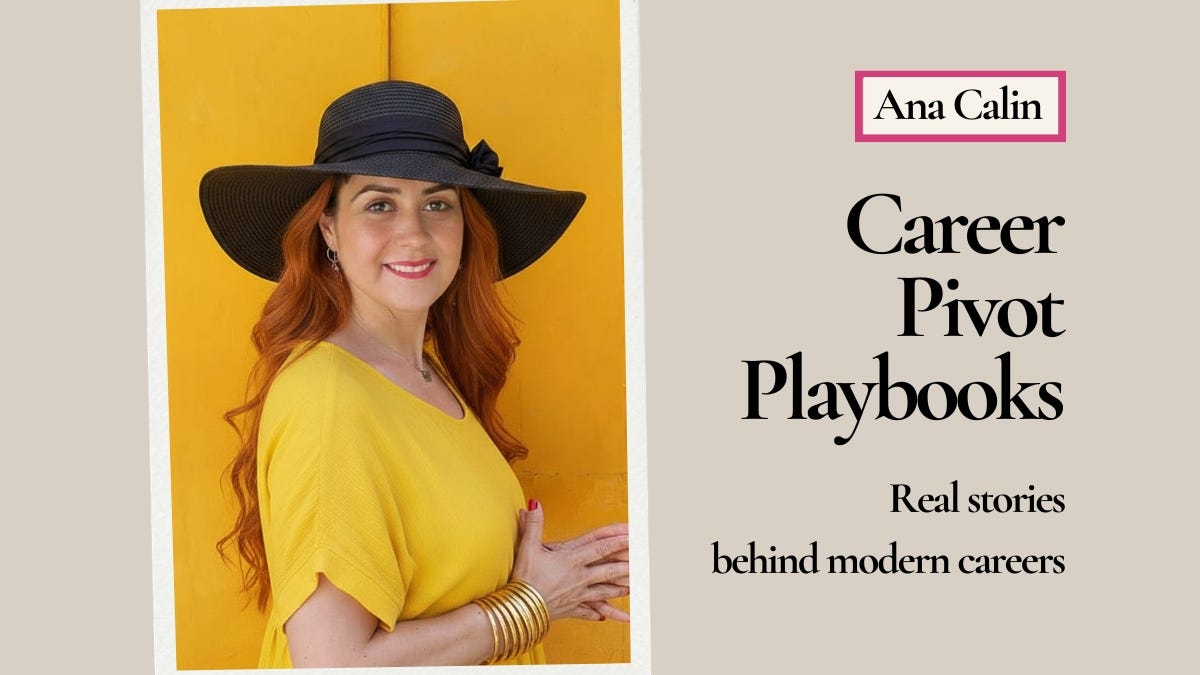
Ana Calin is a Forbes-recognised marketing leader, mama to Eva, and the creator of How We Grow — one of the fastest-growing newsletters on Substack with 70,000+ subscribers.
She went from corporate marketing director to $119K/month in 14 months, hit Bestseller in under 3 months, and built the whole thing while pregnant.
She teaches newsletter creators how to build something that pays them — without a massive audience, sales calls, or burnout.
You can follow her work here →

Ana reflects:
“Can you share a bit about your professional background and the path that led you to where you are today?”
15 years in corporate marketing. Amsterdam, San Francisco, London. 120+ countries. The kind of LinkedIn profile that made people say “wow.”
And I was miserable.
Not in a dramatic way. In the slow, quiet way where you stop noticing you’re unhappy because you’ve been unhappy so long it just feels like Tuesday.
I quit at 35. No plan. No audience. No newsletter. Just a very clear feeling that I was building someone else’s thing — and the equally clear feeling that I had about 40 more years of working life left, and I refused to spend them making someone else rich.
I started multiple businesses. Some worked. Most didn’t. Then in September 2024, I launched a Substack called How We Grow. 10 subscribers. My husband, two friends, and some LinkedIn connections being polite.
14 months later: 70,000+ subscribers. $119K+ months. Bestseller in under 3 months. Forbes called it a “must-subscribe-to.” I built the whole thing while pregnant — and then while breastfeeding at 3am with my daughter Eva on my chest.
The path wasn’t a pivot. It was an escape.
“What sign, moment, or slow realization told you it was time to diversify, and what did you have to push through to actually act on it?”
Must be when I fainted in a hotel bathroom. In Singapore. After travelling to three different continents within the same week.
Not dramatically. Not in a way that made a good story at dinner. I was on a work trip — another city, another conference, another morning of smiling at people whose names I’d forget by Thursday. I got up, walked to the bathroom, and the next thing I knew I was on the floor looking at the ceiling tiles.
My body quit before my brain had the courage to.
That’s the part nobody tells you about burnout. It doesn’t announce itself. It doesn’t give you a dramatic exit moment. It just pulls the plug while you’re brushing your teeth in a hotel you don’t want to be in, in a city you flew to for a meeting that could’ve been an email.
I lay on that bathroom floor and had the clearest thought I’d had in years: This is not the life I’m supposed to be living.
Not “this is hard.” Not “I need a vacation.” This is not it.
What did I push through to act on it? Everyone. My family thought I was having a breakdown. My colleagues thought I was ungrateful. My bank account thought I was insane.
The average woman waits 2.3 years longer than the average man to start a business — not because of capability, but because of how many people tell her to “be realistic.”
I stopped being realistic. Best decision I ever made.
And I haven’t been back on that bathroom floor since.
“Which skills or experiences from your previous career unexpectedly became an advantage in what you do now?”
The biggest one nobody expects: corporate presentations.
I spent 15 years making PowerPoints nobody wanted to watch. Turns out, structuring a boring 40-slide deck for a VP who doesn’t care teaches you something invaluable: how to hold attention when someone doesn’t owe you any.
That’s the entire game on Substack. Your reader owes you nothing. They will close your email in 3 seconds if you don’t earn the next sentence. Corporate taught me how to survive in rooms full of people who didn’t care — and that’s exactly what the internet is.
The second one: brand positioning. In corporate, I positioned products worth millions. Now I position newsletters. The frameworks are identical. The product just happens to be me.
“How did you decide where to build visibility or credibility (Substack or elsewhere), and what role does that platform play in your overall career or income mix?”
I chose Substack because I was done being a renter on someone else’s platform.
On Instagram, the algorithm owns your audience. On LinkedIn, one policy change can wipe your reach overnight. On Substack, every subscriber is an email address I own. Nobody can take that away. No algorithm change, no platform pivot, no CEO having a weird Tuesday.
Substack is my home base. My revenue engine. My community. My content lives there. My paid subscribers live there. My courses, my workshops, my digital products — everything funnels back to Substack.
Notes are my storefronts. They bring new people in. But Substack is the house they walk into. I’ll never build on rented land again.
“Who is your work really for, and what problem do you solve so well that people are willing to pay for it?”
My work is for the woman with 200-2,000 subscribers who knows her content is good but can’t figure out why nobody’s paying for it.
She’s not struggling with writing. She’s struggling with conversion. She has a content strategy but no monetization strategy. And she’s been told she needs 10,000 subscribers before she can make money — which is the single most expensive lie in the creator economy.
I don’t teach people to write better. I teach them to convert the readers they already have. That’s the gap. That’s what people pay for.
“What turned out to be harder than you expected when you started… and what was easier than you imagined?”
Harder: Selling without feeling gross. I’d spent 15 years selling other people’s products with zero emotional attachment. Selling MY thing? Terrifying. Every email felt like handing someone a piece of my diary and saying “is this worth $7?”
It took me months to realise: selling isn’t asking for money. It’s telling people the door is open. If you believe what’s on the other side is genuinely valuable, selling is a service. If you don’t — that’s not a sales problem. That’s a product problem.
Easier: Getting subscribers. I thought I’d need to grind for years. Substack Notes changed everything. I posted consistently — personal stories, specific numbers, contrarian takes — and the platform’s algorithm did the heavy lifting. 60-70% of my subscriber growth came from Notes. The platform WANTS you to grow. That was a shock coming from Instagram, where the algorithm seemed to personally dislike me.
“How have you found the journey? What advice/strategies and tips would you give to others wanting to grow their audiences?”
The journey has been the most fun I’ve had working in my entire career. And I’ve worked in some glamorous places.
My advice is controversial, so here it is:
1. Clean your list before you grow it. I delete subscribers every month - ghosts who’d never opened a single email. My revenue went UP. Everyone obsesses over growing the number. Nobody talks about the fact that a dirty list is actively hiding you from the people who love your work.
2. Stop writing. Start converting. Your writing is already good enough. If people are subscribing for free, your content isn’t the problem. Your conversion system is. Set up a welcome email. Build an upgrade sequence. Write a paywall paragraph that actually sells. These things take an afternoon and work forever.
3. Post Notes like your business depends on it. Because it does. 3-5 Notes per day. Personal stories with data. Contrarian takes. Permission slips. My most viral Note wasn’t about Substack at all — it was about the average age women pivot careers. It got thousands of likes because it spoke to identity, not strategy.
4. Charge more than you think you should. I charge $97/month. Everyone said I was crazy. My subscribers stay longer than anyone else’s. A $5/month subscriber is a tourist. An annual subscriber at $177 is a resident. Build for residents.
5. Make it about them, not your content. Your paid tier should feel like joining something — not reading more posts. Monthly challenges, live access, surprise bonuses, anniversary touches. People don’t cancel things they belong to.
“What nearly made you quit, and what actually kept you going?”
Eva was 11 days old. It was 3am. She was screaming. I was crying. My shirt had milk on it for the third day. And I was convinced I had to choose — the baby or the business.
Then my phone buzzed. Stripe notification. $97. Then another at 4:12am. Another at 6:30.
I hadn’t sent an email. Hadn’t posted. Hadn’t touched my laptop in days.
The systems I’d built kept running while I was falling apart in the dark.
That night nearly broke me. And it’s also the night that proved the whole model works.
What kept me going? Not discipline. Not hustle. Systems. I built a business that doesn’t need me to be present — it needs me to have BEEN present. Past tense. That’s the difference between a job and a business.
“What advice would you give to someone considering a similar pivot or looking to monetize their skills in a more flexible way?”
Stop asking for permission.
I mean it literally. Stop polling your friends. Stop asking your partner if they think it’s a good idea. Stop reading one more article about “the right time to start.”
The average woman pivots careers at 39. The average new female entrepreneur is 42. The average first-time female millionaire is 49.
You’re not behind. You’re not too late. And you definitely don’t need anyone’s approval.
Start with one thing: publish something. A Substack. A post. One piece of writing that says “this is what I know and this is who it’s for.”
It doesn’t have to be perfect. My first post was embarrassing. My 50th was great. My 200th made me $119K in a month. But the 200th only exists because the embarrassing first one did.
Momentum creates clarity. Not the other way around.
“What other platforms, audiences, or income streams are part of your portfolio career… and how do they work together?”
I currently have 5 revenue streams and they all funnel through one place: my Substack.
1. Paid subscriptions. The foundation. Recurring revenue.
2. Digital products. Workshops, ai tools, and other resources. These serve as entry points — people buy a product, discover the newsletter, and become paid subscribers.
3. The 10K Launch Lab. My flagship cohort programme. 30 days. One task per day. Students build and launch their first offer. Average first-launch revenue: $3,847.
4. Brand partnerships and sponsorships. Selected carefully. I only work with brands my audience actually needs.
5. Affiliate income and Substack recommendations. Passive. The recommendation system alone delivers thousands of subscribers on autopilot.
The flywheel: free content on Notes and sometimes LinkedIn brings people in → they subscribe to How We Grow → the welcome email converts some to paid → paid subscribers become the warmest audience for launches → launches fund the business → the business funds my time to create more free content.
It’s a loop. It runs while I sleep. That’s the whole architecture.
“Looking back, what’s one decision that changed everything… and what’s next for you?”
The decision: Quitting the corner office at 35 without a plan.
Everyone called it reckless. In hindsight, it was the most calculated risk I’ve ever taken. Not because I knew it would work — I didn’t. But because I calculated the alternative: 30 more years in a career that made me feel nothing. That math was scarier than any startup risk.
What’s next: Two new publications. “How We Buy” — about buyer psychology, the science of why people pay, rooted in behavioural economics. And “Wear Orange” — something deeply personal about fertility, motherhood, and the journey that brought Eva into my life.
I’m also scaling the education side. More workshops. More cohorts. More ways to take the system that built my $100K months and put it in other people’s hands.
The vision is simple: build something that pays you without consuming you. That was always the mission. It hasn’t changed. The scale has.

Links & Resources
Connect with Ana…
Related Articles
I tracked every dollar my newsletter made for 12 months
I charge 20x more than most Substacks. Here's why my subscribers stay longer
Why the Most Profitable Substack Creators in 2026 Will Be Storytellers, Not Strategists
Start Here: The $50K/Month Newsletter Nobody Saw Coming
On Forbes: How Brands Can Win On Social Media In 2025: Nine Trends To Watch
Read More
I’m Katharine, a future-focused career strategist helping professionals build income options and stay relevant as work evolves.
My newsletter Learn Grow Monetize offers weekly modern career playbooks, strategies, along with expert career guidance to help ambitious professionals turn their experience into income.
🙏 I appreciate you being here and supporting this growing archive… and thank you to all the creators who contribute, it’s such a pleasure to learn from them.
❤️ Loved it? Restack 🔁 and share ✅
🤔Is there a question you wish had been asked?
Drop it in the comments, and let’s keep the conversation going.
Loved being part of this discussion with you. Definitely have a flair for finding the most interesting questions
this article was great!!! thank you, Katharine for putting this together with Ana!🫶
don't sleep on Ana's $10k Launch Lab. the program is amazing and works!!