


This Career Pivot Playbook features Andi Bitay, the writer behind Ditch the Templates, where she writes about building on Substack, finding your voice, and turning ideas into paid work.
Andi had what most people aim for… experience, clients, and a stable freelance business.
On paper, everything made sense. In practice, she felt stuck.
She wanted to do more than client work and local projects. She wanted to reach a wider audience and be part of a bigger conversation.
So she started creating in English and shifted her focus to building online.
No built-in advantage. No quick results.
Instead, she focused on writing consistently, testing ideas in public, paying attention to what people responded to, and maximizing early traction.
Ditch the Templates came from that transition. A place to think in public, test ideas, and build something that didn’t depend on clients alone.
In this Playbook, Andi breaks down what it actually took to start again, what most people get wrong about Substack, and how she turned her writing into a successful business.
✨About Career Pivot Playbooks
A public archive of modern career blueprints…
Most careers no longer follow a straight line.
People pivot gradually.
They extend their work beyond institutions.
They combine roles, platforms, and income streams.
Career Pivot Playbooks is a weekly series curated by Katharine Gallagher documenting how professionals build resilient, future-ready careers by turning existing skills into income, often combining Substack with consulting, teaching, research, creative work, or business ownership.
The focus isn’t outcomes.
It’s about how careers are shaped in practice.
About Andi
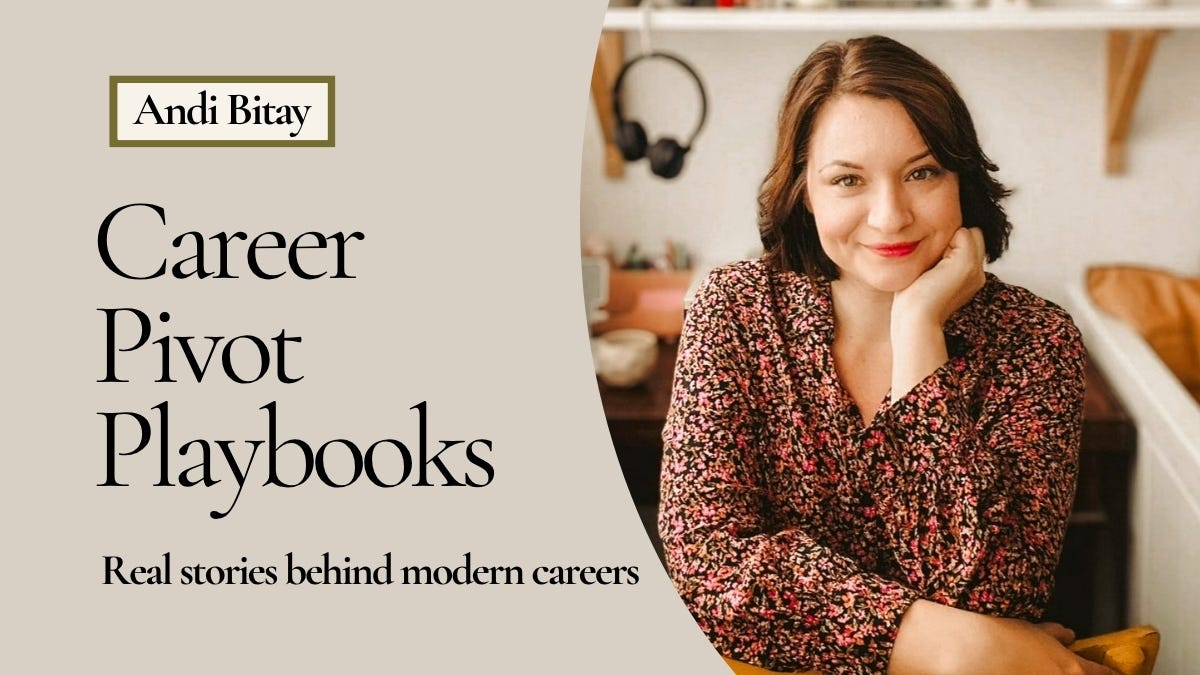
Andi Bitay is a content strategist and Substack mentor.
She helps creators and entrepreneurs build on Substack, grow their audience, and turn their writing into paid offers.
Her work focuses on clear thinking, strong positioning, and creating content that connects and converts.
You can follow her work here →

Andi reflects:
“Can you share a bit about your professional background and the path that led you to where you are today?”
I always knew I wanted to work in communications. I started out as a TV editor, but the world was shifting quickly, and somehow, I managed to move with it. I became one of the first online journalists, bloggers, and social media managers in my home country. I fell in love with digital content early on. It didn’t matter if it was my own or a client’s, I just loved creating.
The hardest part of my career was the time I spent at agencies. On paper, everything looked right. I was moving forward, climbing the ladder, but I was deeply unhappy. I couldn’t really find myself in that environment.
So when my son was born about 10 years ago, I went freelance and never looked back. Freelancing gave me freedom, but over time, constant client work started to drain my creative energy. That’s when I launched my own lifestyle blog, and later built a business helping female entrepreneurs with their social media.
Still, something was missing. The really exciting things just weren’t happening there. In Eastern Europe, trends tend to arrive a few years later, and I could feel that gap more and more. I started craving something bigger: working internationally, being part of the global conversation, earning more, and staying in sync with what’s actually happening online.
So I began creating content in English. It wasn’t a straight path, but eventually, it led me to Substack.
“What sign, moment, or slow realization told you it was time to diversify, and what did you have to push through to actually act on it?”
Honestly, it was a quiet inner voice that kept coming back to me. It said: if you don’t even try, you’re going to regret it. And at some point, staying where I was—doing what felt familiar and safe—started to feel worse than the idea of trying and failing.
One of the biggest challenges was my English. I hadn’t really used it since my school years. I’d never worked in English before; at most, I’d ordered food on holidays. That slowed me down a lot and brought up a fair amount of frustration.
There was also a harder realization: the results I had achieved in a small country didn’t really carry weight internationally. It felt like I had to start all over again from zero.
“Which skills or experiences from your previous career unexpectedly became an advantage in what you do now?”
Over time, I realized that people aren’t really interested in how convincingly I can prove I have a decade of experience. That’s not what builds trust. What actually matters is something much simpler… and much harder. Showing how I see things, sharing my perspective, and saying what I really think.
And I recognized something familiar in that. It’s the same thing I had already learned back home, just on a smaller scale. The moment I stopped trying to “prove” myself and started showing my way of thinking—how I connect the dots, how I see the bigger picture—people began to listen. They started to trust my voice.
I wouldn’t even call this a skill, it’s more of a mindset. But having experienced this once before was a huge advantage. I could go back to that place within myself and rebuild from there. Of course, it also helped that I adapt quickly to new things. I can usually figure out how a platform works quite fast, and I’m genuinely curious about how people use it.
“How did you decide where to build visibility or credibility (Substack or elsewhere), and what role does that platform play in your overall career or income mix?”
That’s a good question. For me, it really comes down to whether I actually enjoy being on a platform. I need to feel excited to open it every day. When that feeling fades, I slowly disappear from there. That’s exactly what happened with Instagram and LinkedIn.
I first started writing on Medium, and that’s where I came across Substack. I gave it a try, and something just clicked. It felt much more motivating, almost like going back to my early blogging days.
Right now, Substack is my main focus. It’s where I build visibility and credibility, and it plays a central role in both my work and income. At the same time, I do want to slowly expand to other platforms like Instagram and Pinterest. But I’m careful with that because I don’t want to burn myself out, so I’m taking it step by step rather than trying to be everywhere at once.
“Who is your work really for, and what problem do you solve so well that people are willing to pay for it?”
My clients often tell me that I help them see things differently, and I point out things they couldn’t see before. In a way, I help them rewire how they think about their content and give them a completely new perspective.
I mostly work with female entrepreneurs, writers, and experts who want to build a home base for their content on Substack. I help them reach more people, monetize their work, express themselves more clearly, and create real connections with others.
Because communication is complex. It’s not just strategy and numbers, it’s emotions first. What your audience feels matters, but just as much, what you feel as a creator matters too. The real work is bringing those two into alignment so that the content resonates, the connection is real, and the business is still sustainable and profitable. That challenge is what motivates me every single day.
“What turned out to be harder than you expected when you started — and what was easier than you imagined?”
When I started writing in English, I thought it would be much easier. I assumed I could more or less translate what I had already created before, and that people would quickly come and want to work with me. To be honest, I was used to things working that way. But it didn’t happen like that.
It took me almost two years to reach my first meaningful business breakthrough. There were many moments when I wanted to quit. But by then, I had already invested so much time and energy that turning back didn’t feel like an option anymore. For the first time, I felt like I was truly fighting for something that didn’t come naturally or easily into my life.
I was facing myself on a deeper level. My self-worth, my mindset. Constantly questioning what I might be missing, what I couldn’t see about my own patterns that was holding me back. And at the same time, I had to keep my local business alive. I couldn’t just walk away from my existing income. So I was building two things in parallel, and that was exhausting.
What turned out to be easier, though, was the connection itself. Once my message started to land, once I found my voice in English, the right people did find me. And those connections felt even deeper and more aligned than I had expected.
“How have you found the journey? What advice/strategies and tips would you give to others wanting to grow their audiences?”
I think this journey looks very different for everyone. People come to Substack with different goals, styles, and backgrounds… But one thing I see over and over again is this: people don’t really dare to step outside the clichés. They hold back from sharing sharper, more honest, sometimes uncomfortable thoughts.
Instead, many try to prove how knowledgeable and smart they are, and how worthy they are of a subscription. It almost feels like they’re trying to write as if they were featured columnists at a major publication. And that’s exactly where the connection gets lost because the audience doesn’t see the person behind the words. The writing doesn’t stay with them. It’s not memorable. Trust doesn’t have a chance to build.
At the core, we’re drawn to something much more human: stories, perspective, personality. These are ancient forces. We gather around people who make us feel something or make us think differently. If a piece stays with you hours or even days later, that’s when it truly lands. But if someone just hits “like” and forgets it a minute later, then it didn’t really reach them.
“What advice would you give to someone considering a similar pivot or looking to monetize their skills in a more flexible way?”
It’s worth it. And if you stay aware, keep shaping things as you go, and don’t let the fear of failure stop you, you’ll get where you want to go. What really matters today is flexibility. Not just financially, but in how you think. The ability to adapt, to shift, to let go of what no longer works. We don’t just not know what the world will look like in 10 years; we don’t even know what it will look like by the end of this year. That uncertainty isn’t temporary anymore, it’s the new normal. And the more you can build your work and your mindset around that, the more freedom you’ll actually have.
“What other platforms, audiences, or income streams are part of your portfolio career… and how do they work together?”
Right now, in terms of platforms, my main focus is Substack, but I’m planning to gradually expand beyond it. In the background, I offer Substack strategy and management, LinkedIn ghostwriting, and social media management. These provide consistent income and keep everything grounded.
One of my most popular services is the Substack Audit. And then there’s Bloom Your Substack, a 4-week 1:1 program I’ve now launched twice, and both times it sold out within 24 hours. This spring, I’m also planning to introduce smaller digital products, along with a mini course designed to help beginners get started on Substack.
So it’s a mix: client work for stability, and my own offers for growth and scalability. Over time, these pieces are starting to support each other more and more.
“Looking back, what’s one decision that changed everything… and what’s next for you?”
Looking back, the decision that changed everything was definitely the moment I hit ‘publish’ on my very first imperfect English post. Right now, I’m all about growing Ditch the Templates and evolving my services.
At the same time, I’ve just launched a second Substack called Still Becoming. It’s a bit of a passion project, less about business and more about community and personal fulfillment. I have big plans for it.

Links & Resources
Connect with Andi on her two publications→

Related Articles
Substack Just Told You Where It’s Heading. Did You Notice?
I stopped chasing ‘more.’ Here’s what I’m building instead.
The “general post” era is over
Read More
Behind the Pivot
Learn how to turn your current skills and experience into income and build a portfolio career beyond a single job, so you’re more resilient and in control.
The Career Pivot Archive
Real-world career pivots, portfolio paths, and practical lessons from some of your favourite Substackers you can apply to your own next move.
Career Questions Answered
Practical, strategic answers to the career questions ambitious professionals are asking as work, security, and opportunity continue to change.
I’m Katharine — a future-focused career strategist helping professionals build income options and stay relevant as work evolves.
🙏 I appreciate you being here and supporting this growing archive… and thank you to all the creators who contribute, it’s such a pleasure to learn from them.
❤️ Loved it? Restack 🔁 and share ✅
🤔Is there a question you wish had been asked?
Drop it in the comments, and let’s keep the conversation going.
Thank you so much, Katharine! It’s amazing to read my journey now, almost like an outsider, and reflect on what I was living through and the lessons I learned. Thank you for the opportunity to share it with your readers!