


This Career Pivot Playbook features Cristina, an Equal Employment Opportunity Specialist and the writer behind The Responsible AI Brief, a platform at the intersection of AI ethics, civil rights, and governance.
She didn’t come from tech. She came from the work of making institutions fairer, one policy, one conversation, and one training at a time.
Then AI started showing up in the systems she knew best. And she noticed something most people in the room were missing.
What she did next is the playbook.
Inside, Cristina talks about the moment she realized her background wasn’t a liability in AI spaces; it was the thing those spaces were missing most. She gets into the identity friction of stepping into a field dominated by engineers and lawyers without a technical degree. And she’s direct about what it actually takes to build credibility when no one handed you a seat at the table.
She also shares what surprised her most about starting The Responsible AI Brief, what she had to push through, what she’d do differently, and where she’s headed next.
If you’ve ever wondered whether your non-technical background belongs in a technical conversation, this one is for you.
✨About Career Pivot Playbooks
A public archive of modern career blueprints…
Most careers no longer follow a straight line.
People pivot gradually.
They extend their work beyond institutions.
They combine roles, platforms, and income streams.
Career Pivot Playbooks is a weekly series curated by Katharine Gallagher documenting how professionals build resilient, future-ready careers by turning existing skills into income, often combining Substack with consulting, teaching, research, creative work, or business ownership.
The focus isn’t outcomes.
It’s about how careers are shaped in practice.
About Christina
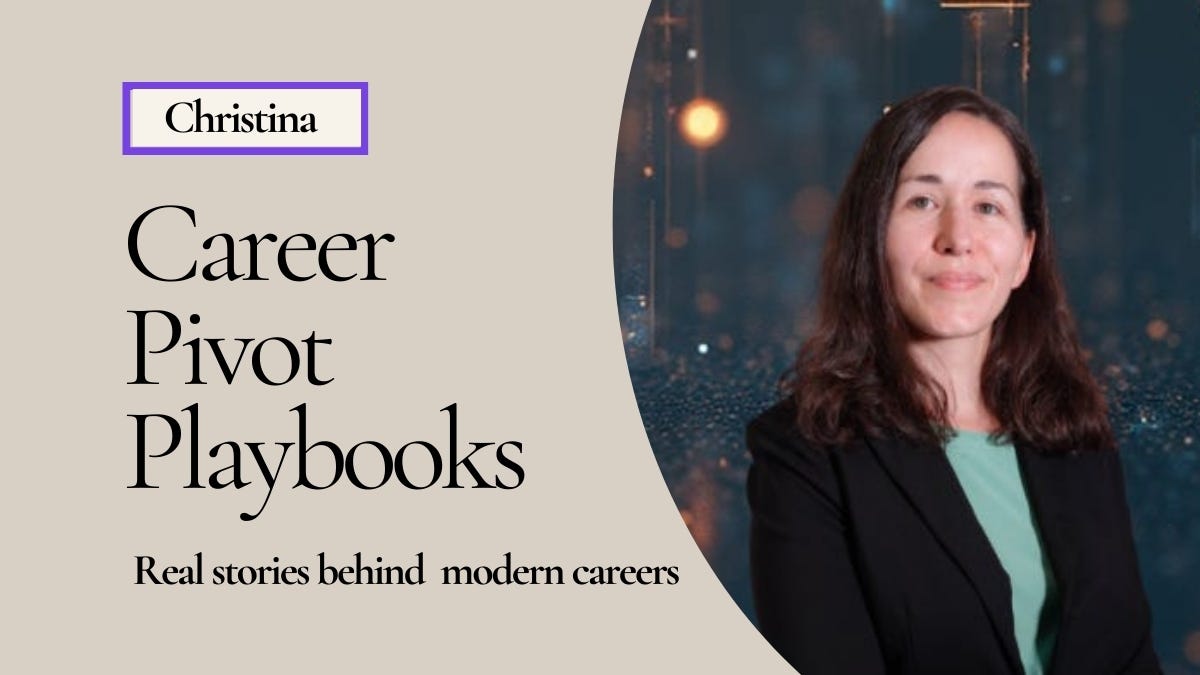
Cristina is the writer behind The Responsible AI Brief, a newsletter about AI ethics, governance, and civil rights thinking.
She is an Equal Employment Opportunity Specialist, DEI practitioner, and humanities-trained writer who is building her career at the intersection of bias, policy, and AI safety.
Today, she brings years of equity work into rooms that have rarely seen it, translating the human cost of automated systems into writing that doesn’t require a technical degree to understand.
You can follow her work here →
Christina reflects:
“Can you share a bit about your professional background and the path that led you to where you are today?”
My background is in the humanities, the kind of education that teaches you to read between the lines and think critically, and I am grateful for that. From there, I built a career in Diversity, Equity, Inclusion (DEI) and Equal Employment Opportunity, which, at their core, are about systems and structures.
For years, that meant working within institutions, navigating policy, helping organizations understand that equity isn’t a checkbox, it’s a design problem. I got good at translating complex frameworks into plain language, at sitting with people and facilitating difficult conversations.
What I didn’t expect was that all of that work would eventually lead me here, writing about artificial intelligence. But in hindsight, it makes complete sense.
“What sign, moment, or slow realization told you it was time to diversify, and what did you have to push through to actually act on it?”
It wasn’t one specific moment, it was more like a slow accumulation of noticing.
I kept seeing AI come up in hiring tools, performance management systems, and in the workplace in general, and I kept noticing the same thing: nobody was asking the right questions. The technologists weren’t thinking about disparate impact. The DEI folks weren’t fluent enough in how the systems actually worked. I saw a gap
What I had to push through was the imposter syndrome that comes with stepping into a space dominated by engineers and lawyers with very specific credentials. I don’t have a computer science degree or a law degree, but I have years of understanding how policy shapes people’s lives, and I’ve come to believe that’s exactly what’s missing from most AI governance conversations.
“Which skills or experiences from your previous career unexpectedly became an advantage in what you do now?”
All of it and not just in the ways I expected.
EEO and DEI work trained me to look at systems from the margins inward. That’s actually a sophisticated analytical lens, and it maps directly onto AI ethics. When I read about algorithmic bias or automated decision-making, I’m not encountering new ideas, I’m seeing old problems wearing new clothes.
The humanities background gave me something equally valuable: the ability to write about hard things in ways that don’t require a PhD to understand. A lot of AI policy writing is inaccessible by design, whether intentionally or not. I can bridge that gap.
“How did you decide where to build visibility or credibility (Substack or elsewhere), and what role does that platform play in your overall career or income mix?”
I chose Substack because a good friend of mine suggested it to me, and she was right, it is a great platform for creating engaging collaborations and connections, like this one with you, Katharine. Thank you for asking me to join you in this interview.
I’m less than six months in, so I won’t pretend I’ve figured it all out. But what I’ve found is that Substack gives me something I didn’t have before: a record. A body of work that shows how I think and what I care about. A consistent body of writing builds trust.
Right now, it’s less about income and more about positioning. I’m building toward a career in AI safety and governance, and every piece I publish is part of making the case that I belong in that conversation.
“Who is your work really for, and what problem do you solve so well that people are willing to pay for it?”
My work is for people who care deeply about fairness and justice and who are starting to realize that AI is one of the most consequential equity issues of our time, but who feel locked out of the conversation because it’s too technical or too disconnected from lived experience.
It’s also for people inside the AI space but haven’t had the training to think about bias and systemic impact.
The problem I solve is the gap between values and systems. A lot of people know AI can be biased. Far fewer understand how, why, or what to actually do about it. I write to close that gap, to make AI ethics and governance legible to people who have every reason to care.
“What turned out to be harder than you expected when you started… and what was easier than you imagined?”
Harder: consistency, showing up regularly when you’re also holding down a full-time career and building something new. There are weeks when the ideas flow and weeks when you’re running on fumes and still trying to publish something worth reading.
Also harder: the silence in the beginning. You put something out that you worked hard on, something you genuinely believe matters, and sometimes it crickets. Learning to keep going anyway is its own kind of discipline.
Easier than I expected: finding my voice. I thought I’d spend months figuring out how to “sound” like an AI writer. What I found was that I already had a voice.
“How have you found the journey? What advice/strategies and tips would you give to others wanting to grow their audiences?”
I’m still early in it, so take this with that context in mind, but here’s what I’ve learned so far.
Write about what you actually think, not what you think people want to hear. The pieces I’ve been most nervous to publish have gotten the most response. Cite sources because it also shows the amount of research you did.
Don’t wait until you feel ready. I started before I felt qualified, before I had a big audience.
And engage, write collaborative articles, be part of the community, and build real connections. I have built at least ten connections in these last few months where we try to keep in touch and have talked outside the platform.
“What nearly made you quit, and what actually kept you going?”
The imposter syndrome is real and it doesn’t fully go away. There are moments, usually when I’m reading something written by a policy expert with decades of experience or a researcher with institutional backing, where I think, who am I to be writing about this?
What keeps me going is the response I get from readers who say they finally feel like they can understand this stuff. That they’ve been wanting to engage with AI ethics but everything they found felt either too technical or too disconnected from the real-world consequences they live with.
The more I write about AI policy and governance, the more I understand what I actually think, and the more certain I become that this is where I’m supposed to be headed.
“What advice would you give to someone considering a similar pivot or looking to monetize their skills in a more flexible way?”
Don’t wait for your background to feel like enough. The spaces that need changing most are usually the ones that haven’t made room for people like you yet.
“What other platforms, audiences, or income streams are part of your portfolio career… and how do they work together?”
Right now, my portfolio is in active construction. I guess LinkedIn and Substack is where I’m building my public voice and my body of work in AI ethics.
For me, these two work together for networking and opportunity purposes, you never know who could reach out to you or vice versa.
“Looking back, what’s one decision that changed everything… and what’s next for you?”
Deciding to start The Responsible AI Brief on Substack was quite the change for me and a lot of positive things have followed that, a lot more networking possibilities and hopefully more career opportunities.
Before I started writing, I had a lot of private conviction about where AI governance was going wrong. Now I am building a record of it, and that record could open doors.
What’s next is continuing to build toward AI policy and governance work in a more formal capacity. I want to be in the rooms where these decisions are being made, contributing the perspective that’s most often missing: one grounded in civil rights and equity.
I’m not fully there yet. But I’m further along than I was six months ago, and that’s enough to keep going.
Links & Resources
Connect with Christina…
On LinkedIn
Related Articles
Welcome to The Responsible AI Brief
10 Lessons From the EU AI Act That Every Country Should Consider (Before It’s Too Late)
What If Community Is the First Layer of AI Governance?
Read More
Behind the Pivot
Learn how to turn your current skills and experience into income and build a portfolio career beyond a single job, so you’re more resilient and in control.
The Career Pivot Archive
Real-world career pivots, portfolio paths, and practical lessons from some of your favourite Substackers you can apply to your own next move.
Career Questions Answered
Practical, strategic answers to the career questions ambitious professionals are asking as work, security, and opportunity continue to change.
I’m Katharine — a future-focused career strategist helping professionals build income options and stay relevant as work evolves.
🙏 I appreciate you being here and supporting this growing archive… and thank you to all the creators who contribute, it’s such a pleasure to learn from them.
❤️ Loved it? Restack 🔁 and share ✅
🤔Is there a question you wish had been asked?
Drop it in the comments, and let’s keep the conversation going.
Katharine, thank you for asking me to participate, for interviewing me, and for the beautiful intro. 🤗 💕
I hope my story brings more people from the humanities into AI safety and policy.
That’s an inspiring pivot. Your background brings a perspective the AI world clearly needs. Wishing you continued momentum as your voice grows in that space.