


This Career Pivot Playbook features Daria Cupareanu, the writer behind AI Blew My Mind, a Substack for professionals learning how to use AI in their work without becoming technical experts.
Daria didn’t come from a technical background. She built her career by moving across roles, learning fast, taking on whatever needed to be built next and never staying in one lane.
Then AI started changing what one person could do.
She began testing tools and sharing what she found… at first, it was just another experiment, but it quickly didn’t stay that way.
Inside this interview, Daria talks about the moment things started to click, what she noticed early that others missed, and how her background started to work in her favour.
She gets into the reality of building with AI as a non-technical founder, what actually moved the needle early on, and exactly how she grew her Substack into a compounding audience and income stream.
If you are trying to work out how to stay relevant as AI moves fast, this one will inspire.
✨About Career Pivot Playbooks
A public archive of modern career blueprints…
Most careers no longer follow a straight line.
People pivot gradually.
They extend their work beyond institutions.
They combine roles, platforms, and income streams.
Career Pivot Playbooks is a weekly series curated by Katharine Gallagher documenting how professionals build resilient, future-ready careers by turning existing skills into income, often combining Substack with consulting, teaching, research, creative work, or business ownership.
The focus isn’t outcomes.
It’s about how careers are shaped in practice.
About Daria
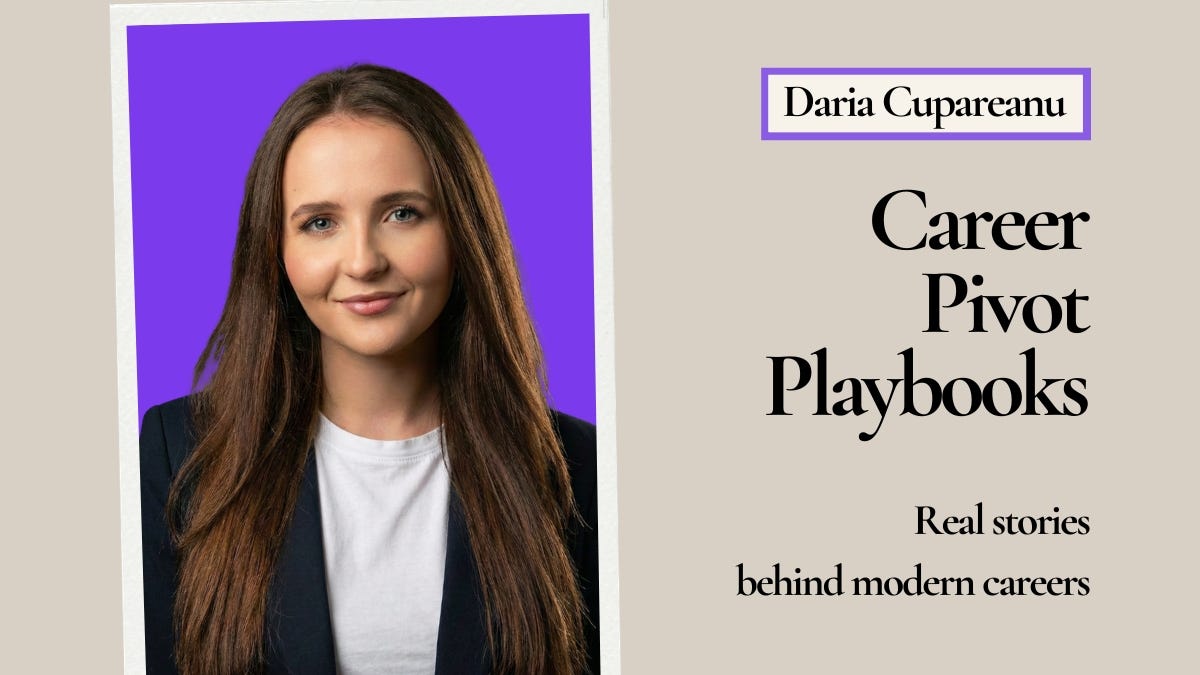
Daria is the writer behind AI Blew My Mind, a newsletter about using AI in real work without a technical background.
Her career spans marketing, consulting, sales, project management, and education. She is an AI founder who delivers practical tools and use cases through a non-technical lens.
Today, she shares clear, practical breakdowns that help experienced professionals use AI in their own work and rethink what they can build on their own.
You can follow her work here →
Daria reflects:
“Can you share a bit about your professional background and the path that led you to where you are today?”
I’ve never had a linear career. I started with marketing roles, then an advisory role at PwC, then B2B sales, then project management. From there I landed in education, designing non-formal programs for teenagers, students, and professors across Romania, everything from Python and SQL to critical thinking and decision-making. That’s where I first discovered my passion for education.
Then I joined a food delivery platform, where I built an account management department for long-tail partners from scratch. Just me at first, grew it to ten people. We put Romania on the global map for commercial results. But even there, I was never doing one thing. Email marketing for 5,000+ partners, team building, business and commercial strategy, data analysis, training programs. Always wearing every hat in the room.
While still at that company, I started my own startup: an educational app for soft skills that later evolved into a recruitment tool. That led me deeper into AI, where I started building tools as a non-technical person, and that was the real mind-blowing moment in my journey.
One night, my business partner said: ‘You’re already sharing all these tools and experiments with me anyway. Why not share them publicly?’ The next day I created my Substack and published my first article.
“What sign, moment, or slow realization told you it was time to diversify, and what did you have to push through to actually act on it?”
There was no big moment. I was already on a path of building businesses and trying different things. My strategy was simple: experiment as much as possible, see what works, double down. What AI changed was that I could finally build things on my own that before would have required an entire team. That opened up everything. The newsletter was one more experiment in the mix. It just happened to be the one that took off.
“Which skills or experiences from your previous career unexpectedly became an advantage in what you do now?”
Being a generalist. For a long time I thought that was a weakness. In my early career, I kept jumping between roles while my peers were years deep in the same position, getting promoted, earning more. I was always starting from scratch with overlapping skills but never the “proper” experience companies pay you more for. That was frustrating.
But everything I collected along the way compounded. Finance and negotiation from my early roles. Building processes from scratch for an entire department, scaling a team, and working heavily with data. Curriculum design and teaching from my years in education. And then marketing, partnerships, product development, and user psychology from running my own startup.
“How did you decide where to build visibility or credibility (Substack or elsewhere), and what role does that platform play in your overall career or income mix?”
I chose Substack because I was already subscribed to newsletters I admired here. That was the whole decision-making process. I only learned about alternatives after joining. Turns out it was a great choice anyway, due to the built-in community features, since I had no existing audience to pull from.
Almost a year in, Substack generates a meaningful part of my income through paid subscriptions, but the value goes beyond that. Having an audience means I can build and sell products, and consulting clients find me through my writing.
“Who is your work really for, and what problem do you solve so well that people are willing to pay for it?”
I struggled to find my niche for months, being a generalist makes that hard. But as the newsletter grew and paid subscribers started coming in, I began analyzing who they were, and a clear picture emerged. My audience is mostly seasoned professionals, 50 and older, with decades of experience in their fields. CEOs, business owners, consultants. People who are incredibly good at what they do and want to either reinvent themselves with AI or start adopting it in their businesses to gain leverage and scale.
What I think I do well is give the full recipe. My content is always practical and I don’t keep anything to myself. When I discover something that works, you get the whole breakdown so you can take it, apply it to your own work, and experiment with the results yourself. People have also told me I have a way of explaining complex, technical things so they feel approachable and clear.
Plus, I want every piece I publish to make you think: I had no idea AI could do that for me. That’s the idea behind AI blew my mind.
“What turned out to be harder than you expected when you started… and what was easier than you imagined?”
When I started, I thought I’d write quick, short articles. Here’s a tool, here’s what I did with it, done. But as I evolved, I realized I love deep dives. I want to approach a topic end to end and not leave anyone wondering halfway through, thinking ‘I should google that’. So my quick posts turned into comprehensive guides with practical walkthroughs, research, and my own takes. The time it all takes caught me off guard, and not just the writing itself, but everything around it: engaging with others, building community, being present. I love that part, but it adds up fast.
What was easier than I expected was growing an audience. Within the first few days I had subscribers from markets completely different from my network in Romania. I kept comparing it to getting users for my startup, which had taken so much longer. Of course, there are others here who are growing much faster than I am, but when I look at where I am today versus where I was yesterday, I’m really happy with it. Especially because it happened organically, without external channels or paid marketing pushing it along. I just didn’t expect that.
“How have you found the journey? What advice/strategies and tips would you give to others wanting to grow their audiences?”
This journey changed my life in ways I didn’t anticipate. Having an audience is the start of so many things, from launching products to building a community to creating a world around what you love doing.
My advice: don’t overthink it and don’t get stuck in your head before you’ve even started. Just experiment. Then watch the data, pay attention to what drives engagement and growth, and double down on those things. Listen to your readers too. A lot of my best content started as a reader request, and combining what your audience tells you with what the data shows will take you further than any growth hack. Keep an eye on what peers are doing to learn from them, but always test things for yourself, because there’s no single recipe that works for everyone. You build your own path.
Lastly, you do have to enjoy the process. It requires serious commitment, and if it doesn’t energize you, it’s going to be hard to sustain.
“What nearly made you quit, and what actually kept you going?”
I never wanted to quit. The only struggle has been the math. For a long time, and honestly still now, the effort I put in far exceeds what I get out of it financially. If I were paid hourly for all the time I invest in Substack, I’d be making a lot more money elsewhere. That gap can be a struggle at times, because you don’t grow overnight. It happens day by day, with better stretches and harder stretches, just like everything in life. But I see this as a long-term game and I’m at peace with that.
“What advice would you give to someone considering a similar pivot or looking to monetize their skills in a more flexible way?”
Don’t pivot by burning everything down. Run things in parallel, experiment on the side, and let the results guide you. Give things time, do the marketing even when you’d rather skip it, and put yourself out there. It will help you in ways you can’t predict.
“What other platforms, audiences, or income streams are part of your portfolio career… and how do they work together?”
Everything feeds into everything else. The newsletter attracts readers. Some become paid subscribers or consulting clients. The consulting gives me real-world experience that makes the content better. Add products I build on the side, and it’s one ecosystem where each piece strengthens the others.
“Looking back, what’s one decision that changed everything… and what’s next for you?”
The decision that changed everything was accepting who I am. I’m different from my peers. I don’t have the same goals. Once I realized how deeply I value freedom and independence, I fully embraced it, even when it meant taking the harder path, earning less for a while, and starting over. That bet on myself changed everything.
As for what’s next: keep growing. The newsletter, the consulting, the products. Everything I’m building right now is still early, and I want to see how far it can go.
Links & Resources
Connect with Daria…
My platform with AI resources:
AI Migrator:
https://ai-migrator.aiblewmymind.com/
- a tool that exports your conversation history from ChatGPT, Claude, or Gemini into a portable profile, so you can switch between AI platforms without starting from scratch.
Related Articles
Claude Cowork: 10 Use Cases I Tested + 67 More by Profession
The Claude Skills That Finally Made AI Write Like Me (And How to Build Yours)
How I Built a Personal AI Assistant (Step-by-Step, No Coding Required)
How to Reduce AI Hallucinations: 7 Research-Backed Techniques
Read More
Behind the Pivot
Learn how to turn your current skills and experience into income and build a portfolio career beyond a single job, so you’re more resilient and in control.
The Career Pivot Archive
Real-world career pivots, portfolio paths, and practical lessons from some of your favourite Substackers you can apply to your own next move.
Career Questions Answered
Practical, strategic answers to the career questions ambitious professionals are asking as work, security, and opportunity continue to change.
I’m Katharine — a future-focused career strategist helping professionals build income options and stay relevant as work evolves.
🙏 I appreciate you being here and supporting this growing archive… and thank you to all the creators who contribute, it’s such a pleasure to learn from them.
❤️ Loved it? Restack 🔁 and share ✅
🤔Is there a question you wish had been asked?
Drop it in the comments, and let’s keep the conversation going.
Thank you so much, Katharine, for giving us a space to share our stories. Since we don’t usually write much about ourselves in our own newsletters (because they each have their own focus), interviews like the ones you create are really valuable for us and for our communities too.
So thank you for the invitation and for such a thoughtful interview!
So great to read your stories in detail Daria! Everything you share tells that you and your business partner did everything right here.
Like you said, this is for the long game, and you already have an amazing advantage :)