


This Career Pivot Playbook features Elena Calvillo, a former software engineer and product manager building a new kind of product career around prompt-led creation.
Elena’s path began in engineering. She spent years building systems from scratch. Databases, APIs, full products. In 2019, she moved into Product Management. The role stayed technical, but the building stopped. Her work shifted toward planning, coordination, and decision-making, with little direct ownership of what shipped.
Over time, that gap became harder to accept. The distance between having an idea and seeing it live felt too large. Not because she lacked skills, but because the role no longer allowed her to use them fully.
The shift came when Elena realized she did not need to return to traditional coding. She needed a new way to direct it. Using natural language tools and drawing on her engineering background, she began moving ideas from concept to working product in days rather than months.
In January 2026, Elena left her corporate role and committed to this direction. She shut down a safe, generic newsletter and rebuilt her work under a clearer name, Prompt-Led Product. The change reflected a belief she had been forming for years. Product managers should be able to build, not just manage.
Substack has since become the center of her work. It is where she documents what she is building, what works, and what does not. The newsletter supports her apps, informs future education, and anchors her work in public proof rather than promises.
This Playbook explores how prompt-led building, clear positioning, and hands-on experimentation can come together to form a sustainable portfolio career. It shows how experienced product professionals can stay relevant by narrowing their focus and reclaiming the act of building.
✨About Career Pivot Playbooks
A public archive of modern career blueprints…
Most careers no longer follow a straight line.
People pivot gradually.
They extend their work beyond institutions.
They combine roles, platforms, and income streams.
Career Pivot Playbooks is a weekly series curated by Katharine Gallagher documenting how professionals build resilient, future-ready careers by turning existing skills into income, often combining Substack with consulting, teaching, research, creative work, or business ownership.
The focus isn’t outcomes.
It’s about how careers are shaped in practice.
About Elena
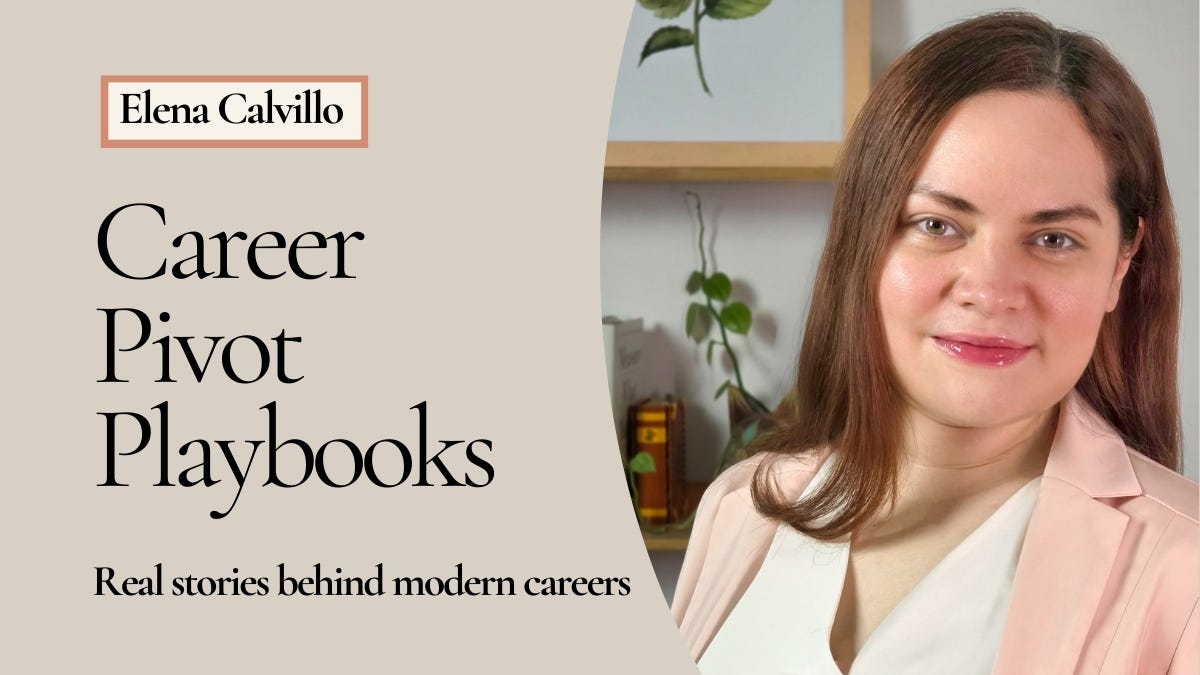
Elena Calvillo is a Product Manager who stopped waiting for permission to build. She is the creator behind Prompt-Led Product.
While she started her career in engineering, she spent the last several years deep in the traditional product management cycle. She managed backlogs and defined requirements, but she wasn’t building. The gap between having an idea and shipping it became the problem.
Elena left her corporate role to close that gap. She realized she didn’t need to return to traditional coding. She needed to direct AI. Using tools like Lovable and Cursor, she began moving ideas from concept to working product in days rather than months.
She rebranded her work to Prompt-Led Product to reflect this shift. It is not about engineers coding faster. It is about Product Managers reclaiming the ability to ship.
You can follow her work here →

Elena reflects:
“Can you share a bit about your professional background and the path that led you to where you are today?”
I started my career as a software engineer. I built things from the ground up. Database schemas, API design, the whole stack. I loved it. Then around 2019, I transitioned into Product Management. Different challenge, still technical, but my hands weren’t actually in the code anymore.
Fast forward to my last few years: I was a Product Manager at different companies, mostly in healthcare. Look, I was deep in the corporate machine. Backlog management. Stakeholder meetings. Defining products but never actually building them.
That really upset me. I was becoming a “ticket mover” instead of a creator. The gap between having an idea and shipping it felt too big to overcome.
Then I realized something: I didn’t need to learn to code again. I needed to learn to direct code differently. Natural language with tools like Lovable and Cursor. My background as an engineer meant I knew what good database design looked like, what edge cases mattered, and when something was technically broken versus when it was just a bad prompt.
Suddenly I could prototype an idea on Tuesday and have something real by Thursday. From concept to working product in days, not quarters.
That speed changed everything.
Now I’m a Product Manager who builds. But more importantly, I’m a former engineer who knows how to ask the AI the right questions. It sounds simple, but it fundamentally changed how I think about my job.
“What sign, moment, or slow realization told you it was time to diversify, and what did you have to push through to actually act on it?”
I left my corporate role in late January. That single decision forced me to stop planning and start shipping. Before that, I was already feeling the friction. I had a newsletter called “Product Release Notes” that felt safe. Too safe. At first, I was just reporting on industry news or product management processes. But over the last couple of months, I’ve been working on building processes.
So I burned the bridge. Rebranded everything to “Prompt-Led Product” because that’s actually what I believe in. I had to push through the fear of looking “unprofessional” to corporate recruiters. But honestly? I chose to be specific and weird instead of generic and palatable. That felt right.
The rebranding wasn’t about personal branding theater. It was about actually committing to a worldview: that product managers should be builders, not just managers.
“Which skills or experiences from your previous career unexpectedly became an advantage in what you do now?”
The fact that I was a software engineer for years before becoming a PM? That’s kind of my secret weapon.
I spent years designing databases from scratch. Writing APIs. Thinking about data relationships, edge cases. When I stopped coding and moved to PM work, I didn’t lose those mental models. I just stopped executing them myself. This is probably an underrated skill in the product world, but it’s a key skill for engineers. It makes them respect you right away.
Then Lovable came along. Suddenly I could execute again. But here’s the crucial part: because I’ve built databases, I could tell when Lovable was getting the schema wrong. Because I understand API design, I could prompt more effectively. Because I’ve debugged production issues, I knew exactly what edge cases mattered.
That’s not me “learning to code” with AI. That’s me directing AI because I already know what good code looks like.
When Lovable couldn’t visualize that curved snow-on-the-floor effect for the aiadventchallenge.com, I didn’t struggle with the limitation. I dropped into CSS myself because I knew that was faster than explaining it in English. I could context-switch between “let the AI handle it” and “I’ll do this part” because I understand both sides.
My corporate PM peers would spend weeks writing specs for a database schema. I spent an hour in Lovable designing it because I already knew what a good schema was. They had to trust engineers to implement. I could validate the implementation because I knew what correct looked like.
That background is why I can move 10x faster than someone learning to build for the first time. I’m not learning to build. I’m learning a faster way to build things I already understand.
“How did you decide where to build visibility or credibility (Substack or elsewhere), and what role does that platform play in your overall career or income mix?”
I chose Substack because it forces clarity. You cannot hide bad logic in a text post. There’s nowhere to hide.
Substack isn’t just a blog for me. It’s my portfolio now. It’s how I document the reality of building. When I interviewed Brian Balfour about Reforge’s transformation, that interview anchored my credibility in ways nothing else could. When I launched AI Advent Challenge, the newsletter was the launchpad. It’s the engine that drives traffic to my apps and future courses.
I’m not on every platform. I’m not “building my personal brand on LinkedIn” in that hollow way. I’m just showing the work publicly.
The newsletter is the center. Everything else orbits it.
“Who is your work really for, and what problem do you solve so well that people are willing to pay for it?”
My work is for Product Managers who feel obsolete.
It’s for the PM who wants to prototype something this weekend without waiting for a developer. It’s for the person who’s been told “your job is just to write specs now” and knows that’s bullshit. It’s for people who want to stay relevant in a world where code is becoming more accessible.
I solve the “technical paralysis” problem. For years I watched PMs get paralyzed because they couldn’t code. Now they can. It looks different, it feels different, but the capability is there.
I’m building courses on vibe coding. How to use English as your programming language. How to ship faster because you’re not blocked on developer availability. I’m teaching people that you don’t need to know React to build a working prototype.
“What turned out to be harder than you expected when you started — and what was easier than you imagined?”
Harder than I expected: Focus, honestly.
The AI Advent Challenge started in December and became a big surprise. Now it’s an annual thing. But how can you do that and also try to validate new ideas like DraftKit and CampaignDays? Keep writing every week and send my paid subscribers valuable content. Focus on getting it out there and have a full-time product manager work from 9 to 5. That’s intense (and it’s hard to stop).
I wasn’t ready for how tired I was from making decisions outside of work, but at the same time, it gives me energy. Should I fix bugs in the current product or work on the new one? Should I write content about AI Advent or promote DraftKit? Both are important, but I can’t do both.
Easier than I expected: The actual tech stack.
It would have taken me years to build a complete working app on my own. I would spend so much time reading, understanding, and building. With Lovable, I set up working applications in just a few days. Supabase managed the database. Resend the email that was already sent. I was able to do things that felt impossible two years ago. The barrier to entry was much lower than I feared.
I could even make my own analytics dashboard and track the funnel, the metrics that mattered the most to me.
“How have you found the journey? What advice/ strategies and tips would you give to others wanting to grow their audiences?”
Be useful or be entertaining. Ideally, both.
My strategy is radical transparency. I don’t just say “I built an app.” I show the prompts I used. I show where the AI broke. I show the bugs that snuck through. Readers respect the process more than the result. They want to see how the sausage gets made.
If you want to grow a newsletter, stop acting like an expert and start acting like a curious explorer who takes good notes. I think people are getting tired of the polished, opinionated vibe of the typical CEO. They want to know what really happened.
I share my failures as openly as my wins. That feels riskier, but it builds actual trust.
“What nearly made you quit, and what actually kept you going?”
The silence nearly killed me.
When you publish something and no one reacts, it’s more disappointing. You’re putting real thoughts into the void and hearing nothing back. That’s the part that nobody tells you about. It also prevents many people from succeeding outside.
The community helped me. Working with my Substack network on articles helped me stay on track. I saw other builders succeed, and that made me realize the market is big enough for everyone. I wasn’t competing; I was just building alongside them.
And then one day people started responding. Contributors said yes. Readers engaged. But those early months of silence? That’s the hardest part.
“What other platforms, audiences, or income streams are part of your portfolio career… and how do they work together?”
I view my work as active and passive products stacked together.
The Newsletter: Prompt-Led Product is the funnel. Everything flows through it. That’s where the audience lives.
The Apps: AI Advent Challenge is the established product. It worked. CampaignDays and DraftKit are still in validation. I’m not building in secret. I share the validation process live. I let people watch me fail, iterate, and hopefully succeed.
The Education: My upcoming course on vibe coding. This captures the insights I’m learning in real-time. It’s not theoretical because I’m literally building products right now.
They feed each other. The newsletter builds visibility. The apps generate case studies. The course will teach what the apps proved. It’s not a funnel in the traditional sense. It’s more like a system where each piece makes the others stronger.
“What advice would you give to someone considering a similar pivot or looking to monetize their skills in a more flexible way?”
Don’t quit your job until you have traction. But don’t wait to start building until you quit.
Start now. Rebrand yourself before you feel fully qualified. I shifted from “Product Manager” to “Prompt-Led Product” when I had imposter syndrome firing on all cylinders. But that label forced me to step up. You become what you name yourself.
Also: the people who succeed aren’t the ones waiting for perfect timing or perfect conditions. They’re the ones who started weird and committed to being that weird.
“Looking back, what’s one decision that changed everything — and what’s next for you?”
The decision to fully embrace “Prompt-Led Product” as my identity changed everything.
It gave me a north star. Every decision flowed from that. Not “what sounds cool?” but “does this align with teaching PMs how to build?”
Next, I’m scaling the education side hard. I want to build a generation of PMs who stop writing Jira tickets and start shipping code. That’s not a feature. That’s a movement.
What actually kept me going through AI Advent was realizing something: I’ve always been a builder. My dad is an electrical engineer. I grew up deconstructing things and putting them back together. Even in corporate, the newsletter was side work that paid nothing but I couldn’t not do it.
The builder is part of my identity. I’ll probably never get rid of it. This project just reminded me that I don’t want to.

Links & Resources
Website: elenacalvillo.com
LinkedIn: https://www.linkedin.com/in/elena-product-manager/
App (Live): AIAdventChallenge.com
App (Beta): DraftKit.app
App (Beta): campaigndays.io
Related Articles
I Won a Vibecoding Challenge With Two Apps I Built in 45 Minutes With These Exact Prompts
Why I’m Killing Product Release Notes (And What Comes Next)
The 2025 AI Building Report Card: What Actually Worked (And Who Got Left Behind)
The Complete Product Playbook: How I Shipped AI Advent Challenge Without a Dev Team
Product Management Already Evolved: You’re Just Now Realizing It
Read More
Behind the Pivot
Learn how to turn your current skills and experience into income and build a portfolio career beyond a single job, so you’re more resilient and in control.
The Career Pivot Archive
Real-world career pivots, portfolio paths, and practical lessons from some of your favourite Substackers you can apply to your own next move.
Career Questions Answered
Practical, strategic answers to the career questions ambitious professionals are asking as work, security, and opportunity continue to change.
I’m Katharine — a future-focused career strategist helping professionals build income options and stay relevant as work evolves.
🙏 I appreciate you being here and supporting this growing archive… and thank you to all the creators who contribute, it’s such a pleasure to learn from them.
❤️ Loved it? Restack 🔁 and share ✅
🤔Is there a question you wish had been asked?
Drop it in the comments, and let’s keep the conversation going.
I think this... 'anyone willing to embrace the tools'... is key for success in any sector heading into the future. Thanks Elena for showing us how it is done!
I love this take, Pinkie, 'take matters into her own hands'... I think the future will demand more and more of us to do just that by taking ownership of our skills :)