


This Career Pivot Playbook features Farida Khalaf, the writer behind Lights On, a systems-driven newsletter from a data engineer and cybersecurity thinker, decoding complex data, technology, and business trends into clear, actionable insight.
Farida started in international finance and global affairs, working across NGO and multilateral projects where her job was to make complex decisions clear and usable.
Her career moved through project-based roles across different settings. That gave her a front-row view of how decisions are made, what drives them, and what rarely gets explained.
Over time, she noticed a pattern. Work often ended for reasons other than the problem itself.
When Covid hit, that reality became harder to ignore.
Instead of relying on one path, she started building others in parallel, expanding her work and testing new directions.
Lights On came out of that shift. A place to write, think clearly, and explain what is often missed.
In this Playbook, Farida shares how she approached that transition, what shaped her thinking, and how she is building work that does not rely on a single path.
✨About Career Pivot Playbooks
A public archive of modern career blueprints…
Most careers no longer follow a straight line.
People pivot gradually.
They extend their work beyond institutions.
They combine roles, platforms, and income streams.
Career Pivot Playbooks is a weekly series curated by Katharine Gallagher documenting how professionals build resilient, future-ready careers by turning existing skills into income, often combining Substack with consulting, teaching, research, creative work, or business ownership.
The focus isn’t outcomes.
It’s about how careers are shaped in practice.
About Farida
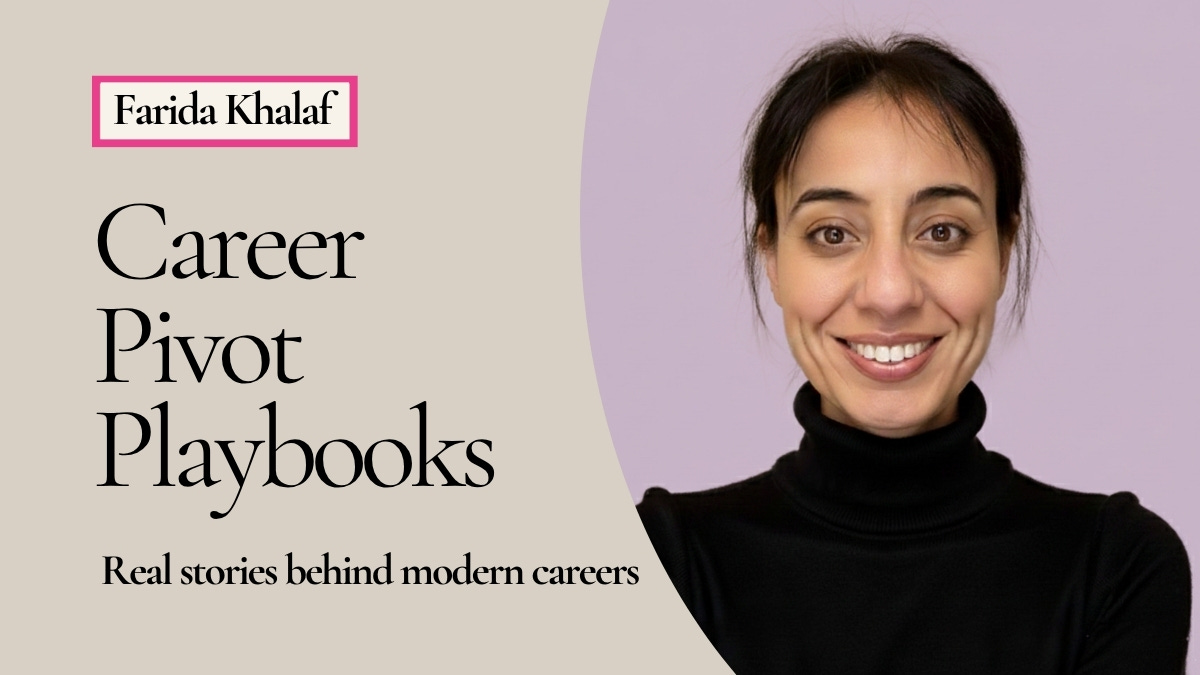
Farida Khalaf is the writer behind Lights On, a Substack that examines systems, decisions, and real-world dynamics with clear, evidence-based thinking.
Economist. Data engineer. Writer. In that order, and sometimes all at once.
With experience across NGOs, multilateral programs, and government work, she draws on business analysis, data, and cybersecurity to make complex information clear and usable.
That clarity carries into her writing, for readers who want to understand what is actually happening, not just being told what to think about it.
You can follow her work here →

Farida reflects:
“Can you share a bit about your professional background and the path that led you to where you are today?”
I am an economist by degree and a data engineer by everything that came after.
My first job was account settlement grant projects between countries, calculating liabilities, tracking accountability across every task. The reporting was the core of it. Not just visuals, but explanation. Why did this number move? What does this pattern mean legally, contractually, in the real context of two governments trying to work together? I had to make complexity legible to people who didn’t have time for the full picture.
That became my strength and it still is. I don’t just analyse data. I tell its story.
Most of my career has been project-based, joined through word of mouth rather than HR pipelines. Each project lasted six months to three years, with its own terrain and its own problems. But underneath all of it, the dynamics of data are universal. The context changes. The logic doesn’t. Two master’s degrees, international finance and global affairs gave me fluency in the NGO and multilateral world. World Bank, UN programs, governmental initiatives.
“What sign, moment, or slow realization told you it was time to diversify, and what did you have to push through to actually act on it?”
Working in NGOs taught me something nobody tells you: the work doesn’t always stop because the problem is solved. It stops because of politics. Programs that were genuinely needed get cancelled not for lack of initiative or funding, but because of the push and pull between decisive players who are thinking about the relationship, not the problem.
When COVID hit, the shutdown wasn’t a prediction anymore. It was a process. I watched the entire project-based workforce reckon with what I had always known privately: nothing is permanent.
I had a parallel passion for cybersecurity. I started doing penetration testing, some bounty hunting. That opened consulting doors in data security and cloud management. Contract-based, word of mouth but it removed the anxiety of a single point of failure and opened the door for a learning curve.
The pivot wasn’t one moment. It was the accumulation of evidence that agility was a feature, not a bug.
“Which skills or experiences from your previous career unexpectedly became an advantage in what you do now?”
Reporting. Knowing who I am writing for before I write a single word.
A brief for a minister reads differently from a technical report for an engineering team. I spent years finding the right frame, the right level of detail, the right language for the right audience. That transferred directly into newsletter writing except now my audience is global, curious, and doesn’t owe me their attention.
Data also trained me to think in evidence. I don’t like arguments that float. I want the number, the mechanism, the case that explains why something is true. That discipline makes my writing explainable, not commentary.
“How did you decide where to build visibility or credibility (Substack or elsewhere), and what role does that platform play in your overall career or income mix?”
I tried Medium and LinkedIn. Neither gave me traction — their algorithms work for the platform, not the writer. A friend, Devansh, told me to try Substack. I noticed the difference immediately.
Writing is not my primary income yet I still consult and take NGO contracts. But the newsletter is building something consulting alone cannot: a body of work that exists independently of any single client.
“What turned out to be harder than you expected when you started — and what was easier than you imagined?”
I have been posting two to three times a week for a year. The first three to six months, it was mostly me and my friends reading. That is the honest truth and people need to hear it more.
Traction comes slowly. Consistency is the only strategy that actually works. For consistency done right, watch Dr. Sam Illingworth. For understanding Substack’s visibility mechanics, Jenny Oyung’s recent post on substack visibility analysis is excellent.
“Who is your work really for, and what problem do you solve so well that people are willing to pay for it?”
My newsletter is called Lights On. It exists for people who want to understand what is actually happening not the hype, not the marketing narrative. I try not to deliver a message. I try to explain the message that is already there, waiting to be seen clearly.
We live in a mimicry society. Most of what passes for analysis is just a louder version of the consensus. I want to offer the clarity that is apparent but overlooked.
“What nearly made you quit, and what actually kept you going?”
The invisibility of the early months is real. Writing carefully about things that matter to you and hearing almost nothing back requires a specific stubbornness.
What kept me going was the work itself. Each article made the next one sharper. The pivot is a feature, not a bug, I have spent my career on timed contracts with no permanent attachment. That trained me for this.
“What advice would you give to someone considering a similar pivot or looking to monetize their skills in a more flexible way?”
Be genuine. Be part of someone else’s growth sincerely not strategically. If you can lift an article or share a newsletter, do it because it deserves to be seen. Community built on reciprocal generosity is the only kind that lasts.
And be patient. Consistency is not glamorous advice. But it is the only one that is actually true.
“How have you found the journey? What advice/strategies and tips would you give to others wanting to grow their audiences?”
That originality matters. In an AI world flooded with slop writing, the articles that circulate do so because of the quality of their thinking not because of ads or optimized keywords.
“Looking back, what’s one decision that changed everything… and what’s next for you?”
I decided early to write what I actually think, in the register I actually use, about things I have genuinely studied. That decision I would make again without hesitation.
What’s next: more collaborations, expanding Lights On into new territories, and eventually making the writing the centre rather than the complement.
Links & Resources
Connect with Farida→
Favourite recent articles
We Ruined Earth. Now It’s Time to Ruin the Moon.
Read More
Behind the Pivot
Learn how to turn your current skills and experience into income and build a portfolio career beyond a single job, so you’re more resilient and in control.
The Career Pivot Archive
Real-world career pivots, portfolio paths, and practical lessons from some of your favourite Substackers you can apply to your own next move.
Career Questions Answered
Practical, strategic answers to the career questions ambitious professionals are asking as work, security, and opportunity continue to change.
I’m Katharine — a future-focused career strategist helping professionals build income options and stay relevant as work evolves.
🙏 I appreciate you being here and supporting this growing archive… and thank you to all the creators who contribute, it’s such a pleasure to learn from them.
❤️ Loved it? Restack 🔁 and share ✅
🤔Is there a question you wish had been asked?
Drop it in the comments, and let’s keep the conversation going.
Added to my ever-growing reading list :)
So good to read this! I love Farida :)