
Hodman Murad from Between Thinking and Doing: From Data Science Consulting to Building AI for Neurodivergent Productivity✨The Career Pivot Playbooks Series
How Hodman Murad built an AI tool designed for cognitive paralysis, and why some of the strongest career pivots begin by reframing what you already know.


This Career Pivot Playbook features Hodman Murad, the writer behind Between Thinking and Doing, The Data Letter and the founder building AI tools for neurodivergent productivity around one idea most professionals overlook…
You often do not need to start over. You need to reposition what you already know.
Hodman did not plan to build an AI company. She studied public administration, spent years working abroad, then unexpectedly fell into data science through a Master’s in Economics before building a career in consulting and SaaS.
On paper, everything looked successful.
But behind it was a more personal realization…
Most productivity tools are built for people who already know how to start.
Inside, Hodman breaks down how she turned a background in data science, systems thinking, and behavioral research into a product designed to help people overcome cognitive paralysis and actually follow through on difficult work.
She shares what pushed her to finally start, why visibility on Substack and LinkedIn became part of the strategy, and what most professionals misunderstand about building online.
She also talks about fear, momentum, and why volume matters more than perfection when you are trying to create something new.
If you have ever felt like your existing experience could matter more than your current role allows, this one is for you.
✨About Career Pivot Playbooks
A public archive of modern career blueprints…
Most careers no longer follow a straight line.
People pivot gradually.
They extend their work beyond institutions.
They combine roles, platforms, and income streams.
Career Pivot Playbooks is a weekly series curated by Katharine Gallagher exploring how professionals build resilient, future-ready careers by turning existing skills into income through consulting, teaching, research, creative work, business ownership, and platforms like Substack.
The focus isn’t outcomes.
It’s about how careers are shaped in practice.
About Hodman
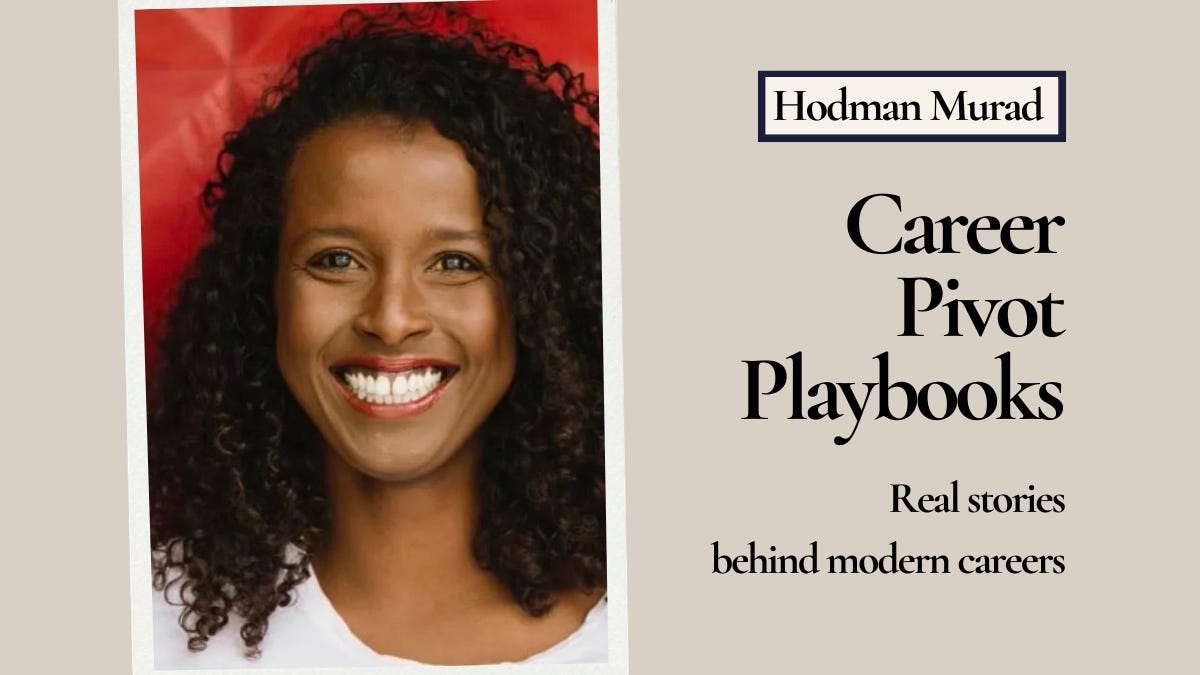
Hodman Murad is the founder of Asaura AI. She spent 7 years in data science consulting and a stint in SaaS before leaving to build the company she’d been researching since her own ADHD diagnosis as a teenager. Watching her friends get the same diagnosis in their 30s pushed her to finally start.
Asaura turns overwhelming work into smaller, doable steps, learning how each user thinks and adjusting in real time. Think of it as a patient coach who knows when to stop breaking things down so you don’t get stuck planning.
She writes about neurodivergent productivity, founder lessons, and what current tools get wrong on Substack and LinkedIn.
You can follow her work here →
Hodman reflects:
“Can you share a bit about your professional background and the path that led you to where you are today?”
I never planned to be a data scientist. I earned a bachelor’s in public administration, thinking I’d move to Ottawa and save the world for the Canadian government. Instead, I spent my 20s slinging coffee and waiting tables across Europe and South America, taking work from anyone who’d hire an inexperienced foreigner.
When my father passed suddenly in my late 20s, I knew I needed something to focus on and build. I enrolled in a Master’s in Economics program, mostly because I’d been a fan of Mark Carney since his days at the Bank of Canada. (Real nerd stuff, I know.) A required Data Analysis course turned into a 7-year consulting career, then a stint in SaaS. I fell in love with data by accident.
“What sign, moment, or slow realization told you it was time to diversify, and what did you have to push through to actually act on it?”
Asaura AI is me getting back to the world-saving I meant to do when I was younger.
I was diagnosed with ADHD as a teenager. I had two patient parents who helped me design systems to stay on top of my responsibilities. In our 30s, I watched friend after friend get diagnosed with ADHD or identified as neurodivergent, and I wanted to pay forward what my parents had done for me.
So I started reading every academic paper I could find on non-pharmaceutical treatments for living with a neurodivergent mind. The treatments turned out to be procedural and formulaic. I expected nothing else from peer-reviewed papers, but it hit me fast: I can use my reinforcement learning background to replicate these proven treatments and help people work through executive dysfunction.
I founded Asaura AI at the end of 2025 because it was time. There’s never been a better moment to be an entrepreneur.
“Which skills or experiences from your previous career unexpectedly became an advantage in what you do now?”
Coding, obviously. Python for data work translated easily to building software.
The bigger surprise was how much I'd absorbed from sitting in on creative meetings while supporting marketing teams. I haven't built every marketing tool I want for Asaura yet, but I know what good looks like, and that's half the battle.
“How did you decide where to build visibility or credibility (Substack or elsewhere), and what role does that platform play in your overall career or income mix?”
Substack and LinkedIn are my main channels right now. Substack’s blogging and video tools let me make content I cross-post to LinkedIn. YouTube and TikTok are next on the marketing roadmap. It’s a lot of work, but I need to test and see where my audience lives. Ask me again in 6 months and I’ll have a sharper answer.
“Who is your work really for, and what problem do you solve so well that people are willing to pay for it?”
Asaura’s built for high performers with cognitive paralysis. That includes anyone with ADHD or neurodivergent traits, anyone staring down a project too big to know where to begin, and anyone who hits the wall at the end of a long workday with one task left and no ignition to start it. They want to do great work. They just need structure to find traction in their hardest moments.
Current productivity software runs on a flawed assumption. It treats every user as someone who’s already capable of starting. Tools like Jira, Asana, and Notion record tasks. They don’t help you do them. They’re passive repositories.
Gallup reports that 59% of the global workforce is disengaged, and 44% experience high daily stress. The bottleneck nobody’s solving for is what I call Initiation Failure: the mental labor required to translate a high-level goal into the next physical action. That freeze response feeds the estimated $438 billion in lost global productivity each year.
Asaura’s AI breaks goals into smaller, doable steps. It learns your patterns, adjusts its step size based on how you’re feeling, and gives you a reliable structure to follow. That’s what separates Asaura from ChatGPT or Claude. You get a system to follow, not a chat thread.
I built it the way you’d design a marathon runner’s shoe. A marathon shoe handles the walk to the corner store without breaking a sweat. Asaura is engineered for the brains that experience the highest cognitive friction, which gives everyone else an everyday productivity edge.
“What turned out to be harder than you expected when you started… and what was easier than you imagined?”
I originally wanted users to run Asaura locally, but cross-platform compatibility for Windows became a wall I couldn’t get over.
I was surprised by how easily I adapted to building with JavaScript. My data science roles primarily required Python, so I wasn’t familiar with building software in other languages, beyond just building data pipelines and analyzing data.
“How have you found the journey? What advice/strategies and tips would you give to others wanting to grow their audiences?”
My advice would be:
Don’t skip the validation stage. If you think your tool is needed, get out there and talk to the people it will help. Don’t just talk to your friends and family about it either. The people who love you don’t really provide the most objective opinions. Everyone you interview during validation will make for good beta testers, too.
Don’t get sucked into the idea that building software has to be expensive. Even for someone like me who didn’t vibe code Asaura, it’s possible to make something great with close to $0 in cost. Although a couple of expenses did come up during the build, they were pretty insignificant.
Get comfortable posting multiple times a day, and get comfortable showing your face. Whatever you think is too much is probably not enough. Unless you’ve got funding for ads or influencers, social presence is how you raise impressions. Volume beats polish.
“What nearly made you quit, and what actually kept you going?”
Honestly, I haven’t hit that wall yet. Ask me in a year.
“What advice would you give to someone considering a similar pivot or looking to monetize their skills in a more flexible way?”
Just start. I spent years thinking about what I wished I’d start, afraid I wasn’t good enough or didn’t have the marketing skills to launch something like Asaura. I wonder where I’d be if I’d started 3 years ago. The next best time is now.
You’re going to be terrible at first. Keep going. Nobody’s judging you harder than you’re judging yourself.
“What other platforms, audiences, or income streams are part of your portfolio career… and how do they work together?”
Substack and LinkedIn are the active channels. YouTube and TikTok are next. Each one feeds the others, and Asaura sits at the center as the product they all point toward.
“Looking back, what’s one decision that changed everything… and what’s next for you?”
Less a decision, more an observation. I worked for a man who made me think, ‘well, if this guy can do it...’.
I’ve watched Barack and Michelle Obama in interviews talk about walking into Ivy League classrooms and corporate boardrooms and realizing the rooms weren’t as scary as they’d built them up to be. I didn’t get what they meant until I worked for that man. So thanks to him, I guess.
What’s next: Asaura 2 just came out. The bigger vision is to make neuro-inclusion the default in how every team operates from day one. Every workplace should assume that some of its best people freeze before they start, and give them tools that meet them where they are.

Links & Resources
Connect with Hodman…

Related Articles
I Know Why Elon Musk Keeps Letting Grok Make Explicit Images of Taylor Swift
Atomic Habits for ADHD and Neurodivergent Brains
Ronan Farrow, Sam Altman, and Why Ethical AI Is Becoming the New Empty Promise
How we build better AI guardrails
Read More
Behind the Pivot
Learn how to turn your current skills and experience into income and build a portfolio career beyond a single job, so you’re more resilient and in control.
The Career Pivot Archive
Real-world career pivots, portfolio paths, and practical lessons from some of your favourite Substackers you can apply to your own next move.
Career Questions Answered
Practical, strategic answers to the career questions ambitious professionals are asking as work, security, and opportunity continue to change.
I’m Katharine — a future-focused career strategist helping professionals build income options and stay relevant as work evolves.
🙏 I appreciate you being here and supporting this growing archive… and thank you to all the creators who contribute, it’s such a pleasure to learn from them.
❤️ Loved it? Restack 🔁 and share ✅
🤔Is there a question you wish had been asked?
Drop it in the comments, and let’s keep the conversation going.
 | A guest post by
|