

This article was co-authored by John Brewton.
This Career Pivot Playbook features John Brewton, the writer behind Operating, a Substack about the history and future of running companies, and what it takes to build and lead one in the AI-first economy.
John’s background is operator-first. He grew up inside a family business and after attending Harvard and the University of Chicago, he went back to the fold to help his family to grow and eventually sell their business.
But it is what came after this huge exit is where his story it gets even more interesting.
He didn’t slow down. He didn’t stop working… He made a decision that most people with his experience never seriously consider, and it changed the shape of his career entirely.
Today he runs a strategic advisory firm, leads a paid founder community, and publishes daily on Substack. Writing became the thread connecting his thinking, his consulting, and the operators and builders who follow his work.
In this Playbook, John talks about what two decades of running a real business actually can teach you, what the exit really felt like, why he started writing in public… and how he built a second career that most operators never think to try.
✨About Career Pivot Playbooks
A public archive of modern career blueprints…
Most careers no longer follow a straight line.
People pivot gradually.
They extend their work beyond institutions.
They combine roles, platforms, and income streams.
Career Pivot Playbooks is a weekly series curated by Katharine Gallagher documenting how professionals build resilient, future-ready careers by turning existing skills into income, often combining Substack with consulting, teaching, research, creative work, or business ownership.
The focus isn’t outcomes.
It’s about how careers are shaped in practice.
About John
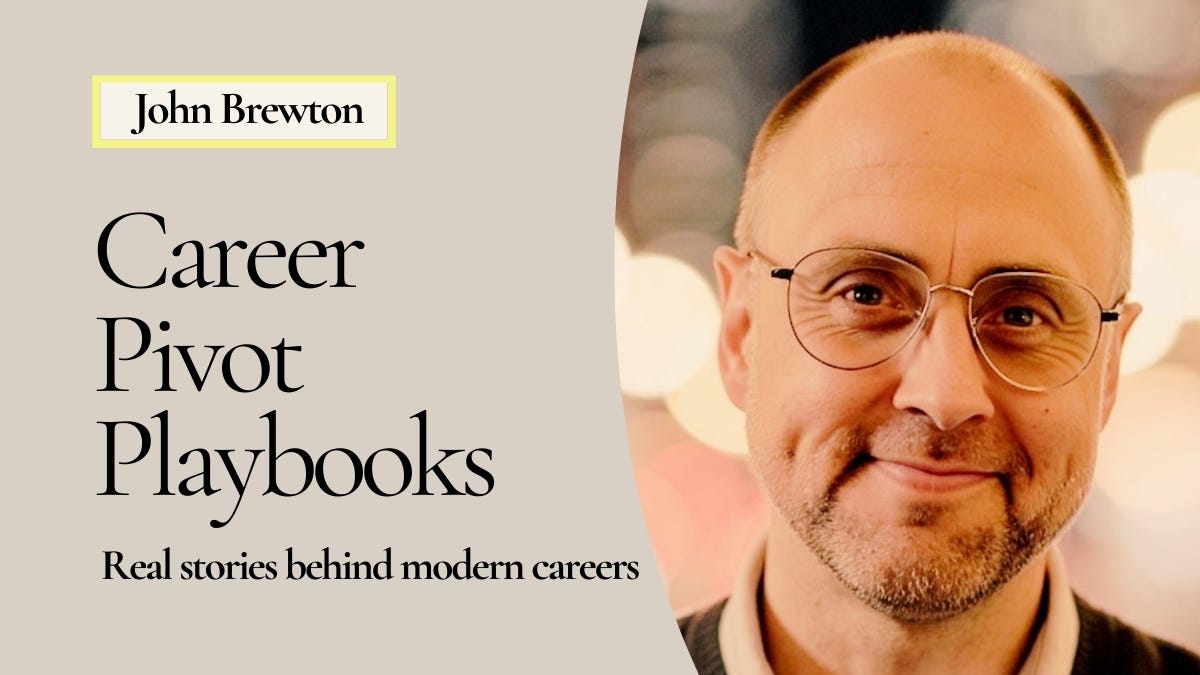
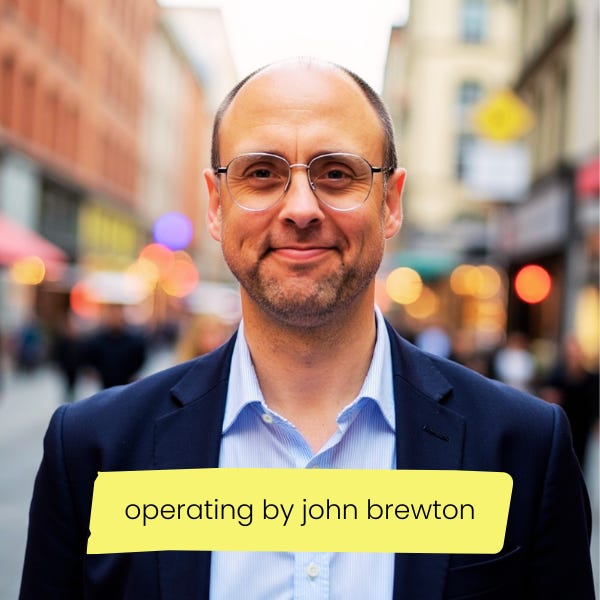
John Brewton is the Founder & Managing Director of 6A East Partners, a strategic advisory firm, and the creator of Operating by John Brewton, a bestselling Substack newsletter with +5,000 subscribers and +60,000 followers across social platforms.
A Harvard-trained economist with 20+ years of operating experience, John scaled and exited a $75 million family business before building one of Substack’s fastest-growing publications on business strategy, economics, and the AI-first economy.
He writes for the people who actually run things. He writes for builders.
You can follow his work here →
John reflects:
“Can you share a bit about your professional background and the path that led you to where you are today?”
I grew up inside a family business. R.G. Brewton was a B2B industrial distribution company my family built from scratch (warehouses, forklifts, Fortune 500 contracts, manufacturing plants, the whole operation). Dinner table conversations were about margins and logistics before I knew what either word meant.
Out of high school, oddly, I chased a rockstar dream as a drummer for a few years, before becoming very tired of working four jobs to get by and deciding to head to college. I began my college career at the Commnity College of Allegheny County, before transferring to the Honors College at the University of Pittsburgh and then to Harvard. I went to Harvard to study economics, then started PhD work at the University of Chicago. I loved the intellectual rigor, but I kept getting pulled back toward the practical side, how do companies actually work? What separates those that survive from most fail? Eventually I chose the family business over the academic track, on the advice a professor. The plan was actually to take one year to help my folks sell the company after I had finished all of my phd coursework and research.
One year became 13. I started work at the ground level as a Sourcing Specialist, then as an Operations Analyst, implemented our first ERP system, automated hundreds of hours of manual work, earned my way into the Director of Operating position after four years of work, and eventually took over as CEO.
Over the next five years, we scaled from $42 million to $75 million in revenue. We improved EBITDA by over 300%. We managed Fortune 500 relationships with companies like Boeing, Tesla, Harley Davidson, General Motors, and Johnson Controls. We built international operations in Mexico and Costa Rica. And in August 2021, we completed a successful exit and sale of the business. Our COVID story could be a book, but that one will have to wait for another time.
After the sale, I founded 6A East Partners, my strategic advisory firm, and started writing. That writing became Operating by John Brewton on Substack, and it’s become the centre of everything I do now.
“What sign, moment, or slow realization told you it was time to diversify, and what did you have to push through to actually act on it?”
When you sell a company your family built, you don’t just lose a business. You lose an identity. For thirteen years, the answer to “what do you do?” was obvious. After the exit, it wasn’t.
I started consulting, which felt natural. But I noticed something: the most impactful conversations I was having weren’t behind closed doors with a single client. They were the frameworks and lessons I was writing down for myself, things I’d learned the hard way about running a P&L, managing people, making decisions under uncertainty. I realised that if I published those ideas, I could reach thousands of operators who needed the same clarity but didn’t have a $500-an-hour advisor.
What I had to push through was the voice in my head that said operators don’t write newsletters. Operators run things. But the truth is, writing is operating, it’s just public. And once I committed to publishing every single day, everything changed.
“Which skills or experiences from your previous career unexpectedly became an advantage in what you do now?”
Three things, and none of them are what people expect.
First, economics training. My background in behavioural economics and market dynamics gives me a lens that most business thinkers don’t start from. The analytical and mathematical rigor that has come from that training is invaluable each and every week of my working life.
Second, operational discipline. Running a 100-person company taught me systems thinking. I don’t just write article and advise my client, I build operations around how my strategic thinking and content is produced and applied. I track every post and every client’s performance in spreadsheets. I run weekly forensic reviews on what worked and what didn’t for me and my client. I treat my very singular work as a company, because it is one.
Third, being an introvert. I know that sounds counterintuitive for someone building a public brand, but deep focus is a superpower, as is the capacity to listen intently, absorb negative feedback without anxiety and calmly see the bigger pciture.
“How did you decide where to build visibility or credibility (Substack or elsewhere), and what role does that platform play in your overall career or income mix?”
I’m everywhere, but strategically. LinkedIn is my top-of-funnel, it’s where I reach operators, founders, and executives with 7-10 posts per week. That’s where I built my audience from under 0 to over 30,000 followers in about a year. Substack is my intellectual home base. It’s my heart. I publish seven articles a week on Substack across several formats: long-form operating essays, company case studies, my weekly “Operating Week Ahead” briefing for busy folks, and practical frameworks that translate big ideas into small-team execution.
The system is designed as a funnel: free content on social creates awareness, free Substack content builds trust, paid subscriptions deepen the relationship, and the Operating Founder membership creates a community of serious builders who eventually become consulting clients. Every piece of content works to serve that ladder. It’s deifnitely a work in progress, but I’m happy with where things are.
“Who is your work really for, and what problem do you solve so well that people are willing to pay for it?”
I write for operators, builders, founders and creators of one person businesses, small businesses and family businesses.
The problem I solve is this: Strategy is critically important and super fun to develop. But disciplined, consistent execution is always and forever the variable. The tools are changing fast, AI is rewriting the playbook for how work gets done, but the need for clarity, structure, and good judgement only grows. Most business content is theory dressed as insight. I give people frameworks they can actually use, grounded in 200 years of management practice and the newest signals from markets. Think of it as an operating manual for the AI-first economy.
“What turned out to be harder than you expected when you started — and what was easier than you imagined?”
Harder: The sheer volume required to break through. There’s no shortcut to earning an audience’s attention. I committed to daily publishing and it took months before the compounding kicked in. It’s lonely work, especially in the early days when you’re writing into what feels like silence. If I had known how much work all of this would take when I started two years ago, I doubt I would have persisted.
Easier: Having something authentic to say. That sounds simple, but it’s the biggest advantage of pivoting after a full career rather than starting from scratch. Twenty years of work gave me a library of experiences to draw from. I never have to wonder what to write about. I have more ideas than I have hours. That endless reservoir of creativity is also how I know I’m doing the right work.
“How have you found the journey? What advice/strategies and tips would you give to others wanting to grow their audiences?”
Substack has been transformative for me. I love the community, curiosity, and kindness across the platform.
My advice: treat your newsletter like a business, not a blog. Track your numbers religiously. Know your open rates, your click-through rates, and your conversion from free to paid. Run a weekly forensic on your content, what performed, what didn’t, and why. Build relationships with other writers through Notes and cross-promotion. And above all, publish consistently. Consistency compounds. I write every single day, and that discipline is the single biggest driver of my growth.
“What nearly made you quit, and what actually kept you going?”
The identity crisis after selling the family business nearly broke me. When you’ve operated a company your whole adult life and suddenly that’s gone, you don’t just lose a job, you lose the structure that tells you who you are every morning.
There were months where I had no idea what to do next, and I wasn’t sure any of this would work over the last two years. But I knew I loved making the content and was making wonderful new friends.
What kept me going was the response from readers. What kept me going was the new relationships. Scalability is overrated. Moving one person forward matters more than a thousand likes. I genuinely believe that, and it’s what gets me up at 4 AM to write.
“What advice would you give to someone considering a similar pivot or looking to monetize their skills in a more flexible way?”
Your experience is the asset. Your humanity is the asset. Your eccentricity is the asset. You are the asset. Stop undervaluing what you know. You have a library of insights that other people will pay to access. The world doesn’t need more generic content. It needs your specific perspective, delivered with honesty and discipline.
Start writing before you feel ready. Publish before it’s perfect. Build the plane while you fly it. And design your content as a system, not a series of one-offs. Every post should serve a purpose: build trust, demonstrate expertise, or deepen a relationship. If it doesn’t do one of those three things, don’t publish it.
“What other platforms, audiences, or income streams are part of your portfolio career… and how do they work together?”
My portfolio has four engines working together. 6A East Partners is my strategic advisory practice, working with larger companies and growth-stage businesses on AI transformation, operational strategy, and financial performance. Operating by John Brewton is my Substack newsletter with free and paid tiers, plus the Operating Founder membership—a $99/year program that sold out 100 seats in two weeks and now includes weekly live cohort sessions with serious founders building real businesses. I also build across LinkedIn, X, TikTok, and Facebook, and am working to make each serve a different segment of the discovery process for my work.
They all feed each other. Social creates reach. The newsletter creates depth and trust. The paid membership creates community. One Substack article becomes 14 LinkedIn posts, multiple social clips, and a library of reusable frameworks. The system is designed so that no single piece of content dies after one use. I have enough content in my Canva libraries and on my computer to post multiple times a day for the next two years.
“Looking back, what’s one decision that changed everything… and what’s next for you?”
The decision to publish every day. Everything follows from that. Daily publishing forced me to develop systems, build discipline, sharpen my thinking, and treat my writing like the business it is. It’s the operating principle behind everything I’ve built since the exit.
What’s next: I’m building Operating into the go-to resource for people building businesses for the first time, people pivoting their careers in an entrepreneurial direction. I’m expanding the Operating Founder community, developing more comprehensive resource libraries and downloadable tools, and continuing to document everything I’m learning in real time. I’ll also be launching a Skool comunity for the Founders program in the week’s ahead.
The long-term vision is to build something that helps the next generation of operators and businesses think more clearly, execute more effectively, and build lasting companies.

Links & Resources
Connect with John →
Website: operatingbyjohnbrewton.com
LinkedIn: linkedin.com/in/johnbrewton
Related Articles
(Access the entire library of articles and resources for $7.99 per month)
0 to 55,000 - The First 90 Days Playbook - What I’d Do Differently Knowing What I Know Now
The Operating by John Brewton Resource Library - No Filler. All Killer.
WINNING THE LOSER’S GAME: The Creator Economy and the Companies We All Need to Build
Operating Stories: Hermès and the Manufacturing of Scarcity
Operating Economics: Building Antifragile Companies
How Three Decades Rewrote the Economics of Companies
Read More
Behind the Pivot
Learn how to turn your current skills and experience into income and build a portfolio career beyond a single job, so you’re more resilient and in control.
The Career Pivot Archive
Real-world career pivots, portfolio paths, and practical lessons from some of your favourite Substackers you can apply to your own next move.
Career Questions Answered
Practical, strategic answers to the career questions ambitious professionals are asking as work, security, and opportunity continue to change.
I’m Katharine — a future-focused career strategist helping professionals build income options and stay relevant as work evolves.
🙏 I appreciate you being here and supporting this growing archive… and thank you to all the creators who contribute, it’s such a pleasure to learn from them.
❤️ Loved it? Restack 🔁 and share ✅
🤔Is there a question you wish had been asked?
Drop it in the comments, and let’s keep the conversation going.