


For Jose Antonio Morales, the pivot wasn’t about escaping a job or chasing something shinier. It was about noticing how fear quietly shapes decisions, and choosing to meet that fear with curiosity rather than avoidance.
After a career at Microsoft, Jose began questioning the stories he’d inherited about success, security, and progress. Instead of replacing one clearly defined path with another, he started writing as a way to explore what felt honest, uncertain, and unfinished.
That practice became Growing Fearless is an Adventure, a space to reflect on identity, courage, and the daily choices that make work feel meaningful again. Less about arriving somewhere new, more about learning how to move forward without needing certainty.
He also writes Automato, a Substack exploring agency, systems, and conscious living in an increasingly automated world.
This Career Pivot Playbook explores how slowing down, paying attention, and engaging fear directly can open up a more intentional way of working and living.
✨About Career Pivot Playbooks
A public archive of modern career blueprints…
Most careers no longer follow a straight line.
People pivot gradually.
They extend their work beyond institutions.
They combine roles, platforms, and income streams.
Career Pivot Playbooks is a weekly series curated by Katharine Gallagher documenting how professionals build resilient, future-ready careers by turning existing skills into income, often combining Substack with consulting, teaching, research, creative work, or business ownership.
The focus isn’t outcomes.
It’s about how careers are shaped in practice.
About Jose
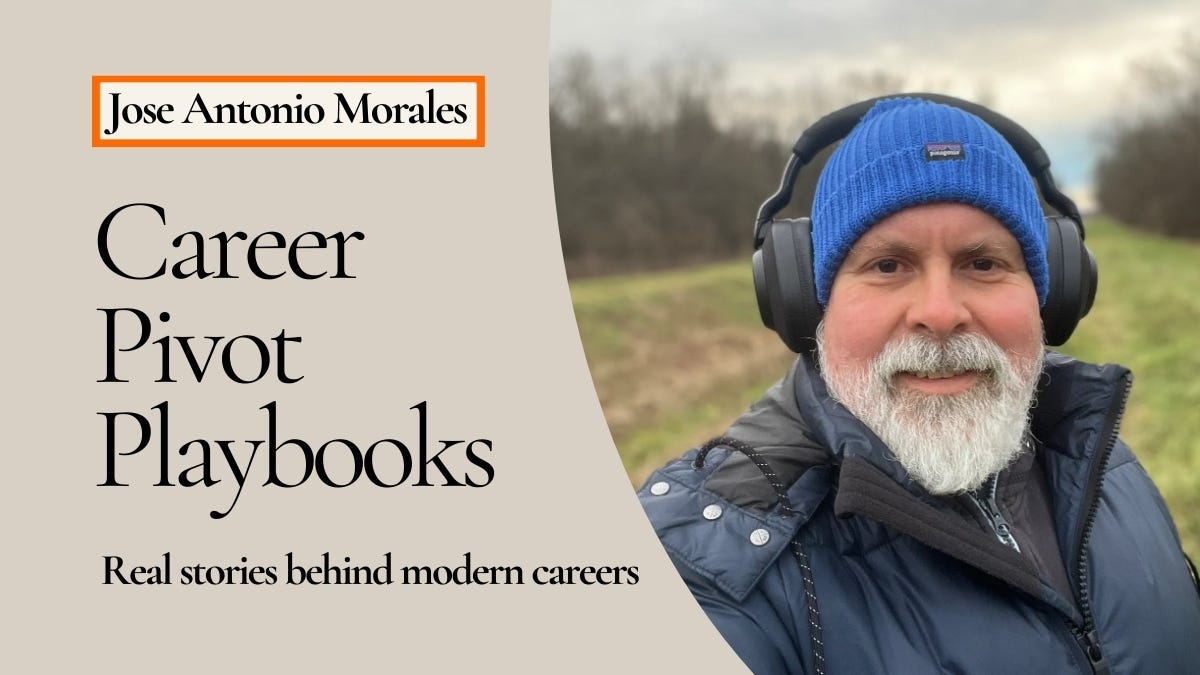
Jose Antonio Morales is a writer and former Microsoft professional exploring how fear, identity, and intentional action shape meaningful work and life. Through his writing, he invites independent thinkers to question inherited definitions of success and build clarity and courage on their own terms.
On Substack, Jose writes Growing Fearless is an Adventure, where he shares reflections, essays, and lived insights on navigating fear, cultivating agency, and moving forward without needing everything figured out.
You can follow his work here →

Jose reflects:
“Can you share a bit about your professional background and the path that led you to where you are today?”
I was born in Lima, Peru, in the early seventies. It was a time when curious kids like me dreamed about computers that knew everything, science fiction turning into reality, and adventures that felt just around the corner.
I was deeply in love with life and with the sense of possibility it offered. I got my first game console—an Atari 800XL—in the late eighties, and that was, in many ways, the beginning of my professional path. A few years later, I started teaching people how to use their new PCs at home and eventually opened a small business importing computer parts and accessories.
My parents were worried because my school results weren’t very good. The school psychologist repeatedly explained to them that there was nothing wrong with me: my intelligence was above average, I understood the material, but I struggled with tests. That tension during my school years shaped me deeply and convinced me of one thing—I wanted to prove that it was okay to be myself.
I became an entrepreneur.
I opened several companies in Lima, experienced a couple of serious failures, and also had periods of real success. I became a close partner of Microsoft Peru, worked in parallel as a tech lead for a law firm, and even spent some time working inside a government ministry—an experience I cut short after uncovering a corruption ring.
I never completed my university studies in informatics. I tried multiple paths, but none of the academic environments felt right. In hindsight, part of it was likely a fear of being reduced to grades again, after years of struggling with formal evaluation systems.
All of this shaped how I work today: practical, self-directed, deeply curious, and focused on real-world impact rather than credentials. My path hasn’t been linear, but it has been consistent in one thing—building, learning, and questioning systems from the inside.
“What sign, moment, or slow realisation told you it was time to diversify — and what did you have to push through to actually act on it?”
I’m almost 53, and I’ve gone through multiple pivots in my life. Two of them stand out as defining moments: the decision to move to Slovenia, and later, the decision to return to Slovenia from New York. What’s interesting is that both pivots share the same underlying pattern in how I make decisions.
I worked with Microsoft for many years, and my contributions consistently delivered strong results. Still, I kept wondering why I was never offered a formal role. I worked as a partner, but much of my time was spent in strategy and marketing discussions—shaping campaigns, clarifying ideas, and helping teams understand how Microsoft tools could genuinely serve customers. I also trained team members, not just in how to use the tools, but in why they mattered.
During that time, I met a Slovenian woman. To keep the story short, we decided to marry and build our life in her country. I wanted my future children to grow up in a place that felt safe, fair, and socially balanced.
Then, one day, while returning from Europe, I got a call from Frank, a close friend at Microsoft. He asked me to come to the office immediately—he had important news. It was the job offer.
It was my dream job. The best-case scenario.
And I declined it.
I chose to move to Slovenia instead, starting from zero, with little money and without speaking the language.
Ten years later—seven of them working very closely with Microsoft Slovenia in a role remarkably similar to what I had done in Peru—I found myself asking the same question again: Will I ever get an offer here? This time, something appeared, indirectly, when I accepted a project in New York as Chief Innovation Officer for a management consulting firm. Ironically, every time Microsoft came closer, I moved countries.
My wife, our two sons, and I relocated to the U.S. After two years, a fundamental values clash with the company’s owner made it clear I had to leave. We returned to Slovenia—this time with a much bigger internal decision attached.
I was 39, and I decided to consciously “manufacture” a midlife crisis. I asked myself hard questions: Is this it? Could I be good—maybe even great—at something beyond tech? What is my real potential?
When we returned to Slovenia, I made a radical choice: I stopped working in tech altogether. I wanted to discover who I was without it. And I did.
For the past fifteen years, I’ve worked as a social entrepreneur. I’ve traveled across Europe, founded two coworking spaces, and created an event series called Fear & Fail. Over time, a deeper truth emerged: I never loved technology for its own sake. I loved it because of its power to empower people. What I truly cared about was people.
I’ve always been a bit unconventional by mainstream standards. But that was the point from the beginning—to be myself. What I’ve learned along the way is that authenticity comes with a cost. And I’ve chosen, again and again, to pay it.
Every time I faced a major pivot, my guiding question was always the same: Am I being true to myself? It was never primarily about outcomes, status, or security, but about the meaning of the decision.
I took time to decide. I reflected deeply, tried to sense what was genuinely mine, and evaluated the consequences carefully. I was never naïve about the risks, but even when I could see them clearly, I chose to act in alignment with myself.
In that sense, all my major decisions have felt like falling in love. You know there are risks, uncertainty, and no guarantees, yet you still choose to step forward.
“Which skills or experiences from your previous career unexpectedly became an advantage in what you do now?”
Not very long ago, I learned that the reason I struggled with exams in school was due to undiagnosed attention disorders, and the pressure from my family didn’t help.
With age, I discovered that my mind operates best in diverse environments where multiple fields of knowledge converge. I’m a generalist, and I usually have trouble explaining what I do.
Without realizing it, after years in coworking, mentoring young entrepreneurs, and delivering training programs, I became good—maybe even a specialist—in community building. I’d also venture to say I’m a strong pattern recognizer, which makes me effective as a consultant for processes, workflows, and information system design.
But the big surprise came after my 50th birthday, when I discovered I could integrate my people skills with my tech side.
I started consulting for a company that hadn’t solved a critical issue in five years. They’d hired the best experts from around the world, but for reasons no one understood, no solution materialized. When they called me, I identified the problem and laid out a solution in less than 30 minutes. They hired me to drive the implementation.
That’s when I learned about the internal politics—the different relationships between business decision makers, internal conflicts, fears, and unspoken tensions. I could see each person for who they are, what they do, and what they love in their work. They saw me not as “the consultant” but just as Jose. That helped me partner with the key decision makers, earn their support, and solve the problems with almost no friction.
The results? Absolutely great.
What once seemed like scattered interests and attention challenges turned out to be my superpower: the ability to see patterns across domains and connect with people as people, not as roles or obstacles.
“How did you decide where to build visibility or credibility (Substack or elsewhere), and what role does that platform play in your overall career or income mix?”
As you know, I love tech, so I’ve been an early adopter—Internet services, e-commerce, and of course, social media.
I’ve been present in SM since the beginning. I always wanted to build a following, but it didn’t work as expected. I have a big network—after all, I traveled extensively, hosted events, spoke at conferences, visited coworking spaces around the world. But a following? That was different.
For five years, I wrote a monthly newsletter using Kit. My subscribers hovered around 100-120 people, and I felt stuck there. I left Twitter when it became X, stopped using Facebook, and kept my LinkedIn profile active.
I wondered if the problem was me, my content, or how I expressed my ideas. But I refused to be a servant of any algorithm. I had to be myself.
Then, about six months ago, I started on Substack, and everything changed. My two publications now have over 1,800 subscribers.
At this moment, Substack subscriptions aren’t generating significant monthly income, but I want Substack to become my main revenue source. What makes the difference? Substack rewards depth over performance. The platform lets me write the way I think—connecting ideas across domains, taking time to explore concepts, building genuine relationships with readers rather than chasing metrics. It’s not about gaming an algorithm; it’s about finding people who value the same things I do.
“Who is your work really for — and what problem do you solve so well that people are willing to pay for it?”
My work is for people who want to break the mold, who feel the need to explore their potential. No matter where they are or what they do, I think of them as entrepreneurs—people who wish for a better life, question the norms, and want to take risks. But they don’t necessarily know how to make it happen, and they often feel lonely in their aspirations.
My main publication is called Growing Fearless is an Adventure, where I write about fear, community building, purpose, impact, tools, and adventure—all the pillars of a good and always-evolving life.
My other publication, Automato, is for knowledge workers who want to step up in this new world of smart tools without having to become overly tech-oriented. It’s about using technology and AI strategically, not being overwhelmed by it.
The problem I solve: People feel stuck between who they are and who they could become. They see the gap but don’t know how to bridge it. They’re intimidated by change, isolated in their ambitions, and overwhelmed by the tools available. I help them navigate that transition—not by giving them a formula, but by showing them how to recognize patterns, build supportive communities, and use the right tools without losing themselves in the process. I make the path less lonely and more achievable.
“What turned out to be harder than you expected when you started — and what was easier than you imagined?”
Finding a value proposition is always tough.
I love Substack as a platform because it facilitates serendipity, I enjoy that immensely.
“How have you found the journey? What advice/ strategies and tips would you give to others wanting to grow their audiences?”
On Substack, other publishers genuinely want to support each other. The incentive structure rewards this—by helping others, you gain more exposure too. It’s a true win-win.
I’ve found an incredibly diverse group of people on the platform, from young and ambitious writers to older professionals with decades of experience. Because of that diversity, the BS antennae are sensitive. There’s little tolerance for aggressive attitudes, fake personalities, or extreme transactional language. Substack feels like a more cultured space.
I believe it’s possible to build a real community here, not just a network. I’ve connected with people I’d never find on LinkedIn, from countries far from where I am now. I’ve talked with so many amazing, inspiring, positive people. I can’t be more enthusiastic about the platform.
To anyone looking to start publishing on Substack, I’d say:
Start with who you are. Think about your best authentic self today, and find a first version of something you can talk about that could be helpful to someone. Even if you have little experience but it’s a theme you love—share it. There’s always someone who can benefit from your perspective. It’s not about having all the knowledge or decades of experience; it’s about your unique take on a theme.
Follow your intuition over formulas. Look at recommendations from experts, but you don’t have to follow everything they say. Trust your gut. And remember: online presence isn’t the same as physical presence. You need to be “more” present online to be seen.
Connect authentically. Don’t just broadcast—engage. Build real relationships with other writers and readers.
Iterate. Build version two of your publication. Include a clearer value proposition. Keep growing until you hit it. Your voice will evolve as you write, and that’s exactly how it should be.
The beauty of Substack is that it rewards depth, authenticity, and patience. It’s not about going viral—it’s about finding your people and building something meaningful together.
“What nearly made you quit, and what actually kept you going?”
Whenever we make a decision, we build expectations. My faulty decisions often make me feel like I should quit. But then I remember that my assumptions are just pretexts to decide—what I find along the way is usually a clue to something even better than my expectations.
I want my ideas and projects to work well, be self-sustaining, and support others on their path. That keeps me going. Seeing the impact of my work is the most wonderful source of meaning and happiness for me.
Let me share a short story.
Initially, my coworking space was modeled like most similar businesses. It wasn’t working. The town where I live is too small, I would never have enough members to pay myself a salary. That was a big “quit moment.” That was the expectation crashing into reality.
But then I asked myself: What if this coworking space isn’t there to pay me anything? Would the model work to be self-sustaining?
The answer was yes.
We now have two coworking spaces and just passed ten years of operations. It’s not a traditional business, but it generates no loss, covers all expenses, helps the users, and brings meaning, network, and impact to me and my business partner.
What nearly made me quit: The gap between what I expected and what reality delivered.
What kept me going: Redefining success. When I stopped measuring the space by whether it paid me a salary and started measuring it by whether it sustained itself and served others, everything changed. The “failure” became one of my greatest sources of meaning.
“What advice would you give to someone considering a similar pivot or looking to monetize their skills in a more flexible way?”
Make decisions when you’re in love with the meaning of them. If you decide out of fear, you can’t feel the love.
Decisions come with a price tag—they bring change and unexpected opportunities. But thinking about monetization at the pivot moment might be the wrong thing to do.
First, fall in love with the problem you want to solve or the life you want to build. The money follows meaning, not the other way around.
Build the urgency to decide, but don’t decide until you’re ready. A pivot isn’t an escape plan—it’s a commitment to something that matters more than what you’re leaving behind.
If I start asking “How am I going to make money?” the answers will not be about me, what I want, or what I’m good at. The answers will be about expectations of others, and that might be disempowering.
“Does this bring meaning to me and serve others?”—that’s when things actually started working. The coworking spaces, the consulting breakthroughs, the Substack growth—none of it happened because I optimized for revenue. It happened because I optimized for impact and authenticity.
My advice:
Question your assumptions about what success looks like
Give yourself permission to redefine the game you’re playing
Build something self-sustaining first, worry about profit later
Trust that if you solve a real problem authentically, the monetization will follow—maybe not in the form you expected, but often in ways that are better
The pivot isn’t about finding a more flexible way to make money. It’s about finding a more authentic way to create value. The flexibility and the money are side effects of getting that part right.
“What other platforms, audiences, or income streams are part of your portfolio career — and how do they work together?”
My main platform is Substack, and my presence in other networks is not yet part of a strategy.
Reflection & Future Vision
Looking back, what’s one decision that changed everything — and what’s next for you?
The decision that changed everything: Accepting the risk of starting from zero.
Every time I’ve made a complete change and embraced beginning again, it has paid back—not always in the ways I expected, but always in ways that mattered more.
What’s next: I want to prove that it’s possible to build an authentic community online—one that creates real meaning, not just engagement metrics. I’m building toward making Substack my primary income source while helping others navigate technology without losing their humanity.
I don’t have a detailed roadmap—but I never have. What I do have is the willingness to start from zero when it feels right and the trust that optimizing for meaning always leads somewhere worth going.
Links & Resources
Related Articles
Are You Building a Network or a Community?
What It Takes for Authentic Communities to Work
Read More
Behind the Pivot
Learn how to turn your current skills and experience into income and build a portfolio career beyond a single job, so you’re more resilient and in control.
The Career Pivot Archive
Real-world career pivots, portfolio paths, and practical lessons from some of your favourite Substackers you can apply to your own next move.
Career Questions Answered
Practical, strategic answers to the career questions ambitious professionals are asking as work, security, and opportunity continue to change.
I’m Katharine — a future-focused career strategist helping professionals build income options and stay relevant as work evolves.
🙏 I appreciate you being here and supporting this growing archive… and thank you to all the creators who contribute, it’s such a pleasure to learn from them.
❤️ Loved it? Restack 🔁 and share ✅
🤔Is there a question you wish had been asked?
Drop it in the comments, and let’s keep the conversation going.