


This Career Pivot Playbook features Juan Salas-Romer, an entrepreneur and builder whose work spans finance, real estate, hospitality, education, and business creation… and the founder of Build to Thrive on Substack.
Juan’s career didn’t pivot once.
It unfolded across countries, industries, and moments where adaptation mattered more than planning.
From early work in Venezuela through commercial banking, private financing, real estate development, hospitality, and founder education, his path has been shaped by disruption, responsibility, and long-term stewardship.
Each chapter added skills, perspective, and systems… even when circumstances forced change rather than choice.
That lived understanding of disruption would later become central to how Juan approached writing.
Rather than positioning himself as an expert with all the answers figured out, Juan began writing as a way to think, to make sense of nonlinear careers, forced pivots, and the quiet work of rebuilding momentum. Over time, that writing became a signal others recognized in themselves.
Build to Thrive emerged not as a brand play but as an extension of that thinking.
A place to translate experience into frameworks, tools, and assets that compound and to support founders and operators navigating uncertainty without losing themselves in the process.
This Playbook explores how lived experience, when paired with reflection, systems thinking, and public writing, can become the foundation of a resilient portfolio career.
✨About Career Pivot Playbooks
A public archive of modern career blueprints…
Most careers no longer follow a straight line.
People pivot gradually.
They extend their work beyond institutions.
They combine roles, platforms, and income streams.
Career Pivot Playbooks is a weekly series curated by Katharine Gallagher documenting how professionals build resilient, future-ready careers by turning existing skills into income, often combining Substack with consulting, teaching, research, creative work, or business ownership.
The focus isn’t outcomes.
It’s about how careers are shaped in practice.
About Juan
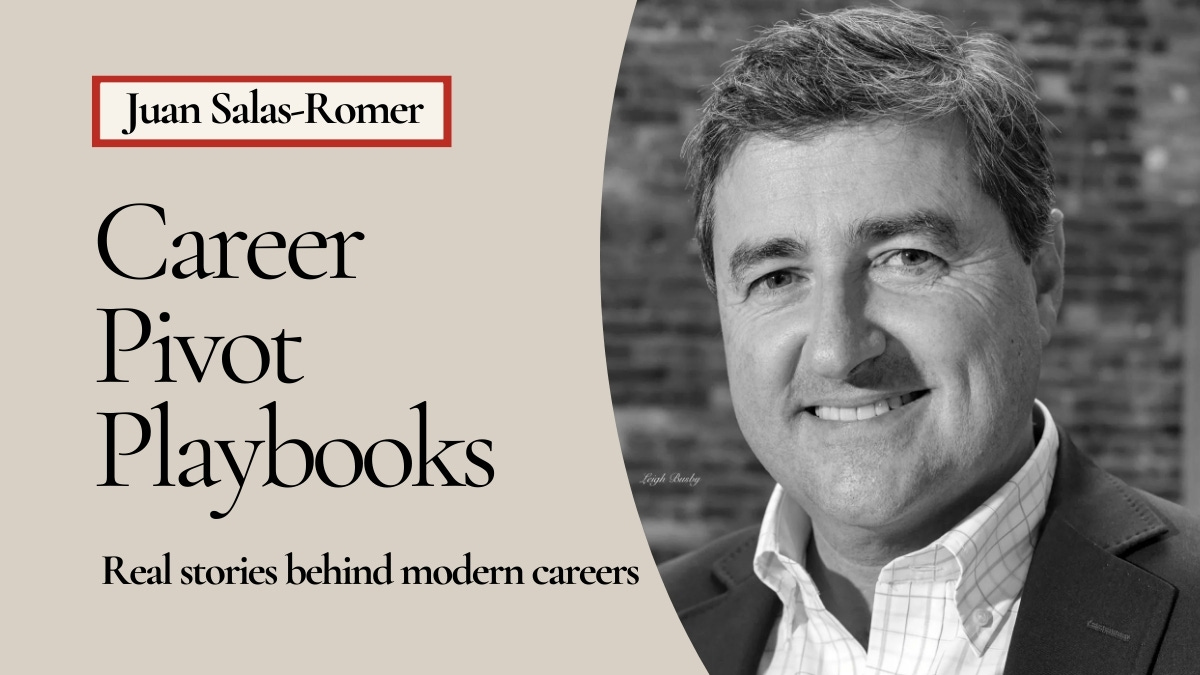
Juan Salas-Romer is an entrepreneur and builder whose career spans finance, real estate, hospitality, and entrepreneurship education. After navigating multiple market disruptions and business reinventions, he now helps founders turn lived experience into systems and assets that compound over time.
On Substack, Juan writes Build to Thrive, a newsletter focused on clarity, leverage, and long-term value creation for professionals transitioning into entrepreneurship and founders.
You can follow his work here →
Juan reflects:
“Can you share a bit about your professional background and the path that led you to where you are today?”
My academic background is somewhat conventionaI earned a degree in Entrepreneurship and later an MBA in Finance. The life that unfolded around those credentials, however, was anything but linear. My career evolved across countries, industries, and moments where adaptation mattered more than planning.
I was born and raised in Venezuela, in a household where politics, community involvement, and social responsibility were part of everyday life. I started working at 13, driven more by curiosity than necessity. From an early age, I was always involved in something. I archived books, worked in auto shops, helped with television production, sold T-shirts, and eventually opened a small retail store. Alongside that work, I became active in civic life and later helped co-found Habitat for Humanity Venezuela. Long before I had language for it, I was learning how systems shape people and how much responsibility comes with building anything that lasts.
After the 1998 presidential elections, Venezuela changed quickly and profoundly. As the country moved toward dictatorship and daily life grew more unstable, the range of possible futures narrowed. Leaving was not a career decision. It was a necessary one. I came to the United States to start again.
After completing my MBA in 2003, I worked in commercial banking and later launched a private financing business. That chapter ended during the 2008 financial crisis. As clients defaulted, I found myself processing 26 foreclosures tied to roughly 67 apartment units. It was painful and disorienting work, but it also became a turning point. I did not choose to become a real estate investor or developer. I became one because walking away was not an option and stewardship mattered.
What followed were years of learning in real time. I became an operator, landlord, negotiator, and problem solver all at once, often without a playbook. Over time, those early efforts expanded into larger multifamily projects and hospitality work, including the turnaround of a hotel. What began with four million dollars in outside capital eventually grew into a portfolio valued at approximately thirty five million dollars over a fourteen year period. The growth was not only financial. It was shaped by constraint, accountability, and earned trust.
In 2019, I opened a coworking space as part of my hospitality work. When COVID forced it to close in 2020, it created another moment of reflection. During that pause, I turned outward. Using recovery funds, I built a business accelerator that graduated forty seven founders and supported more than one hundred small businesses with coaching, education, and access to resources. Many of them were navigating uncertainty of their own.
By 2025, I stepped back again, this time without a crisis forcing the pause. What followed was not a single pivot but a series of iterations. I began writing as a way to think more clearly, to test ideas, and to search for signal. I paid attention to what consistently resurfaced in my own interests and to what showed up again and again in the challenges my readers were facing.
Over time, patterns emerged. The questions I was trying to answer for myself were the same ones others were quietly wrestling with. How to regain momentum after disruption. How to make sense of nonlinear careers. How to build something durable without losing yourself in the process. Writing became a way to meet those questions honestly, refining them in public rather than pretending to have final answers.
That work eventually became a newsletter. The newsletter became the foundation for what is now my fifth business. It was not built from a single breakthrough, but from the steady alignment between lived experience, curiosity, and the real pain points people trusted me to explore alongside them.
“What inspired you to make a career pivot, and how did you know it was the right time?”
The financial crisis in 2008 forced me to adapt quickly. Years later, COVID did the same. Those moments stayed with me. Over time, I began to see a pattern. Relying solely on effort, or on a single business model, left me more exposed than I wanted to admit. The shifts in my direction were not sparked by dramatic breakthroughs, but by quieter realizations that I needed to build things capable of enduring disruption.
Acting on that insight required letting go of familiar roles and comfortable identities. It meant being willing to learn in public, to experiment, and to start again even when the next step was not fully clear. The hardest part was not the uncertainty itself, but trusting that adaptability was not a weakness. It was a skill I had been developing all along.
For a more comprehensive description of my career and what assets compound even when life forces pivots, you can read the following article→
How to Build Assets That Compound (Even When Life Forces You to Pivot)
“Which skills or experiences from your previous career unexpectedly became an advantage in what you do now?”
Operating through uncertainty taught me how to make decisions without perfect information, how to build systems instead of relying on brute force, and how to recognize patterns across industries.
I also learned how to move from doing everything myself to building teams and processes that scale and how to translate complex situations into clear, actionable steps for others.
“How did you decide where to build visibility or credibility, and what role does that platform play in your overall career or income mix?”
Writing started as a personal tool, not a branding strategy.
I needed a way to process what I had learned across finance, real estate, hospitality, and education. Writing helped me do that. Over time, the newsletter became a place where I could share those lessons in real time, without pretending to have everything figured out.
Today, it supports everything else I do (consulting, tools, education) by building trust and long-term relationships rather than chasing short-term attention.
“Who is your work really for and what problem do you solve so well that people are willing to pay for it?”
My work is for founders and operators who feel like they’ve accumulated experience but haven’t yet turned it into leverage.
I help people translate what they’ve lived through into systems, frameworks, and assets that compound — so they’re not starting from zero every time circumstances change.
“What turned out to be harder than you expected and what was easier than you imagined?”
Harder: trusting myself enough to build in public.
Easier: teaching once I allowed myself to draw directly from lived experience instead of theory.
“How have you found the journey, and what advice would you give to others wanting to grow their audiences?”
Substack rewards consistency and substance.
My advice is to focus on clarity over volume and depth over reach. Write to think, not to perform.
“What nearly made you quit, and what actually kept you going?”
The hardest moments were internal questioning whether my experience still mattered or whether I was behind.
What kept me going was realizing that each chapter added something durable: skills, perspective, relationships, or credibility that didn’t disappear when circumstances changed.
“What advice would you give to someone considering a similar pivot or looking to monetize their skills in a more flexible way?”
What advice would you give to someone considering a similar pivot or looking to monetize their skills in a more flexible way?
One idea I often share comes from Dan Koe’s article “How to Fix Your Entire Life in One Day”.
He describes a simple but powerful framework: dissonance → uncertainty → discovery.
The idea is that growth doesn’t start with better tactics. It starts when you notice the tension between who you are and who you’re becoming (dissonance), allow yourself to sit in not knowing (uncertainty), and only then discover a new direction that feels sustainable.
My advice is not to rush that process. Many people try to erase discomfort with action. Instead, use it as information. The right moves tend to become obvious once identity and direction catch up with experience.
“What other platforms, audiences, or income streams are part of your portfolio career, and how do they work together?”
My work spans consulting, education, digital tools, real estate, and writing. Each reinforces the others. Writing builds clarity and trust. Consulting sharpens insight. Tools turn experience into repeatable value.
“Looking back, what’s one decision that changed everything… and what’s next for you?”
The decision to slow down long enough to make sense of my experience instead of immediately replacing it with the next project.
What’s next is continuing to build tools, systems, and communities that help others do the same — with more clarity and less burnout.

Links & Resources
Website: https://juansalasromer.com
Business Health Check: https://juansalasromer.com/diagnostic
Experience to Income Guide: https://juansalasromer.com/monetization
The Vault (Tools, tactics & prompt library)
The Builder’s Store:
https://juansalasromer.com/tools-marketplace
Newsletter:
Related Articles
These pieces expand on themes referenced throughout the interview:
The Accidental Developer
On forced pivots, operating through crisis, and learning by doing)
How to Build Assets That Compound (Even When Life Forces You to Pivot)
(On leverage, systems, and building durability beyond hustle)
The Year I Stepped Into a New Identity
(On identity shifts preceding sustainable change)
Read More
Behind the Pivot
Learn how to turn your current skills and experience into income and build a portfolio career beyond a single job, so you’re more resilient and in control.
The Career Pivot Archive
Real-world career pivots, portfolio paths, and practical lessons from some of your favourite Substackers you can apply to your own next move.
Career Questions Answered
Practical, strategic answers to the career questions ambitious professionals are asking as work, security, and opportunity continue to change.
I’m Katharine — a future-focused career strategist helping professionals build income options and stay relevant as work evolves.
🙏 I appreciate you being here and supporting this growing archive… and thank you to all the creators who contribute, it’s such a pleasure to learn from them.
❤️ Loved it? Restack 🔁 and share ✅
🤔Is there a question you wish had been asked?
Drop it in the comments, and let’s keep the conversation going.
Thank you, Juan. I loved understanding how you built such success.