


This Career Pivot Playbook features Kim Doyal, an AI strategist and online business owner using her Substack to help women turn their experience into income without getting stuck on the tech.
She didn’t come from a technical background. Her career path started in retail management, then dramatically shifted after a major life change forced her to rethink how she worked and lived.
She moved into online business with no clear roadmap and figured it out by doing.
Inside this interview, Kim shares what that transition actually looked like, the patterns she started to notice, and how her earlier experience began to work in her favor.
She breaks down how she built her brand through content and podcasting, what helped her create multiple income streams, and how she is now using AI in practical ways inside her business.
If you are trying to build something sustainable, on your terms, without feeling “technical enough,” this one is for you.
✨About Career Pivot Playbooks
A public archive of modern career blueprints…
Most careers no longer follow a straight line.
People pivot gradually.
They extend their work beyond institutions.
They combine roles, platforms, and income streams.
Career Pivot Playbooks is a weekly series curated by Katharine Gallagher documenting how professionals are building resilient, future-ready careers, with professionals often using Substack alongside research, consulting, teaching, creative work, or operating businesses.
The focus isn’t outcomes.
It’s about how careers are shaped in practice.
About Kim
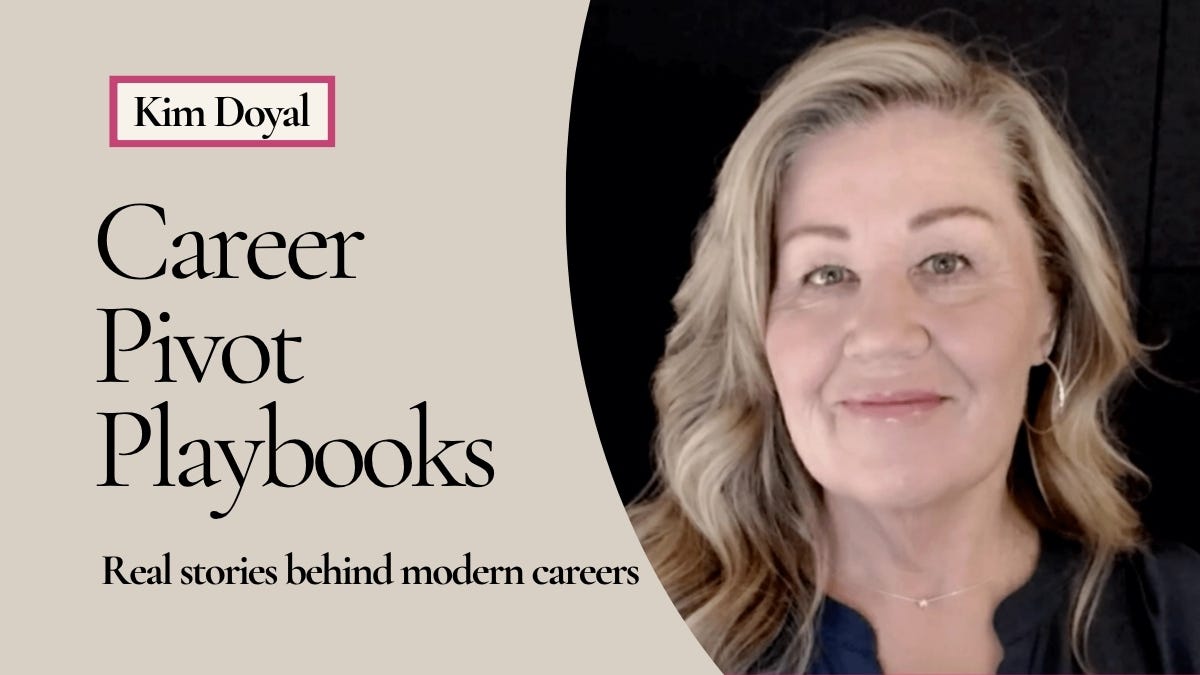
Kim Doyal is an AI strategist and online business owner who shows you how to build with AI without a technical background.
She spent over 17 years building online, creating offers, content, and systems that generate real income while supporting her life.
Today, she teaches how to use AI to save time, create your own tools, and turn your experience into something people will pay for.
You can follow her work here →

Kim reflects:
“Can you share a bit about your professional background and the path that led you to where you are today?”
The bulk of my professional background was in retail management — training manager, then district manager. All of that changed when I was widowed in 2003. I was 32. My kids were six and two.
Even before that, I’d always had an entrepreneurial itch. I opened a retail scrapbook store with a friend in 1998, did some contract recruiting — there was always this sense that I was meant to be doing something else, I just hadn’t found it yet.
Five years after losing my husband, I had a small financial cushion and attended a conference in San Francisco called the Wealth Expo. A friend and I stumbled into a breakout session on internet marketing. That was 2006, and I was hooked.
I didn’t jump right away, but by 2008, I made the decision to go all in — build a business from home so I could be there for my kids. I was completely non-technical. That didn’t stop me.
“What sign, moment, or slow realization told you it was time to diversify, and what did you have to push through to actually act on it?”
The moment wasn’t one single thing — it unfolded over a few years. But losing my husband made it crystal clear: there was no way I could be a retail district manager and actually be present for my kids. The job is too demanding, too consuming.
What gave me the runway to act was a small settlement after his death. Nothing to retire on, but enough to buy me some time. And I’d always wanted to work for myself anyway — this just made the decision undeniable.
Right out of the gate I did two things: hired a coach (mostly learned what not to do) and enrolled in a social media marketing course when social media was barely a thing. I showed up, connected with people, did the work.
When I say I wasn’t technical — I mean it. But I was committed. I showed up every day, and that was enough to keep moving forward.
“Which skills or experiences from your previous career unexpectedly became an advantage in what you do now?”
One of the major retailers I worked for in San Francisco had me opening new stores constantly as a district manager. That process — the coordination, the planning, the structure, the scheduling — it’s actually not that different from launching anything online. You’re moving a lot of pieces at once and someone has to hold it all together.
I was in management very young, so I learned early that hard work isn’t optional and things just have to get done. That mindset carried over completely.
And retail is people. Customers, employees, conflict, communication — all of it. Learning to read a room, build trust quickly, handle difficult situations... that translated more than I ever expected into building an audience and working with clients.
“How did you decide where to build visibility or credibility (Substack or elsewhere), and what role does that platform play in your overall career or income mix?”
In 2008, I jumped on every platform that existed. Facebook, Twitter, all of it. I just showed up and did what I was supposed to do. Some of those accounts are long gone now, but I was everywhere early.
I also knew from the start that writing and SEO mattered, and that’s when I fell in love with WordPress. I grabbed the domain “The WordPress Chick,” became the WP Chick, and just shared my journey. I kind of fell into that space — and it worked.
But honestly? My podcast was probably the single biggest factor in growing my brand. What started as the WP Chick podcast eventually became the Kim Doyal Show, and I did it for almost ten years. I alternated solo episodes with interviews — that rhythm was intentional. The interviews built my network and some of my best friendships. The solo shows built trust.
Hour-long episodes do something interesting — people spend real time with you. They get to know how you think, how you work, what you actually believe. I became a trusted voice, almost like a friend. Someone once tweeted that I seemed like I’d be fun to have a beer with. I responded that yes, I absolutely was.
The podcast made me relatable in a way no other platform could.
“Who is your work really for, and what problem do you solve so well that people are willing to pay for it?”
My work is for the person who doesn’t think they’re technical enough — but has a lifetime of wisdom, experience, and skills they haven’t fully monetized yet. Specifically, I’m talking to midlife women entrepreneurs who want time freedom and financial growth, and who are looking at AI thinking... where do I even start?
I used to say, when I was figuring out WordPress: “If I can build IKEA furniture, I can figure this out.” I was never a coder, never a developer. I’m still not. But I learned enough to build, to teach, and to solve real problems — and that’s exactly the bridge I help others cross now.
Because here’s what I see: there are a lot of people 45 and older who know AI is important, who don’t want to be left behind, but who have no idea how to integrate it into their actual business. They’re not intimidated by work — they’re intimidated by tech. Those are two very different things.
My sweet spot is showing people they can build what they need. Custom solutions, content systems, operations tools — things that used to require a developer. The era of “I’m not technical enough” is over. You just need someone to show you how. And yes, people are already paying me for it.
“What turned out to be harder than you expected when you started — and what was easier than you imagined?”
Honestly? More has been easier than I expected than hard. I’ve been working online long enough that I’m constantly blown away at what’s possible — and I just keep applying the same principle: if I can build IKEA furniture, I can figure this out.
The hardest part has been carving out my own space. There’s so much happening in AI right now, and a lot of noise around it. I’m not interested in building some enterprise software company — that’s not where I am in my life, and it’s not what lights me up. But I do want to scale financially, serve my audience well, and maintain the quality of life I’ve built. That combination means the path has been slower, and I’m genuinely okay with that.
I’m still finding my spot. It’s going to be a combination of everything I bring — the experience, the voice, the technical skills I’m building in real time. It’s evolving every day, and honestly, that’s the part I love most.
“How have you found the journey? What advice/strategies and tips would you give to others wanting to grow their audiences?”
The Substack journey felt a little bumpy at first — mostly because I was still carrying old habits into a new platform. My newsletter had been a structured weekly format with segments for five and a half years, and that worked really well. But when I actually looked at my Substack data, the individual standalone posts were outperforming the newsletter by a wide margin. That was a turning point.
The best advice I can give? Tune out the noise and just start. Clarity comes through doing, not planning. You have to show up, write, engage, connect — and then let the data tell you what’s working.
There are a lot of formulas floating around for growing on Substack, but honestly the thing that matters most is being a genuine person who’s interested in other people. I’ve had handfuls of “let’s just hop on Zoom and meet” conversations, and they’ve turned into real friendships. It feels like early Facebook did — 2008 to maybe 2015 — when people were actually there to connect.
On consistency: it doesn’t look the same for everyone, and that’s fine. Don’t adopt someone else’s cadence if it doesn’t fit your life. The more you publish, the clearer everything gets — what you want to say, who you’re saying it to, and what actually resonates.
“What nearly made you quit, and what actually kept you going?”
Plenty of times. I’m 18 years into this as of this year, and there have been a lot of rough patches along the way.
The through-line on most of them? Not trusting myself. Every single time I ignored a gut feeling about working with someone or taking on a project, it went sideways. Without exception. The internet marketing space is where influencers were born, and there is so much noise and so much bullshit wrapped in a very convincing package. I’ve invested a lot into masterminds, coaching, and programs over the years — some of it transformative, some of it a very expensive lesson in discernment.
What kept me going was usually something small. A win. A moment of realizing I was actually there for my kids, or later for my parents, or just... watching my siblings come home from traditional jobs completely drained, their schedules not their own. That was enough to recalibrate.
I’ve had significant launches — the Content Planner did really well and showed me what’s possible. I’ve also had months where I was barely scraping by. Both are real. But honestly? The worst day working for myself is still better than a great day at a job.
“What advice would you give to someone considering a similar pivot or looking to monetize their skills in a more flexible way?”
The most honest advice I can give is also the least sexy: be patient and do the work. It doesn’t happen overnight, regardless of what you’ll hear out there.
And it depends where you are in your life. Hustle culture used to genuinely make me angry — I was a single parent, raising two kids alone, running a business. I couldn’t have worked harder if I’d tried. The “if you wanted it badly enough you’d grind more” noise was not just unhelpful, it was insulting. So go at a pace that actually works for your life, but be consistent. Those are not the same thing.
Trust yourself. If something doesn’t feel right, listen to that. You will save yourself time, money, and a lot of heartache.
Get comfortable with discomfort — because you’re going to have to stretch in ways you didn’t anticipate. Most people don’t love selling, and they especially don’t love selling themselves. I still wrestle with it. But if you want to monetize your skills, build a real business, keep the lights on... you have to learn to sell. Not manipulate, not perform — sell. And that starts with understanding your own why deeply enough that sharing it stops feeling like a pitch and starts feeling like a conversation.
Bad days are part of it. They don’t mean you’re failing. They mean you’re building something real.
“What other platforms, audiences, or income streams are part of your portfolio career… and how do they work together?”
Everything has been an evolution, and it’s all been connected. Web design agency, outsourcing company, podcasting, done-for-you services, coaching, content and copy and email marketing. I’ve taught courses, built curriculums, and launched an e-commerce product — the Content Creators Planner — that we scaled to half a million in sales. I studied copywriting, went deep on every skill I picked up, and somewhere along the way realized that all of it was preparing me for exactly this moment.
So right now, everything runs through Kim Doyal. Client work, teaching, content. I recently relaunched my YouTube channel and I’m tightening the focus so it’s entirely AI-based and built around serving my ideal audience. The throughline across everything is the same person, the same voice, the same mission.
I’m also working on something I’ve been calling a secret project — a platform specifically for women, completely outside the marketing space. There’s a digital app component, content, and something designed to genuinely help women in a different way. The website is built, I’m developing the content, and I’m giving myself a full year to do it right. Once the app is running, the goal is to grow it, scale it, and eventually — maybe — sell it.
I have no interest in rushing it. I’ve learned enough to know that the best things I’ve built were built with intention.
“Looking back, what’s one decision that changed everything… and what’s next for you?”
The decision that changed everything was choosing to start an online business when I had no technical background whatsoever. I just had faith in myself and a commitment to a different kind of life.
Freedom was the driving force for so long. I’d worked for big corporations, six days a week, salaried, with the kind of expectations that grind you down slowly. The first Christmas I worked for myself felt almost foreign — the chaos of retail’s fourth quarter just... wasn’t there. That quiet was everything.
As for what’s next: I want to scale, but on my own terms. I have what I’m calling a boutique agency, continuing to work with women and help them integrate AI into their businesses in real, meaningful ways. I’m diving head-first into agents and automations, testing what I’m learning across different spaces outside of marketing. The secret project. YouTube. All of it.
I don’t have a burning desire to be a household name or build an enterprise company. Genuinely couldn’t care less about that. I want to do work I love, spend time with people I care about, and travel. Life is really good.
Nobody knows where AI is heading — and honestly, that’s part of the magic. Right now this is a “let’s see where it takes us” chapter, and I keep surprising myself with what’s possible. I’m having a ball.

Links & Resources
Connect with Kim…
On YouTube
On LinkedIn
Website: kimdoyal.com
Related Articles
I Let an AI Agent Audit My Content Strategy. It Found 37 Posts I Forgot Existed.
How I Built My Own Platform (Website & More) with AI. And What I’d Do Differently
You’re Sitting on a Lifetime of Stories (And a Blank Page Keeps Proving It)
I World-Built My Brand Like J.K. Rowling Built Hogwarts (And You Can Too)
Read More
Behind the Pivot
Learn how to turn your current skills and experience into income and build a portfolio career beyond a single job, so you’re more resilient and in control.
The Career Pivot Archive
Real-world career pivots, portfolio paths, and practical lessons from some of your favourite Substackers you can apply to your own next move.
Career Questions Answered
Practical, strategic answers to the career questions ambitious professionals are asking as work, security, and opportunity continue to change.
I’m Katharine — a future-focused career strategist helping professionals build income options and stay relevant as work evolves.
🙏 I appreciate you being here and supporting this growing archive… and thank you to all the creators who contribute, it’s such a pleasure to learn from them.
❤️ Loved it? Restack 🔁 and share ✅
🤔Is there a question you wish had been asked?
Drop it in the comments, and let’s keep the conversation going.
Thank you so much for the interview, Katharine... and the opportunity to share my story.
I appreciate you and the work you're doing. 🥰
Love the story , Kim Doyal , you did not fall apart , you chose to build 💗What struck me most wasn’t the AI.
It was the reminder that experience compounds.
Life forced her to start over at 32.
What followed was two decades of learning, building, adapting, and beginning again.
The technology is interesting. The resilience is the story.
Because most of us are not held back by a lack of tools. We are held back by the belief that it is too late to begin again.
loved the interview , Katherine .