

This article was co-authored by Mantel Featherson.
This Career Pivot Playbook features Mantel Featherson, the writer behind FutureProof50, a Substack for professionals over 50 who want to turn what they know into income they control.
Mantel’s background is corporate change management. He spent over two decades inside some of the biggest names in the business, DuPont, Merck, SAP, and KPMG, helping organizations navigate the hardest part of any technology rollout. Not the systems. The people.
But when he was laid off at 55, most people with his background would have found another corporate job and moved on. Mantel saw it differently. What came next was not straightforward, but it led somewhere most professionals never think to go.
Today he runs a premium advisory program, is building a learning community, and publishes on Substack for an audience the business world largely ignores. Writing became the thread connecting his thinking, his framework, and the professionals who follow his work.
In this Playbook, Mantel talks about what two decades in corporate change management actually taught him about people, what the layoff at 55 really felt like, why he started writing in public, and how he built something most professionals in his position never think to try.
✨About Career Pivot Playbooks
A public archive of modern career blueprints…
Most careers no longer follow a straight line.
People pivot gradually.
They extend their work beyond institutions.
They combine roles, platforms, and income streams.
Career Pivot Playbooks is a weekly series curated by Katharine Gallagher documenting how professionals build resilient, future-ready careers by turning existing skills into income, often combining Substack with consulting, teaching, research, creative work, or business ownership.
The focus isn’t outcomes.
It’s about how careers are shaped in practice.
About Mantel
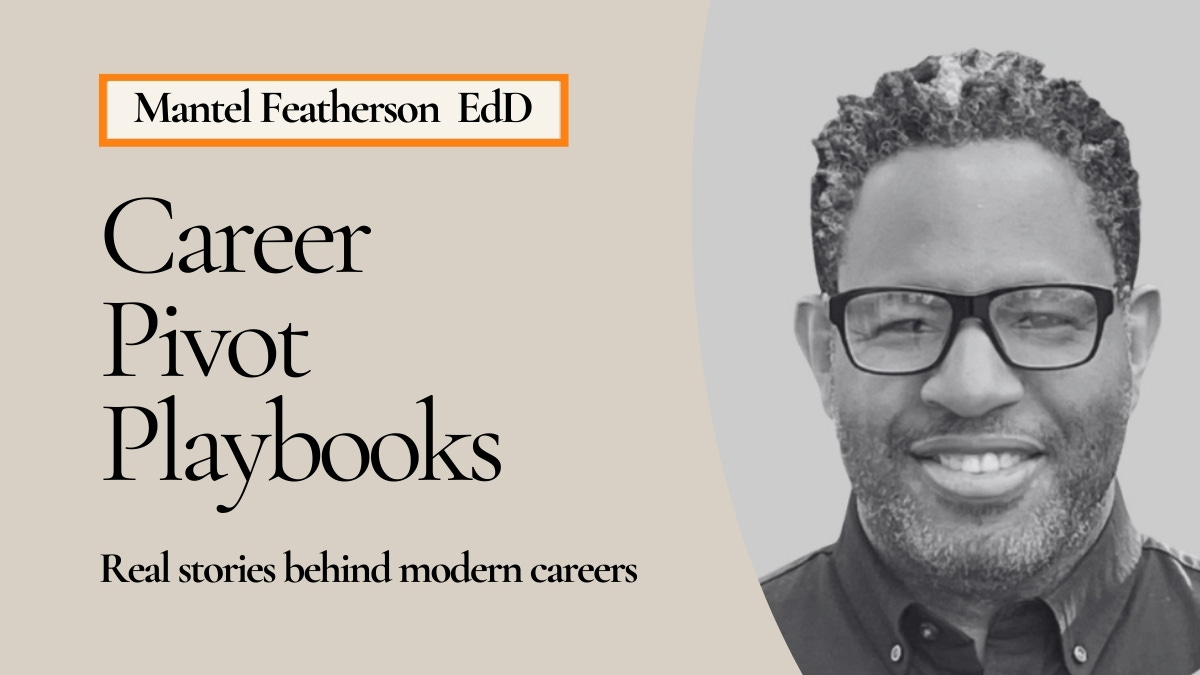
Mantel Featherson spent over 20 years helping large organizations manage change. Then, at 55, the organization changed on him. A layoff in November 2023 launched him into a failed e-commerce business, a job search that went nowhere, and eventually a clarity that only comes from hitting a wall.
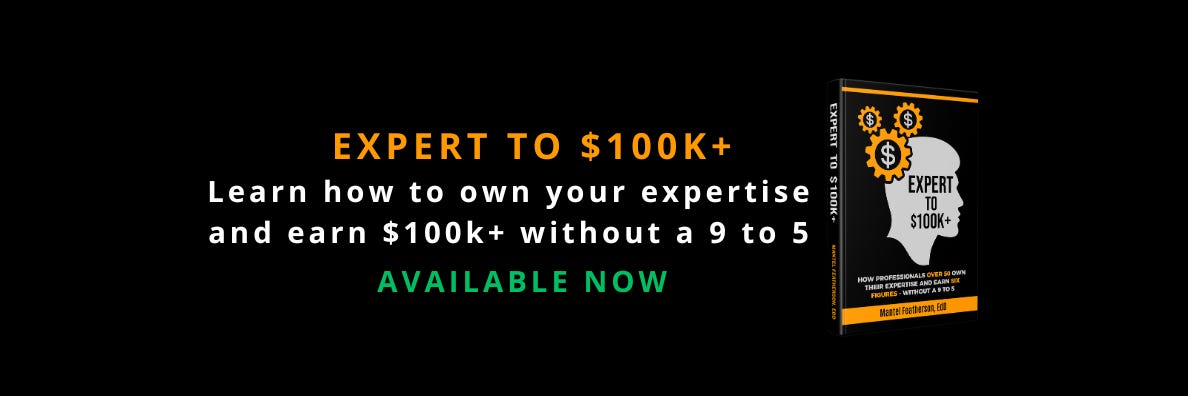
Today he is the founder of FutureProof50, author of Expert to $100K+, and creator of the Expert to $100K+ framework, helping professionals over 50 turn decades of earned expertise into income and independence. He holds a Doctorate in Human Resources Development from Drexel University and is based in Philadelphia, PA.
You can follow his work here →

Mantel reflects:
“Can you share a bit about your professional background and the path that led you to where you are today?”
I spent over 20 years in organizational change management, working with companies like DuPont, Merck, SAP, and KPMG. My work focused on the people side of technology change, specifically helping workers let go of familiar systems and adopt new enterprise software. Most people think technology implementations are IT projects. They are actually human performance projects, because getting a workforce to change how they work is where most of these initiatives succeed or fail, and that was my lane.
I genuinely enjoyed helping professionals navigate change. However, the corporate structure and politics that surrounded that work was another story.
In 2017, I was looking for a way out of the corporate world, I applied to the Doctor of Education program at Drexel University. My honest motivation was to enter academia. I thought a doctorate would open a door to a different kind of career, one built around research, teaching, and ideas rather than org charts and stakeholder management.
I graduated in 2021 with a Doctorate in Workforce Development. The experience at Drexel was valuable in ways I didn’t expect, but I came out realizing that a career in academia was not the answer I had been looking for either.
So I kept working in the corporate world, with my doctorate, and still searching for something new. In November 2023, at the age of 55, the decision was made for me. I was laid off from my last corporate job.
“What sign, moment, or slow realization told you it was time to diversify, and what did you have to push through to actually act on it?”
After the layoff, I did what most people in my position do. I updated my resume and started looking for a new corporate job. But I was going through the motions, I didn’t want another job. I just didn’t know what else to do.
So while the job search dragged on, I decided to launch an e-commerce business selling fitness and wellness products to the 50+ market. I set up a Shopify store, sourced products, and started writing blog posts. I also hired a marketing agency to help grow the business. Six months later, I had spent over $5,000 in marketing and hundreds of hours of effort. Total revenue: zero dollars. I shut it down.
That failure stung. But it also sparked something. It showed me I wanted to build something of my own. I just hadn’t found the right thing yet.
The clarity came from LinkedIn. I started noticing that posts about ageism and AI displacement were generating enormous engagement. Whenever someone wrote honestly about those topics, the comments flooded in, mostly from professionals over 50 who were frustrated, scared, and feeling invisible.
They were worried about finding work, about retirement, and about staying relevant in an economy that seemed determined to move past them. Reading those comments, I kept thinking: these are my thoughts. This is exactly what I have been feeling.
That recognition became the business. In August 2025, I created Expert to $100K+, a concept and framework designed to help professionals over 50 leverage their most valuable asset, decades of earned expertise, to build impact, income, and independence from the traditional 9 to 5.
The pivot for me was the realization that the problem I was qualified to solve was the one I had been living.
“Which skills or experiences from your previous career unexpectedly became an advantage in what you do now?”
The skill I least expected to matter was my ability to design learning experiences. In the corporate world, that meant building onboarding programs, training curricula, and leadership development programs.
Outside of it, that same skill became the foundation of the book (Expert to $100k+) my forthcoming course, advisory programs, and the frameworks I create for my 50+ professional audience. I understand how adults actually learn. I know what makes people act on new information instead of filing it away and forgetting it.
That is not a common skill among content creators, and it shows in the quality of what I build.
Change management turned out to be an even bigger advantage than I anticipated. My entire career was spent helping people navigate uncertainty, resistance, and fear of the unknown. My audience lives in that space every day.
They are smart, accomplished professionals who have been told, directly or indirectly, that their best years are behind them. I know how to meet people there and help them move forward. That is not something you learn from a course. It comes from years of sitting in rooms with people who are scared and helping them find a way through.
“How did you decide where to build visibility or credibility (Substack or elsewhere), and what role does that platform play in your overall career or income mix?”
I chose Substack because it rewards depth over virality. My audience is not scrolling for quick entertainment. They are professionals in their 50s who have been burned by shallow advice and empty promises, and they need substance they can actually use.
Substack lets me build a body of work that compounds over time, own my direct relationship with readers, and monetize without being at the mercy of algorithm changes or platform decisions made by people who have never thought about this audience.
It is one part of a larger ecosystem that includes a book, community, advisory, and digital products, but it functions as the trust-building engine for everything else. The newsletter is where people get to know me.
Everything else flows from that relationship.
“Who is your work really for, and what problem do you solve so well that people are willing to pay for it?”
My work is for professionals over 50 who are good at what they do but quietly terrified that it no longer matters.
Many of them have been laid off, pushed out, or sidelined. They are staring at the next 15 to 20 years wondering what comes next, whether they have enough saved, whether anyone will hire them again, and whether the career they built still means anything.
The problem I solve is specific. There is a gap between having deep expertise and knowing how to turn that expertise into income outside of a 9 to 5 job. Most people in my audience have never thought of themselves as an expert in the entrepreneurial sense.
They have thought of themselves as an employee, a professional, a title on an org chart. I help them see what they already have, show them how to structure it, and give them a path to build something that pays them for what they know rather than what role they currently occupy in a company.
“What turned out to be harder than you expected when you started — and what was easier than you imagined?”
Launching was harder than I expected. It was the silence at the beginning. You build something you genuinely believe in, you put it out into the world, and the response is crickets.
That tests you in ways that a corporate job never does, because there is no manager or performance review telling you that you are on the right track. You are operating entirely on conviction, and some days that is not enough to quiet the doubt.
The failed e-commerce business made that silence even louder. I had already lost $5,000 six months before I found the right direction. Starting over with Expert to $100K+ meant I was also carrying the weight of that earlier failure.
What was easier than I expected was the resonance once I found my voice. When I stopped writing like an academic and started writing like someone who had actually lived the experience I was describing, people responded immediately. The audience is out there. They are hungry for someone who understands them. They just need to hear from a real person, not a polished personal development brand.
“How have you found the journey? What advice/strategies and tips would you give to others wanting to grow their audiences?”
The journey has been a slow build that is starting to compound, which is exactly what I was told to expect and somehow still surprised me when I experienced it firsthand.
My advice comes down to three things.
First, commit to writing for a specific person with a specific problem. A newsletter for everyone is a newsletter for no one. The more precisely you can describe the person you are writing for, the more that person will feel like you are speaking directly to them, because you are.
Second, write from your real experience rather than from research or theory. Your lived story is your competitive advantage. There are thousands of people writing about career transitions. There is only one person who has lived yours.
Third, treat your free content like something you are proud of. The people who eventually pay for your work are almost always people who were first floored by something you gave away.
“What nearly made you quit, and what actually kept you going?”
Looking at creators with tens of thousands of subscribers and asking myself what I was doing wrong, whether I had started too late, whether the market was already too crowded. That kind of thinking is corrosive and it crept in more often than I would like to admit.
What kept me going was the quality of the audience I was building even when the numbers were small. When a 57-year-old former HR director writes to tell you that something you wrote made her believe she was not too late, you cannot walk away from that.
The mission stayed larger than the metrics on the days when the metrics were not on my side.
“What advice would you give to someone considering a similar pivot or looking to monetize their skills in a more flexible way?”
Stop waiting until you are ready.
You have been getting ready for 20 years. The expertise is already there. What is missing is not more preparation or credentials or a better plan. What is missing is a decision to stop treating everything you know as something that only counts inside a job description.
Start by solving one specific problem for one specific person. Do it so well that they tell someone else. Do not try to build a platform, a brand, a business, and a product all at once. Pick the person. Solve the problem. Prove it works. Everything else gets easier after that.
And if your first attempt fails, as mine did, let it teach you something before you let it stop you. The e-commerce business I shut down after six months of zero sales was not a detour. It was the first chapter in a story that is still being written.
“What other platforms, audiences, or income streams are part of your portfolio career… and how do they work together?”
Expert to $100k+ on Substack is a central part of the ecosystem that I’m building, which also includes my website (https://futureproof50.com).
Beyond that, I am also launching a learning community and work with individuals through my premium advisory program.
I have developed the Expert to $100K+ framework and book, and I am building out a suite of digital products designed to give professionals a repeatable process for monetizing what they know.
I am also developing functional nutrition products specifically formulated for cognitive performance in the 50+ market, which speaks directly to the audience I serve.
These are not separate businesses running in parallel. They feed each other. A Substack reader becomes a student. A student becomes an advisory client. A client’s transformation becomes the next piece of content. The goal is an ecosystem where every entry point leads someone deeper into the work so they build income, impact and independence on their terms.
“Looking back, what’s one decision that changed everything… and what’s next for you?”
The most important decision I made so far was choosing to de-prioritise finding a job.
I knew I couldn’t re-enter a system that had already signaled I was expendable, so I started betting on the one thing no company could take away: my expertise. .
The road between that decision and where I am now was not straight. There was a failed business, a long job search that went nowhere, and more than a few months of genuine uncertainty.
But each of those experiences sharpened my understanding of exactly what my audience goes through, which made everything I build for them more real and more useful.
Looking forward, I am building FutureProof50 into the leading platform for professionals over 50 who are done waiting for permission to build something of their own. The audience is massive, deeply underserved, and ready for something different. I’m excited to serve this audience.
Links & Resources
Connect with Mantel →
Website: www.futureproof50.com
LinkedIn: linkedin.com/in/mantelfeatherson
Expert to $100k+ book : https://futureproof50.com/pages/expertto100k
Related Articles
The Resume is Dead: What Really Gets You Hired (or Paid) after 50
Chasing Side Hustles Is a Waste of Time for Professionals Over 50 — Here’s What to Do Instead
How to Turn 30 Years of Work Experience into Three Income Streams
Read More
Behind the Pivot
Learn how to turn your current skills and experience into income and build a portfolio career beyond a single job, so you’re more resilient and in control.
The Career Pivot Archive
Real-world career pivots, portfolio paths, and practical lessons from some of your favourite Substackers you can apply to your own next move.
Career Questions Answered
Practical, strategic answers to the career questions ambitious professionals are asking as work, security, and opportunity continue to change.
I’m Katharine — a future-focused career strategist helping professionals build income options and stay relevant as work evolves.
🙏 I appreciate you being here and supporting this growing archive… and thank you to all the creators who contribute, it’s such a pleasure to learn from them.
❤️ Loved it? Restack 🔁 and share ✅
🤔Is there a question you wish had been asked?
Drop it in the comments, and let’s keep the conversation going.