


This Career Pivot Playbook features Matteo Turi, a writer and independent thinker focused on how people make decisions, build systems, and explain complexity to themselves.
Matteo’s career didn’t move in a straight line or around a single job title. It evolved through observation, reading, writing, and a growing resistance to shallow explanations. Over time, his attention shifted away from outputs and toward inputs... How people reason. Where incentives distort judgment. Why smart people still make fragile choices.
The pivot was not about leaving a profession. It was about taking ownership of his thinking. Matteo stopped borrowing language and frameworks from institutions and started documenting how decisions actually play out over time. Writing became a way to slow ideas down, test them in public, and make assumptions visible. Not to perform expertise, but instead to sharpen it.
His Substack The Exponential Blueprint became the base for that work because it rewards clarity over speed. Long-form thinking. Repetition of ideas. Readers who return because the work helps them think better, not because it flatters them. Matteo writes for people who want fewer answers and better questions.
His value comes from pattern recognition. He breaks down trade-offs, spots where systems drift, and shows how small decisions compound into serious consequences. The people drawn to his work are operators, builders, and thinkers who want reasoning that still holds when things get messy.
This Playbook explores how owning your perspective, writing in public, and staying precise with language can form the backbone of a modern portfolio career. One built on trust, consistency, and ideas that stand the test of time.
🎯 About Career Pivot Playbooks
A public archive of modern career blueprints…
Most careers no longer follow a straight line.
People pivot gradually.
They extend their work beyond institutions.
They combine roles, platforms, and income streams.
Career Pivot Playbooks is a weekly series curated by Katharine Gallagher documenting how professionals build resilient, future-ready careers by turning existing skills into income, often combining Substack with consulting, teaching, research, creative work, or business ownership.
The focus isn’t outcomes.
It’s about how careers are shaped in practice.
About Matteo
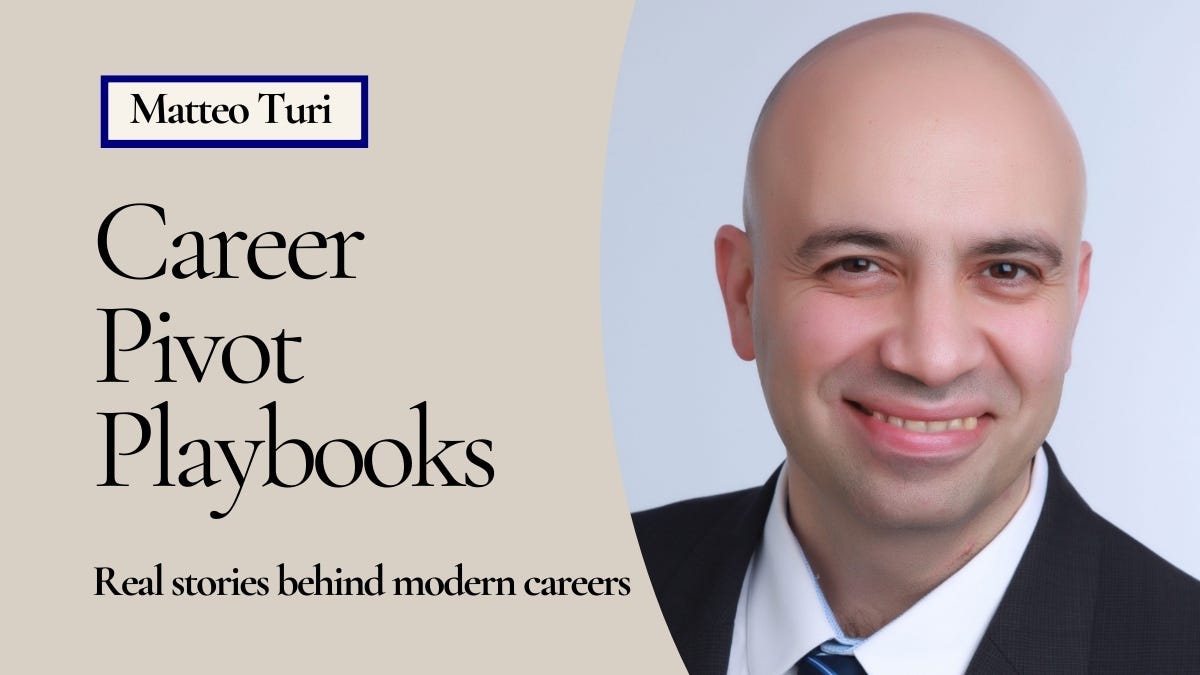
Matteo Turi is a writer and independent thinker focused on decision-making, incentives, and how systems behave over time. Through his work on Substack, he helps operators, builders, and founders think more clearly about risk, trade-offs, and long-term outcomes.
On Substack, Matteo publishes clear, structured writing that turns complex ideas into practical thinking tools. He works through problems in public, showing how small decisions compound and where hidden assumptions quietly lead people off course.
You can follow his work here →

Matteo has just written his book, “Fail, Pivot, Scale” for CFOs and Founders who want to be chased by customers, banks and investors (not the other way around).
Released on Amazon on the 1st March 2026.
How the World’s Smartest Founders Turn Setbacks into $100M Valuations
By Matteo Turi, ACCA - CFO, Investor, and Creator of the Exponential Blueprint
Matteo reflects:
“Can you share a bit about your professional background and the path that led you to where you are today?”
I’ve spent over 30 years in finance, but not in the neat, linear way people often imagine when they hear “CFO”.
My career started in accounting and financial control, then moved through CFO and board roles across blue-chip companies, startups, scale-ups, and turnaround situations. I’ve worked in sectors as varied as energy, biotech, SaaS, commodities, infrastructure, and cybersecurity. Some businesses grew fast. Some stalled. A few nearly collapsed. A couple exited well.
For a long time, my identity was tied to being inside businesses, fixing problems, raising capital, building structure, and dealing with risk. I was the person brought in when things got complicated.
What led me to where I am today wasn’t a dramatic resignation moment. It was a slow, uncomfortable realisation that I was sitting on a body of experience that only existed in boardrooms, while thousands of founders were repeating the same mistakes outside them.
“What sign, moment, or slow realization told you it was time to diversify… and what did you have to push through to actually act on it?”
The pivot wasn’t about leaving finance. It was about decoupling my value from a single role.
I noticed a pattern. Founders were obsessed with growth but confused about valuation. They were chasing revenue while unknowingly increasing risk. They talked about AI, exits, and investors but didn’t understand the structural mechanics that actually make a business investable.
The final push came after watching a profitable, multi-billion-dollar business fail, not because of market conditions, but because of poor cash-flow discipline and decision-making at the top.
That was my “enough” moment.
I realised I didn’t want to just solve problems quietly anymore. I wanted to document patterns, share frameworks, and help people avoid painful, expensive lessons.
“Which skills or experiences from your previous career unexpectedly became an advantage in what you do now?”
What surprised me most is how transferable CFO skills actually are.
Risk management. Capital allocation. Pattern recognition. Governance. Incentive design. Scenario thinking.
These aren’t just finance skills. They are decision-making skills.
The ability to zoom out, see second-order consequences, and say “this looks profitable but it’s structurally dangerous” turned out to be incredibly valuable outside traditional roles.
Writing, teaching, and building frameworks became a natural extension of how I already thought, just made visible.
“How did you decide where to build visibility or credibility (Substack or elsewhere), and what role does that platform play in your overall career or income mix?”
Substack wasn’t a “creator” decision. It was a thinking decision.
I wanted a place to write long-form, opinionated analysis without chasing algorithms or trends. A place where complexity was allowed. Where readers could sit with an idea rather than skim it.
That’s how Fail. Pivot. Scale. began, first as a newsletter, then as a book, and now as the foundation for my wider work.
Substack became the anchor. LinkedIn, podcasts, YouTube, and live sessions orbit around it. It’s not about going viral. It’s about building trust over time.
“Who is your work really for, and what problem do you solve so well that people are willing to pay for it?”
My work is for founders, CFOs, and operators who sense that something is missing in how they’re building, even if things look fine on the surface.
I solve one core problem, the gap between growth and valuation.
Most businesses don’t fail because they aren’t smart enough. They fail because they don’t understand the invisible mechanics that investors care about, such as defensibility, succession, optionality, and risk asymmetry.
I’ve distilled that into what I call the High Valuation Triangle.
Intellectual property and defensibility.
Succession and leadership depth.
Global relevance and scalability.
Once people see this, they can’t unsee it, and that’s where value is created.
“What turned out to be harder than you expected when you started… and what was easier than you imagined?”
What was harder than expected?
Putting my thinking out there.
When you’re used to private boardrooms, publishing publicly feels exposed. You lose control over how ideas land. You’re no longer the smartest person in a closed room.
What was easier than expected?
Finding my people.
The moment I stopped diluting my perspective to sound safe, the right audience leaned in. Not everyone, but the ones who mattered.
“How have you found the journey? What advice/ strategies and tips would you give to others wanting to grow their audiences?”
Substack rewards consistency, clarity, and honesty, not hacks.
My advice is simple. Write like you’re explaining something to one thoughtful person. Don’t optimise too early. Let your worldview repeat. That’s how people recognise you.
Growth came from depth, not frequency.
“What nearly made you quit, and what actually kept you going?”
There were moments I questioned everything, especially when monetisation lagged behind effort.
What kept me going was remembering why I started, to make invisible knowledge visible.
Every message from someone saying “this helped me rethink my business” mattered more than metrics.
“What advice would you give to someone considering a similar pivot or looking to monetize their skills in a more flexible way?”
Don’t pivot away from your experience. Pivot through it.
Your unfair advantage isn’t novelty. It’s pattern recognition built over time.
Start by documenting what you already know. Clarity follows action, not the other way around.
“What other platforms, audiences, or income streams are part of your portfolio career, and how do they work together?”
Today my work spans writing and education, advisory and CFO work, speaking, podcasts, workshops, and framework-based tools for founders and investors.
Each feeds the others. Nothing is isolated.
“Looking back, what’s one decision that changed everything, and what’s next for you?”
The single decision that changed everything was choosing to own my perspective instead of hiding behind roles.
What’s next is building deeper ecosystems where finance, AI, and valuation thinking intersect, and helping more businesses become magnets for capital rather than chasers of it.

Links & Resources
About The Exponential Blueprint
How the World’s Smartest Founders Turn Setbacks into $100M Valuations
By Matteo Turi, ACCA - CFO, Investor, and Creator of the Exponential Blueprint
Through gripping real-world case studies - from Apple and LEGO to Netflix and Amazon - and behind-the-scenes lessons from $480 million inlive transactions, Fail. Pivot. Scale. guides readers through a practical,proven framework to rebuild, reposition, and multiply value in any business.
At the heart of the book lies the High ValuationTriangle™ - a 3-part system used by world-class companies to engineerexponential growth:
Monetize Intellectual Property- Transform your know-how, brand, and processes into recurring revenue anddefensible valuation.
Build a Leadership Engine- Replace dependency on the founder with a scalable management team thatattracts capital.
Go Global- Expand your market footprint, pricing power, and investor reach beyondborders.
Each chapter translates decades of corporate finance andstrategy into language every founder can act on - whether they’re in startupchaos, post-crisis survival, or preparing for exit. With detailed playbooks, scorecards, and transformation stories, Matteo shows how to turn financial pressure into investor magnetism.
This is not a motivational book. It’s a wealth-creationmanual for founders who want to move from “invisible” to “investable” -using the same principles that built the world’s most valuable companies.
If you’ve failed before - good. You’re halfway there.
Released on Amazon on the 1st March 2026.
Related Articles
Formula 1 Doesn’t Sell Speed. Neither Should You.
From “Dead Company” to $9 Billion: The Asset Nobody Realised Was Worth a Fortune
Why most AI strategies will fail.
Read More
Behind the Pivot
Learn how to turn your current skills and experience into income and build a portfolio career beyond a single job, so you’re more resilient and in control.
The Career Pivot Archive
Real-world career pivots, portfolio paths, and practical lessons from some of your favourite Substackers you can apply to your own next move.
Career Questions Answered
Practical, strategic answers to the career questions ambitious professionals are asking as work, security, and opportunity continue to change.
I’m Katharine — a future-focused career strategist helping professionals build income options and stay relevant as work evolves.
🙏 I appreciate you being here and supporting this growing archive… and thank you to all the creators who contribute, it’s such a pleasure to learn from them.
❤️ Loved it? Restack 🔁 and share ✅
🤔Is there a question you wish had been asked?
Drop it in the comments, and let’s keep the conversation going.