


This Career Pivot Playbook features Mia Kiraki, the writer behind ROBOTS ATE MY HOMEWORK, a Substack about using AI and building AI systems without losing what makes you human.
Mia’s background is non-linear… but by design. She started in film, studied in London, and worked across visual and written projects. She later completed two master’s degrees, in Marketing and in Security and Diplomacy, then spent a decade in marketing while building an agency with her husband and building products from the ground up.
Unlike many pivots, she didn’t wait for a single turning point, and her presence on Substack evolved naturally. One project led to another. One skill opened the door to the next. The real shift came when she recognized that her restlessness was not a flaw. It was the engine behind her best work.
Today, she builds AI products, designs custom AI systems, and writes publicly about what she’s learning along the way. Her Substack began almost by accident as a simple outreach idea. It soon became the center of her work, connecting her writing, products, and consulting into one ecosystem where each part supports the others.
In this Playbook, Mia shares how a creative foundation, agency experience, and early AI adoption came together. It’s a practical, honest look at how steady experimentation and writing in public can shape a modern portfolio career.
✨About Career Pivot Playbooks
A public archive of modern career blueprints…
Most careers no longer follow a straight line.
People pivot gradually.
They extend their work beyond institutions.
They combine roles, platforms, and income streams.
Career Pivot Playbooks is a weekly series curated by Katharine Gallagher documenting how professionals build resilient, future-ready careers by turning existing skills into income, often combining Substack with consulting, teaching, research, creative work, or business ownership.
The focus isn’t outcomes.
It’s about how careers are shaped in practice.
About Mia Kiraki 🎭
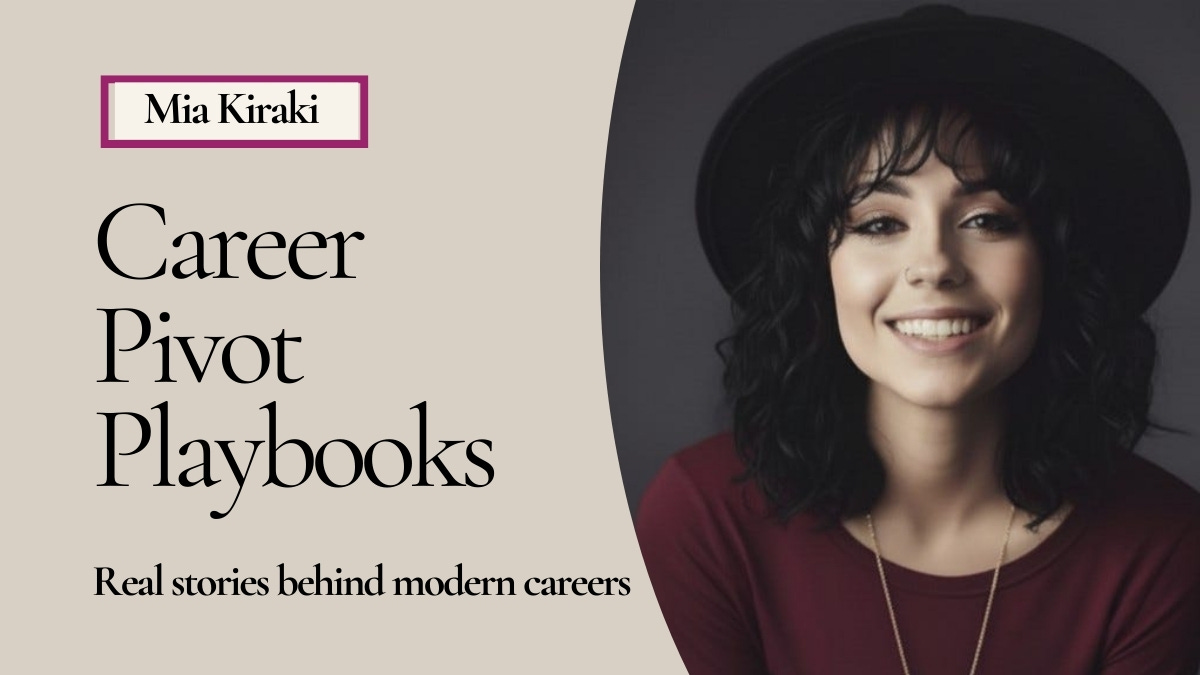
Mia Kiraki is the writer behind ROBOTS ATE MY HOMEWORK - a newsletter about using AI to think sharper and build smarter.
Mia builds AI products, designs custom AI systems, and helps founders figure out how to use AI well.
Her background is gloriously non-linear: film school in London, two masters degrees, a decade in marketing, and a content agency she built from scratch.
Now she’s focused on three things: sharpening thinking with AI, building better systems, and making sure your own taste still shows through.
You can follow her work here →
Mia reflects:
“Can you share a bit about your professional background and the path that led you to where you are today?”
I was always a writer and a creative kid - wrote my first (unpublished, obviously) novel at 10 and grew up in a family of artists and entrepreneurs, so the “do multiple things” gene was baked in early.
I studied Film in London, worked on all kinds of visual and written projects, and loved it. That creative foundation still shapes how I think about content today. Then life took me through two masters degrees (Marketing, then Security & Diplomacy), a decade in marketing - first at agencies, then building my own agency with my husband.
Now I run ROBOTS ATE MY HOMEWORK, build AI products, and help entrepreneurs and founders use AI to sharpen their thinking, build better systems, and make sure their own taste still shows through.
“What sign, moment, or slow realization told you it was time to diversify, and what did you have to push through to actually act on it?”
I’ve always diversified. I can’t sit still. Might be a flaw, a superpower, probably both. So there wasn’t one big moment. It just kept happening.
One project led to another, one skill opened a door to something new.
If anything, the challenge was learning to see that restlessness is a feature!
“Which skills or experiences from your previous career unexpectedly became an advantage in what you do now?”
Film, weirdly enough. Studying and working in film trained me to think in structure and narrative arcs, see how pieces fit together visually, coordinate lots of moving parts, and know what to cut. Turns out that’s exactly what building AI systems and workflows needs.
And empathy - which sounds soft but it isn’t. I build systems for how people think, not how things should work on paper. I can anticipate where someone’s going to get stuck before they do. This combo is probably my unfair advantage.
“How did you decide where to build visibility or credibility (Substack or elsewhere), and what role does that platform play in your overall career or income mix?”
Completely random. I never imagined wanting a newsletter, it was the last thing on my list.
But I needed to move beyond word-of-mouth for my products and services. I needed an outreach strategy for LinkedIn, a way to connect and network with people. And just cold-messaging strangers like “hey let’s exchange notes” felt stupid.
Then my husband said: why don’t you start a newsletter for one of our products and use it to reach out to people on LinkedIn as potential guests?
And I thought, yeah, why not.
I picked Substack because I’d been a casual reader for about a year and liked the vibe. Built the newsletter, but started broad, focusing on AI in general. And within a month, I completely dropped the idea of “this is a newsletter for my product” and just focused on the version of Substack that it is today ❤️
Now it’s its own thing. I don’t have a strict goal for it - I’m launching a paid tier soon, but I won’t gate content. Instead I’m building actual AI solutions and workflows people can use. It’s an experiment. Substack also drives a lot of visibility for my products and services.
“Who is your work really for, and what problem do you solve so well that people are willing to pay for it?”
I do two things that complement each other:
Products - I build SaaS tools like Yahini, which is a content operations platform for B2B blogs. Most tools force you to choose between strategy and workflow, but Yahini integrates both using AI that learns your brand. I built it because I needed it for my own work, and I still use it every single day. I’m also working on custom AI integrations (for both my work and my clients) and a LLM-optimization Shopify app. What I love about this is that I’m learning constantly. AI moves fast enough that I can build something, test it, and improve it the same week.
AI systems - I build custom AI systems with my partner at Chillital. We take a strategy-first approach, designing systems that fit how people actually think and work (and how their businesses operate), not the other way around.
Both are for the same type of person: people who are serious about their work but drowning in the execution. They know quality matters and they just need better infrastructure to make it happen without losing their minds (or their voice).
“What turned out to be harder than you expected when you started — and what was easier than you imagined?”
The building part came easy, like strategizing, messaging, positioning. Give me a product to figure out and I’m happy. Genuinely love that work!
What’s harder is putting the marketing into practice. Which is funny because I’ve been a marketer my whole career. But marketing yourself across multiple business models - an agency, products, newsletter, services - is a different beast.
Strategies overlap, tactics get confusing, you constantly have to shift mindsets.
And with AI moving so fast, you need both speed and resources or you fall behind. It’s a challenge to prioritize what’s worth doing first!
“How have you found the journey? What advice/ strategies and tips would you give to others wanting to grow their audiences?”
Really smooth, surprisingly. I’ve been on other platforms too like X or LinkedIn but the experience on Substack has been so much nicer than I expected. I’ve made actual friends here. We have real conversations. That part still kind of shocks me.
A few things I’ve learned:
Be intentional AND relaxed. Intentional so you’re not wasting time scrolling and posting into the void. But also human, make friends, help people, don’t treat it like a performance.
You won’t figure out your thing immediately. At 1k subscribers I still struggle with finding angles and topics sometimes. I do so many things and it’s hard to know what’s worth writing about. That’s okay. You figure it out by doing it, not by planning it.
Spend time on Notes but be approachable. Nobody wants to read AI-generated notes that look like templates. Speak to people. Ask questions, engage.
Don’t overthink the growth stuff. Write things you’d want to read. Talk to people you find interesting. The audience part follows.
And also, I really, strongly believe it’s a lot of good timing and luck! And I’m saying this because I’ve heard the advice above a million times, and a million times it didn’t work for me.
“What advice would you give to someone considering a similar pivot or looking to monetize their skills in a more flexible way?”
So my advice is a bit less about monetization tactics and more about clarity (and monetization ultimately follows). Figure out what you’re good at. Not what you can do - what you do better than most people. Then find where those people are, and who wants that thing.
And focus. Pick one place to show up consistently instead of spreading yourself thin everywhere. You can be a polymath with lots of skills and still have one clear thing you’re known for - I wrote a whole piece about this, about finding your “one thing” without sacrificing all the other parts of you →
Why complexity is your superpower (and 6 AI rituals to prove it)
“What other platforms, audiences, or income streams are part of your portfolio career… and how do they work together?”
It all feeds each other.
I’m on Substack, LinkedIn, and X - though Substack is where I spend most of my time now.
Income-wise, there’s the AI products and SaaS, consulting and AI systems work with my partner, and soon a paid tier on the newsletter.
The audiences overlap more than you’d think. My LinkedIn audience discovers my newsletter. Newsletter readers discover my products or my work. Consulting clients find me through the newsletter AND LinkedIn. The work I do with clients gives me ideas for products and content.
It’s less of a strategy and more of an ecosystem that kind of built itself.
“Looking back, what’s one decision that changed everything — and what’s next for you?”
I don’t have one dramatic moment. It’s been a series of small decisions that compounded: starting a content agency when everyone needed content and there weren’t enough good agencies around. Pivoting from agency work to building products. Saying yes to AI early. Starting the newsletter on a whim.
None of them felt like “the big decision” at the time.
As for what’s next - I’ve learned not to plan too far ahead in this space. Whatever I think the next two years look like, it’ll be completely different.
So I focus on building things I’m excited about now and staying adaptable. That’s the only strategy that makes sense to me.
Links & Resources
Connect with Mia…
Strategy-First AI Systems Agency
Related Articles
Why complexity is your superpower (and 6 AI rituals to prove it) — How to use 12th-century “Pattern Architecture” and 6 AI rituals to turn your scattered obsessions into a high-value empire.
Autocomplete is stealing your homework — How to rebuild your writing brain when AI keeps trying to finish your sentences for you.
Use AI to turn brain dumps into content ideas, Dumbledore-style — A (slightly creepy) workflow that lets you pour your thoughts into a document and have an AI tell you what to write next.
Reverse-engineer yourself before you train your AI — A “Neural Signature” protocol to code your authority into AI.
Read More
🧩Behind the Pivot
Learn how to turn your current skills and experience into income and build a portfolio career beyond a single job, so you’re more resilient and in control.
✨The Career Pivot Archive
Real-world career pivots, portfolio paths, and practical lessons from some of your favourite Substackers you can apply to your own next move.
I’m Katharine — a future-focused career strategist helping professionals build income options and stay relevant as work evolves.
🙏 I appreciate you being here and supporting this growing archive… and thank you to all the creators who contribute, it’s such a pleasure to learn from them.
❤️ Loved it? Restack 🔁 and share ✅
🤔Is there a question you wish had been asked?
Drop it in the comments, and let’s keep the conversation going.
I think a lot of us feel the same re Substack. It's the first place online I've felt at ease with!
Thank you, Mia, your insights are so inspiring. Showing us all what is possible when you 'say yes to AI' and are willing to keep learning throughout your career.