


This Career Pivot Playbook features Raghav Mehra, the writer behind Cash & Cache, a Substack for people working with AI who want to apply it in real workflows, not just read about it.
Raghav started in fintech as a high-frequency trader, building algorithmic strategies in financial markets. His work was technical, niche, and hard to explain outside the industry.
He built depth early… but depth alone started to feel narrow.
During his MBA, as AI began to move into the mainstream, he saw a gap. Not just in the technology itself, but in how people were learning, applying, and talking about it.
He didn’t come from an engineering background and he didn’t have a clear roadmap. But he started testing, documenting, and sharing what worked.
Cash & Cache came out of that shift. Not as a polished brand, but as a way to think in public and build something alongside his career.
In this Playbook, Raghav shares how he started expanding beyond a single role, why he chose to write before he felt ready, and how he is building something that doesn’t rely on one path.
✨About Career Pivot Playbooks
A public archive of modern career blueprints…
Most careers no longer follow a straight line.
People pivot gradually.
They extend their work beyond institutions.
They combine roles, platforms, and income streams.
Career Pivot Playbooks is a weekly series curated by Katharine Gallagher documenting how professionals build resilient, future-ready careers by turning existing skills into income, often combining Substack with consulting, teaching, research, creative work, or business ownership.
The focus isn’t outcomes.
It’s about how careers are shaped in practice.
About Raghav
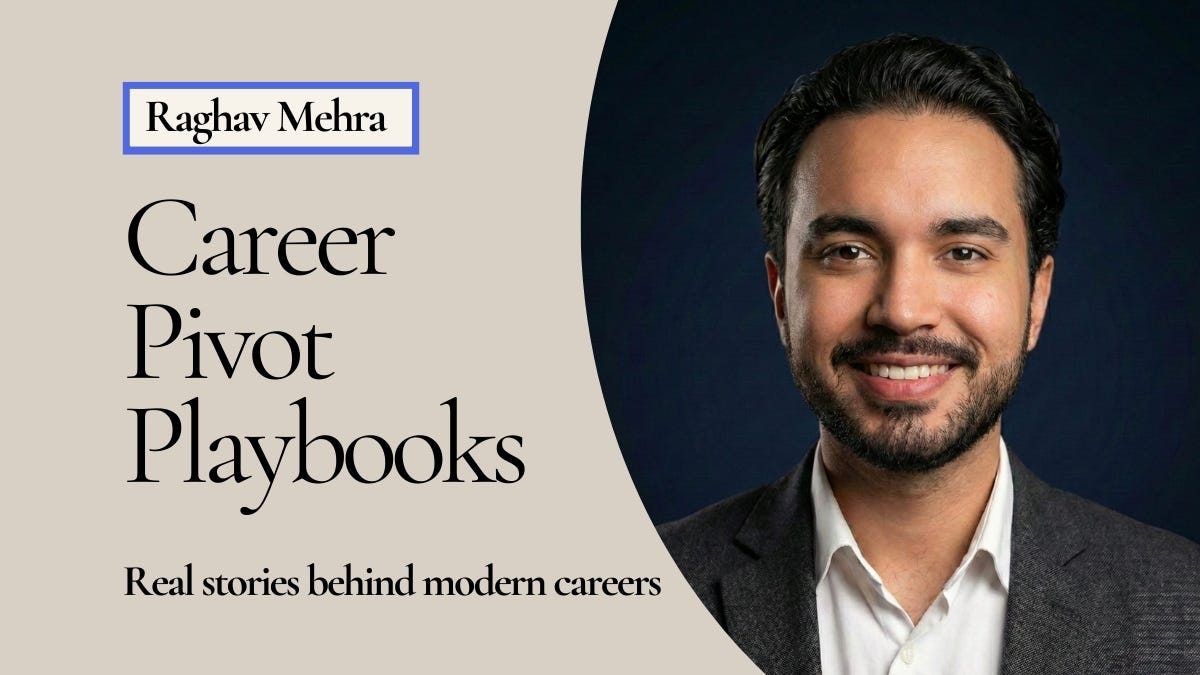
Raghav Mehra is the co-founder of Cash & Cache, a Substack newsletter covering practical AI implementation and research.
He comes from a background in quantitative algorithmic trading and holds an MBA from IE Business School.
He writes weekly alongside co-founder Ashwin Francis for an audience of AI practitioners, product managers, and anyone trying to understand what AI actually means for how we work.
You can follow his work here →

Raghav reflects:
“Can you share a bit about your professional background and the path that led you to where you are today?”
I come from a finance background — more specifically, a fintech finance background. I worked as a high-frequency equity trader for companies in the Indian financial markets. My background has been largely on the finance side, in fintech companies, creating algorithmic strategies and deploying them in financial markets. Basically, using algorithms to make money for my company. I got into this field because of my education in economics and finance.
One thing has always led to another in my life. I started out with economics, took a great interest in financial markets, and got the opportunity to be a trader. I’ve also been a CFA student — I cleared Level 1 and didn’t really get time to do Level 2 because I was working. And then I did my MBA as well, quite recently.
It was during my MBA that I realized I really liked another side of things — strategy, talking things through, working with people, managing strategies. I was also very fascinated by tech, which came from my fintech background. I graduated right when AI was breaking out. I joined business school just when ChatGPT had launched, and I realized this was going to disrupt a lot of spaces. There was an opportunity to fill the gap that still existed in terms of AI integration and learning.
I should also mention — I don’t come from a tech background. My job as a financial markets trader required me to adapt to some tech stacks and operational methodologies, so I learned basic programming like Python on the job. I don’t have a hardcore engineering background.
AI offered me a way to level up. I wouldn’t say match up to an engineer’s expertise — I still think engineers have a prominent role and can’t be fully substituted — but it was a great leveler. I was fascinated by tech but the steep learning curve made it difficult without an academic background. This is where I took a real interest in what AI could do, and how I got into working with AI, documenting workflows. And then I thought — there’s this platform called Substack where you can not just share, but write your thoughts, connect with other people, learn from other people. And here I am.
“What sign, moment, or slow realization told you it was time to diversify, and what did you have to push through to actually act on it?”
I come from finance, so I know enough about the importance of diversification — you cannot put all your eggs in one basket. I realized with my old professional job that my role was too niche. Being a quantitative trader in equity derivatives — most people who asked me what I do didn’t even understand what that meant before I explained it. So I guess you have to build an identity that is not tied to your job, one that is inseparable from you.
Additionally, the external environment forces you to diversify. The job market can be really cruel and you have to prepare for bad weather. Diversification gives you more options at your disposal. But I’d also add — diversification is an ongoing process, at least for me. We are all trying to optimize for having the right mix.
“Which skills or experiences from your previous career unexpectedly became an advantage in what you do now?”
Adaptability is the key skill. If you can adapt to different cultures, methodologies, and philosophies, you can really position that as a competitive advantage. It’s also field-specific — if you’re in finance, you should understand not just financial concepts and principles, but also how to match them to outcomes and how to build an investment or trading thesis. So it’s a mix of field-specific expertise and a general openness to trying out new things.
“How did you decide where to build visibility or credibility (Substack or elsewhere), and what role does that platform play in your overall career or income mix?”
Visibility and credibility only come with time, so you need a lot of patience. There was no real framework for deciding how to use this platform. It was when my friend from undergraduate studies in economics, Ashwin, and I were having a chat, discussing this new and upcoming platform called Substack. We’d both been enthusiastic about AI and how it’s changing the world, and we both came from fintech backgrounds. So we thought, while we’re doing our day-to-day jobs, why not start a newsletter where we document our experiences and dig deeper into this space?
We thought — why not use this to improve our skill set and expertise? That’s how the visibility and credibility thing began. We started documenting and learned every day about what the platform was about, what kind of audience it caters to, and how to grow alongside other writers.
Substack is our bread and butter on this side of things. We both have been doing full-time jobs at different points. I was fresh off graduate studies, Ashwin was working as well. Right now it’s a small part of my income stream — we just enabled the paid tier. Hopefully we can grow further. Even if it’s small, I really enjoy being on the platform.
“Who is your work really for, and what problem do you solve so well that people are willing to pay for it?”
Cash & Cache is primarily for AI product managers and practitioners — anyone who’s working with AI, building with AI, or filling the gaps in their own skill set or organizational architecture using AI. It’s also for people who want to learn more about AI and understand things that aren’t really highlighted out there.
We operate on two levers — the “Cash” lever and the “Cache” lever. That’s why it’s called Cash & Cache. We cover AI research and how anyone can implement AI well for their own workflow. The main problem we solve: people who have difficulty understanding AI for whatever reason, or who want to know how to adapt AI in any meaningful way. Our newsletter focuses on building that practical understanding.
“What turned out to be harder than you expected when you started — and what was easier than you imagined?”
When we started, we had very little idea about blogging or content creation — our backgrounds were completely different before Substack. Getting to know the platform took time, but the bigger challenge was discovering our niche. At first we were talking about AI applications everywhere — FinTech, underserved industries, you name it. It seems specific and broad at the same time, because you want to cover areas that aren’t highlighted, but you also spread yourself thin.
It got easier as we built in public and started getting feedback. After the first few months, we began understanding what connected with our audience — what our first hundred subscribers responded to versus what felt generic or like things that were already everywhere.
The real realization was that it’s not just about finding a niche, it’s finding your take on something. Making it personal. Not being afraid of leaving some rough edges, because what I’ve realized is that people really value a personal connection in writing. That’s something we’re still working on. Nothing is perfect, and nothing ever will be.
“How have you found the journey? What advice/strategies and tips would you give to others wanting to grow their audiences?”
It’s been wonderful, honestly. It’s opened up our world. Substack introduced us to a microcosm of people who share interests, but with one thing that’s very different — people here love to cheer you on. It’s a breath of fresh air when you’re surrounded by social media apps that do just the opposite. In my MBA I learned this term — “enshittification” — the internet has been enshittified, and I really hope that doesn’t happen with Substack.
The best part of this journey has been the people. There are colleagues I’ve never physically met who are better than some of the people I’ve met in my professional career so far.
For advice: first, don’t be scared to hit publish. Don’t overthink it, don’t be scared of taking risks — that comes from my trading background too. Put yourself out there. Try to understand the platform, the audience, the landscape. But also be tactical — understand what’s missing in your space. If you’re writing about business, don’t write about what every other creator around you is already writing. Be different, be yourself. And be nice. Substack rewards genuine interaction, and honestly, being nice is a habit you can build here and carry into the rest of your life.
“What nearly made you quit, and what actually kept you going?”
Nothing on Substack has made me want to quit. In my trading career, that was a different story — it’s an extremely high-pressure environment, and the pressure really gets to you over time. But leaving that wasn’t quitting — I moved from a purely technical role to a more management-oriented one. You can quit a job without quitting your career.
On Substack — I check my dashboard more times than I’d like to admit. I think most creators do, whatever they say publicly. Some days the metrics move slowly and you have to remind yourself that vanity numbers aren’t the goal. Free subscriber counts are just a means to an end. The goal is the process, and believing that if you keep showing up and building something genuinely useful, the results will follow at some point.
“What advice would you give to someone considering a similar pivot or looking to monetize their skills in a more flexible way?”
Two things you have to identify. First, identify what you’re good at. Second, out of those things, figure out what the market actually values — what commands a premium. Your sweet spot is where those two overlap, and you also need to love what you do. When skill, demand, and genuine interest align, monetizing opportunities open up naturally.
For career pivots specifically: when you’re moving from field A to field B, find the overlapping skill sets and amplify that overlap. There will be skills you already have and skills you’ll need to develop. Focus on the ones that command a premium in the market. Keep yourself always learning, and build on what you’ve already done rather than trying to change everything completely.
“What other platforms, audiences, or income streams are part of your portfolio career… and how do they work together?”
Honestly, I’m not as well diversified as it might seem. Substack is one platform — our publication, our product. A regular job is another — the backbone of my income. And I have a long-term investment portfolio I manage myself: a set of companies I believe in, compounding over time through capital gains and dividends. Nothing I’m actively trading day-to-day.
Not a big career portfolio yet. Regular income, Substack which I want to grow, and passive investments. I’m still at an early point in my career — I’m not a 40 or 50-year-old who has everything sorted. That’s just it.
“Looking back, what’s one decision that changed everything… and what’s next for you?”
Moving to Spain for my MBA was the decision that changed everything. I’ve been away from home since I was 18, moved between cities in India, but relocating from India to Spain was a different kind of shift entirely. It wasn’t a smooth transition. But I like to embrace things as they come — different cultures, different opinions, different ways of doing things. I think it genuinely enriches your personality in ways that staying in one environment simply can’t.
Starting Cash & Cache last year was the other big one. Doing something on my own, in public, with real stakes.
What’s next: I want to work for myself. A diversified professional life where I’m not dependent on a single income source or employer — where I can travel, build things I believe in, and love what I do day to day. That might mean a proper business at some point. It will definitely still include Substack. The through-line is the same principle that’s guided everything else: diversify, stay adaptable, keep building.

Links & Resources
Connect with Raghav→
On LinkedIn
Related Articles
I recently launched a new product tool that helps you evaluate any new shiny tool in the market with competitive research and how well it fits into your workflow so that you can adopt the tools that actually matter to you.
I documented everything on how I started building this here:
Anthropic Ships 11 Plugins. I Needed a 12th.
Read More
Behind the Pivot
Learn how to turn your current skills and experience into income and build a portfolio career beyond a single job, so you’re more resilient and in control.
The Career Pivot Archive
Real-world career pivots, portfolio paths, and practical lessons from some of your favourite Substackers you can apply to your own next move.
Career Questions Answered
Practical, strategic answers to the career questions ambitious professionals are asking as work, security, and opportunity continue to change.
I’m Katharine — a future-focused career strategist helping professionals build income options and stay relevant as work evolves.
🙏 I appreciate you being here and supporting this growing archive… and thank you to all the creators who contribute, it’s such a pleasure to learn from them.
❤️ Loved it? Restack 🔁 and share ✅
🤔Is there a question you wish had been asked?
Drop it in the comments, and let’s keep the conversation going.
Thanks Jess, yes I love how Raghav and his partner Ashwin are approaching their careers.
Thank you Katharine for giving me this opportunity to share my career story so far. Glad to address any comments that the readers might have! :)