


This Career Pivot Playbook features Rob Riker, the writer behind The Creator’s Edge, where he helps Substack creators improve their positioning, build real relationships, and turn their audience into income.
Rob didn’t start as a creator. He built his career in finance and construction management, working on high-value projects while figuring out business on the side.
But that pull toward entrepreneurship he had deep down never left.
So he started building the foundations of an online business. Writing, posting, launching, and growing whilst steadily improving the skills that would drive real results.
The real gear shift happened when he changed how he showed up online, invested in the right support, and focused on a specific problem he understood deeply.
Inside this interview, Rob breaks down the moments that forced him to rethink his approach, what finally started working, and how he turned those early wins into a full-time business.
He gets into what most creators get wrong about growth, why positioning matters more than content, and how small changes can unlock outsized results.
If you are building on Substack and feel stuck between effort and traction, this one will give you a clearer path forward.
✨About Career Pivot Playbooks
A public archive of modern career blueprints…
Most careers no longer follow a straight line.
People pivot gradually.
They extend their work beyond institutions.
They combine roles, platforms, and income streams.
Career Pivot Playbooks is a weekly series curated by Katharine Gallagher documenting how professionals build resilient, future-ready careers by turning existing skills into income, often combining Substack with consulting, teaching, research, creative work, or business ownership.
The focus isn’t outcomes.
It’s about how careers are shaped in practice.
About Rob
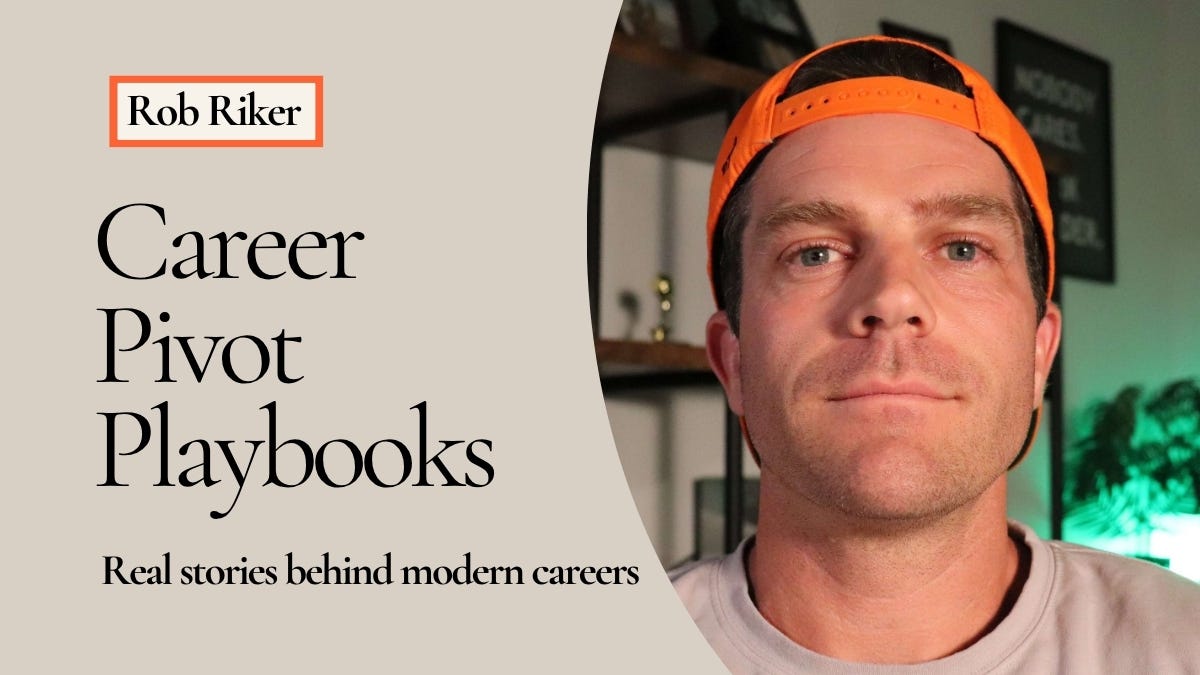
Rob Riker helps Substack creators become the kind of person other creators want to know.
He built a 34,000-person audience on Twitter and a six-figure coaching business by focusing on positioning, relationships, and clear offers.
Today, he teaches Substack creators how to stand out, attract the right people, and turn their audience into paying clients.
His work has been featured in Business Insider, Lifehack, and Tiny Buddha.
You can follow his work here →

Rob reflects:
“Can you share a bit about your professional background and the path that led you to where you are today?”
I graduated in 2009 with a finance degree and went straight into portfolio management, managing over a hundred million dollars in commodity ETFs. After two years I moved to an engineering firm where I spent the next decade doing construction management and project controls on about half a billion dollars worth of work.
But ever since reading Rich Dad Poor Dad in high school, I had this desire for entrepreneurship that never went away. So in 2015, I bought a course on building an online business and chose social skills as my niche because I’d spent years overcoming my own struggles with it, and finally built the social life I wanted. I spent five years building an email list, writing guest posts, trying to sell courses. I worked hard, but the money was minimal.
In 2018, I got on Twitter. For two years I struggled with the same thing a lot of creators struggle with: putting in the work and not seeing it pay off. Then in 2020, a friend helped me see what I was doing wrong. I changed how I was showing up, and my audience actually started to grow.
Around the same time, I hired a coach who helped me create a high-ticket social skills coaching program. Eight weeks later, I’d made nearly $10,000. Then friends started asking how I was selling coaching so well and offered to pay me to help them. That became a business helping coaches build coaching businesses. It got me well past six figures, and in 2022 I was able to leave my 9-to-5 and go full-time.
In 2025, I found Substack and knew it was where I wanted to build next. I brought my relationship-building and positioning expertise to the platform, and now I help Substack creators stand out, build real relationships, and position themselves as someone people actually want to follow and connect with. My product, The Magnetic Substacker, is the system I built around everything I’ve learned.
“What sign, moment, or slow realization told you it was time to diversify, and what did you have to push through to actually act on it?”
Two moments that built on each other.
Before I ever bought a course, I tried selling rap beats online. I built a website, figured out the tech, put them up, and then realized I had absolutely no idea how to actually sell anything. That was the first moment where I thought, “This is never going to work unless I learn how to do this for real.” That led me to buying Ramit Sethi’s Zero to Launch course in 2015.
The second was after putting 5 years of real effort into Ramit’s course. It gave me a strong foundation of online skills, but the money still wasn’t there. And I had this moment where I realized if I just kept doing what I’d been doing, nothing was going to change. So I invested $4,000 in my first coach, and that’s when everything finally started moving.
The common thread is recognizing when you’ve hit the ceiling of what you can figure out alone. I don’t think courses or coaches are magic pills, it needs to be the right thing at the right time. But, for me, the right ones compressed years of trial and error into weeks.
“Which skills or experiences from your previous career unexpectedly became an advantage in what you do now?”
1 — The people skills I taught myself. I spent years studying what makes people connect, out of genuine need because I struggled with it. But once I started applying those skills to my business, everything changed. Understanding how people think, what makes them trust you, what makes them want to connect, that’s the foundation of everything I do now.
2 — My analytical brain. A decade of portfolio management and project controls taught me how to read data and find patterns. That’s become a huge advantage as a creator. It helps me figure out what’s actually working versus what just feels like it’s working, and it’s helped me pivot when I emotionally didn’t want to.
“How did you decide where to build visibility or credibility (Substack or elsewhere), and what role does that platform play in your overall career or income mix?”
I’ve always chosen platforms based on where I genuinely enjoy spending time. I started writing on Twitter in 2018, and it worked because I actually loved being there. I tried Instagram and it never stuck because I just don’t enjoy using it. Early on, you need to be social on social media. If you don’t even want to open the app, you’re fighting an uphill battle.
In September 2025, I found Substack. It’s kind of what Twitter used to be, but more positive and more focused on actual ideas. The way notes connect to the blog, and how the blog connects to the email list, the whole ecosystem is really special. And the culture is incredibly positive.
My main audiences are on Twitter (34,000 followers), Substack (around 1,500 followers), and my email list (around 1,100 subscribers).
“Who is your work really for, and what problem do you solve so well that people are willing to pay for it?”
Smaller Substack creators who have some traction but are struggling to make the next leap. They’re typically at 100 to 300 subscribers. They’ve got some engagement going, but they’re gaining maybe 5 to 10 subscribers a month, and the bigger creators they want to connect with aren’t really connecting back.
The problem I solve is positioning. I help them position themselves as someone people want to follow, connect with, and even pay for help. When that positioning is dialled in, everything else starts working better. The Magnetic Substacker is the product I built around this.
“What turned out to be harder than you expected when you started — and what was easier than you imagined?”
The hardest thing was finding where my audience hangs out and getting my message in front of them. With social skills content, there was no obvious place where those people were gathered. Finding product-market-platform fit can be difficult.
What surprised me was how much easier it was to sell high-ticket offers than I expected. I spent months building courses and writing launch sequences, and I’d make a few hundred dollars. Then I launched high-ticket coaching (with way less effort) to roughly the same size audience and made nearly $10,000 in the first few weeks. Same number of people, wildly different revenue. Selling something expensive isn’t necessarily harder. It just has to be the right offer for the right person.
“How have you found the journey? What advice/strategies and tips would you give to others wanting to grow their audiences?”
I’m having an absolute blast. The connections I’m making on Substack are unlike anything I’ve experienced on other platforms. Real conversations, real friendships, not just surface-level engagement.
My biggest tip is something most people overlook: your bio and profile matter way more than you think. I changed my bio and my subscriber growth more than 12X’d. Same content, same engagement, just a clearer message about who I am and who I help. If your profile sends any subtle signal that tells someone, “You’re not for me,” they won’t subscribe, and your growth is going to be painfully slow. Getting that right is more valuable than almost anything else you can do.
“What nearly made you quit, and what actually kept you going?”
Those first five years when progress was painfully slow. I’d spend months building a product, then another month on launch logistics, and then make a few sales. It was brutal.
What kept me going was this deep desire to help people. And I’ll be honest, I also wanted financial freedom and the flexibility to live the way I want.
But helping people really lights me up. When I was doing social skills content, I had a post go viral on Reddit and hundreds of people responded saying how helpful it was. That filled me so deeply.
Even now, it feels amazing when someone overcomes that frustration of grinding and not making progress. You can see the emotion in their eyes, hear it in their voice, and read it in their words. Those moments kept me going in the beginning, and they keep me going today.
“What advice would you give to someone considering a similar pivot or looking to monetize their skills in a more flexible way?”
Get really specific about the problem you’re going to solve.
A lot of people take a skill set and try to sell it broadly. They think, “I struggled with my goals and then I hit some of them, so now I’ll help people with their goals.” I’ve tried that. It doesn’t work well.
What does work is getting specific about one small, concrete problem.
My latest product is a great example. I built it because Substack creators are frustrated with putting in effort and having slow growth. And I solved that by helping them create a profile and positioning that makes them look attractive, competent, and worth connecting with. That specific problem to specific solution is way more powerful than trying to sell some big transformation.
You just need to solve a real problem that you’ve actually solved for yourself. That’s what gives you the credibility to charge for it.
“What other platforms, audiences, or income streams are part of your portfolio career… and how do they work together?”
My main audiences are on Twitter (34,000 followers), Substack (around 1,500 followers), and my email list (around 1,100 subscribers).
“Looking back, what’s one decision that changed everything… and what’s next for you?”
Betting on myself. And it’s not a one-time decision. I bet on myself when I bought that first course in 2015. I bet on myself every time I hit publish. I bet on myself every time I invest in a coach.
What’s next is helping more people succeed on Substack. More people every year are entering the creator space, and the opportunity is real, but it’s harder than a lot of people make it sound. The creators I help most often have some traction but haven’t cracked consistent growth yet. I help them grow faster, position themselves correctly, and start making real sales. That’s exactly what I’m continuing to build.

Links & Resources
Connect with Rob…
Website: robriker.com
Product: The Magnetic Substacker
Related Articles
Why People Check You Out... But Don't Subscribe
Why You’re Still Invisible on Substack
Read More
Behind the Pivot
Learn how to turn your current skills and experience into income and build a portfolio career beyond a single job, so you’re more resilient and in control.
The Career Pivot Archive
Real-world career pivots, portfolio paths, and practical lessons from some of your favourite Substackers you can apply to your own next move.
Career Questions Answered
Practical, strategic answers to the career questions ambitious professionals are asking as work, security, and opportunity continue to change.
I’m Katharine — a future-focused career strategist helping professionals build income options and stay relevant as work evolves.
🙏 I appreciate you being here and supporting this growing archive… and thank you to all the creators who contribute, it’s such a pleasure to learn from them.
❤️ Loved it? Restack 🔁 and share ✅
🤔Is there a question you wish had been asked?
Drop it in the comments, and let’s keep the conversation going.