

Timo Mason: Helping Founders Grow on Substack and Turn Audiences into Scalable Income Systems✨The Career Pivot Playbooks Series
Timo Mason: Building repeatable systems for Substack growth and helping founders turn engaged audiences into scalable income.


This Career Pivot Playbook features Timo Mason, an online builder and writer focused on Substack growth and audience-led income.
Before coming to Substack, Timo gathered over 15 million views on X, built 45+ digital products, and made over 8,000 sales… largely by testing ideas in public and refining what worked.
His Substack is Write Your Way to Wealth is where he now shares his experiments, observations, and practical lessons on growing an audience and turning writing into sustainable income.
Timo’s path didn’t begin with a clear plan. It developed through early experiments with online business, trading, and public writing… learning what worked by testing ideas in real time and adjusting when they didn’t.
That habit of experimentation would later shape how he approached platforms and growth.
Rather than relying on social reach alone, Timo shifted toward ownership. Substack became the place to build something more durable—where writing compounds, readers opt in, and systems matter more than algorithms.
This Playbook explores how steady experimentation, audience ownership, and repeatable processes can form the foundation of an independent, sustainable way of working.
About Career Pivot Playbooks
A public archive of modern career blueprints…
Most careers no longer follow a straight line.
People pivot gradually.
They extend their work beyond institutions.
They combine roles, platforms, and income streams.
Career Pivot Playbooks is a weekly series documenting how professionals are building resilient, future-ready careers, with professionals often using Substack alongside research, consulting, teaching, creative work, or operating businesses.
The focus isn’t outcomes.
It’s about how careers are shaped in practice.
About Timo🤠

Timo Mason is an online builder and writer whose work centers on Substack growth, audience ownership, and turning writing into income. Drawing on years of hands-on experimentation across platforms and products, he helps founders build repeatable systems that compound over time.
On Substack, Timo writes Write Your Way to Wealth, a publication focused on growing an audience through writing and translating that attention into sustainable, audience-led income—sharing what he’s testing, what’s working, and what he’s learning along the way.
You can follow his work here →

Timo reflects:
“Can you share a bit about your professional background and the path that led you to where you are today?”
I’m not sure where to start, and I think “professional background” is actually the wrong wording here, but I’ll just give you my background. :)
My whole business journey started when I was around 18 and finishing high school. I had this thought in my head that it would be cool to do a business, just as a cool thing. So I asked people in my environment, and even though I had a lot of friends, there was only one guy I knew who actually did business. I asked him which business model I should start with. He said all of them work, but he was doing e-commerce, so I started my first e-commerce store.
It completely failed, not because of the business model, but because my mindset at 18 was very wrong. I was only doing the business to make money, not because I enjoyed it. After a few months of no results, I gave up and decided to switch business models.
After that, I got into trading for about a year, and that was something I actually enjoyed. While trading, I built my own systems, especially a trading journal for myself. I thought it would be valuable to share this with others, so alongside trading, I started building a personal brand to market this trading journal system. That’s how I built a German personal brand.
At some point, I realized I didn’t want to be limited to the German market. I wanted to build an English personal brand and do this worldwide. The trading journal system was a Notion template, and that’s how the personal brand you see now, Timo Mason, came into existence. The original idea was to market this trading journal system, which actually never ended up becoming a product.
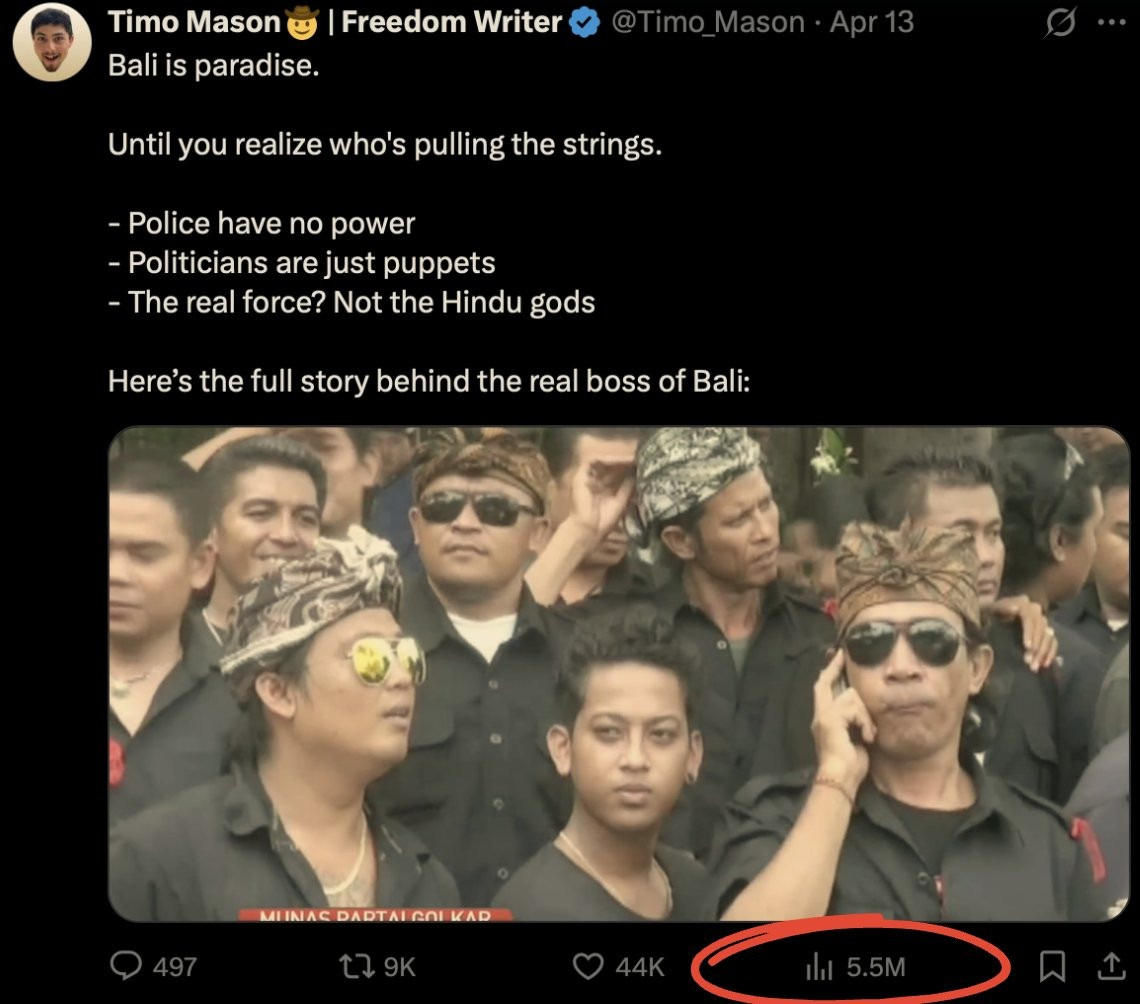
After that, I started marketing other types of systems on Twitter. The first big one was Twitter HQ, which is a Notion content management system for Twitter. That went really well. I had a lot of success on Twitter, reached over 14 million views in total, and had one viral post with around 5.7 million views where I shared a story about Bali.
Eventually, I pivoted from Twitter to Substack because I saw much more potential there. What you build on Substack has a better foundation. Instead of followers that don’t really give you anything, you get email subscribers, which is your actual audience. Even if Substack went down, you’d still own that audience.
“What sign, moment, or slow realisation told you it was time to diversify — and what did you have to push through to actually act on it?”
I slowly understood more and more how the algorithm works and how new social media works, especially on Twitter. People can follow you and see you, but that doesn’t really mean much anymore because the algorithm doesn’t care how many followers you have. Even though I had over 4,000 followers on Twitter, most of them didn’t see a lot of my content because they were on the For You page, not the Following page. That’s just how new social media works now.
What I always knew I could count on was my email list. So naturally, I used Twitter content to get people from Twitter onto my email list. That worked well, but it’s not the same type of conversion you get from Substack. Substack is optimized for email subscribers, not for followers, so the conversion from a Substack visitor to an email subscriber is way better and much smoother.
On Twitter, most of the time I got email subscribers through giveaways. The whole customer journey was pretty long. People would see my giveaway, comment that they want the free thing I promised, then I’d send them a DM with a link to a landing page. On that landing page, they’d enter their email, confirm it, and then finally get the free thing in another email.
On Substack, it’s way simpler. People see something from me, and they just hit subscribe.
“Which skills or experiences from your previous career unexpectedly became an advantage in what you do now?”
The first thing that comes to my mind, I wouldn’t really call it a skill. I’d see it more as a mindset development. I’m not afraid of failure, and failure doesn’t demotivate me or pull me down when I don’t see results. I’m just used to it.
I’ve tried so many things. I’ve built over 45 digital products, published tons of tweets that didn’t get any views, written threads that took hours of work and didn’t get any traction, and created email launch sequences that didn’t bring in any money. I’ve done so much work in the past without getting results that I basically trained my mindset to not expect anything. I just do the work because I like doing the work.
Because of that, my mindset is kind of hardened in a good way. When something isn’t working, I don’t take it personally. I just accept it and maneuver around until something works. That mindset helps me a lot.
On the skill side, Twitter taught me how to write, how to tell stories, and how to catch people’s attention. That transfers directly to what I do now on Substack. I don’t have to learn how to write from scratch. The formats are different, and attention works a bit differently, but the core skill of getting attention is the same. What I learned on Twitter, I can basically duplicate on Substack, and I mean it works really well, im growing around 15 subscriber per week, minimum right now.
“How did you decide where to build visibility or credibility (Substack or elsewhere), and what role does that platform play in your overall career or income mix?”
I already touched on this a bit earlier, but how it plays into the whole business side is that I usually go onto a platform first and then figure the platform out. I look at how it works, how growth works, growth hacks if you want to call it that, and how to maximize growth.
That’s what I did with Twitter. I started on Twitter, figured out how to grow there, and then built a business around Twitter growth and how to grow on Twitter in the fastest and best way. Now I’m doing the same thing with Substack. I’m figuring out Substack growth and then turning that into a business and monetizing it.
For example, I have Article Architect, which is an AI tool to create AI-powered articles, including the outline and the article itself. I’m also working on a lot of other solutions to help people grow on Substack. That’s how the platform itself influences my business.
In terms of income mix, I’m able to do this full-time while traveling through Southeast Asia, which is pretty nice.
“Who is your work really for — and what problem do you solve so well that people are willing to pay for it?”
My work is for people who are stuck in the 9-to-5 hell and want to build a Substack business they can turn into their full income, so they can live a laptop lifestyle and have freedom.
What I focus on is very simple. I help people grow on Substack and then show them how to turn that growth and that audience into customers who are willing to pay for the things they offer.
“What turned out to be harder than you expected when you started — and what was easier than you imagined?”
What was way easier than I expected was connecting with people. Substack is much more social than Twitter and leads to much more real conversations. It was surprisingly easy to connect even with successful people. On Twitter, if you don’t have a lot of followers, you usually get ignored. On Substack, even when I was new, people talked with me, including bigger creators. Networking was just way easier.
What was harder than I expected was adapting to the content format, mainly writing articles. I didn’t have my own article writing style, and in the beginning I really hadn’t figured out how to write articles at all. I was basically clueless. It took a lot of brainpower. I had to put a lot of thought into figuring out how to make the article format work for me.
Now I have it figured out. I have an AI-powered workflow, I’m confident with it, and I even productized it with Article Architect.
“How have you found the journey and what advice would you give to others wanting to grow their audiences?”
The journey itself has been pretty solid. In the beginning, I had slow but consistent growth, and I was happy with that. Over the last months, the more I figured out my system, the faster the growth became, and it even stayed consistent. Overall, it’s been very solid.
The practical advice I’d give to others who want the same results is to not figure everything out from scratch. You still have to make it your own, but you should always look at how other people are doing things. If you’re thinking about how to structure your Substack website, don’t start from zero and just ideate on your own. Look at people who are already doing it successfully and then build your own version.
The same applies to your About page and even to internal processes like how you write articles. There are already a lot of articles about how to write articles. For example, my article about how I write articles. You can take an existing workflow, try it out, and then adapt it to your own needs.
“What nearly made you quit, and what actually kept you going?”
I’d love to give you a really fascinating or dramatic story about a moment where I nearly quit, but I don’t have one. I don’t really think about quitting. Building my own online business is the only thing I want to do and the only thing I can imagine doing long-term.
So for me, there isn’t a thought of quitting, only of adjusting when something isn’t working. Quitting isn’t really an option because there’s no alternative I’d be satisfied with.
“What advice would you give to someone considering a similar pivot or looking to monetize their skills in a more flexible way?”
The actionable advice I’d give, and I want to keep this really practical, is to save up some money and then go to Southeast Asia and figure things out from here. It’s cheaper to live here than in the West, and you’ll find a lot of other people who are building online businesses. That gives you a strong support system and a real sense of community. On top of that, you’re around happy people and nice weather, which honestly helps a lot. If that’s an option for you, I definitely recommend it.
Besides that, when it comes to monetizing your skills in a flexible way, I’d say it’s important to be intentional about how you build and scale your business. There are things that aren’t scalable, like your time. You only have so much of it. Your energy also isn’t scalable. What is scalable is your audience. The bigger your audience, the more reach you have without having to spend more time, like writing more articles.
So be intentional about that. That’s advice I’d give even if you don’t have the freedom or ability to move across the world.
“What other platforms, audiences, or income streams are part of your portfolio career — and how do they work together?”
None, besides that I feed and manage my email list also over ConvertKit mails and Substack is my discovery engine.
“Looking back, what’s one decision that changed everything — and what’s next for you?”
The one decision that really changed everything was booking a one-way ticket to Bali and leaving everything behind with just a backpack. That was the real start. That’s when I began building my English personal brand, and from there everything else followed.
I stayed in Bali for about ten months and used that time to explore and figure things out. Right now I’m in Thailand, and location-wise I’ll see where I go next.
Business-wise, the focus is clear. I’m doubling down on Substack, on Substack growth, growing as fast as possible, and building products that help other people do the same.

Links & Resources
✍Ultimate Social Writing Bundle
Related Articles
Here are examples of Timo’s work:
How One Post Got Me 5,000 New Readers In A Day
Dear Writer, You Sound Like a Bot
Read More
The Career Pivot Archive
Real-world career pivots, portfolio paths, and lessons you can apply to your own next move.
I appreciate you being here and supporting this growing archive.
❤️ Loved it? Restack 🔁 and share ✅
I work as a future-focused career advisor, helping professionals adapt and grow in real time. If this resonates, explore my Substack here →
Katharine from Learn Grow Monetize
Subscribe to the Free Plan and Receive your gift: “Your Skill-to-Income Discovery Tool.”
Is there a question you wish had been asked?
Drop it in the comments, and let’s keep the conversation going.
 | A guest post by
|
Wow, what a journey!