


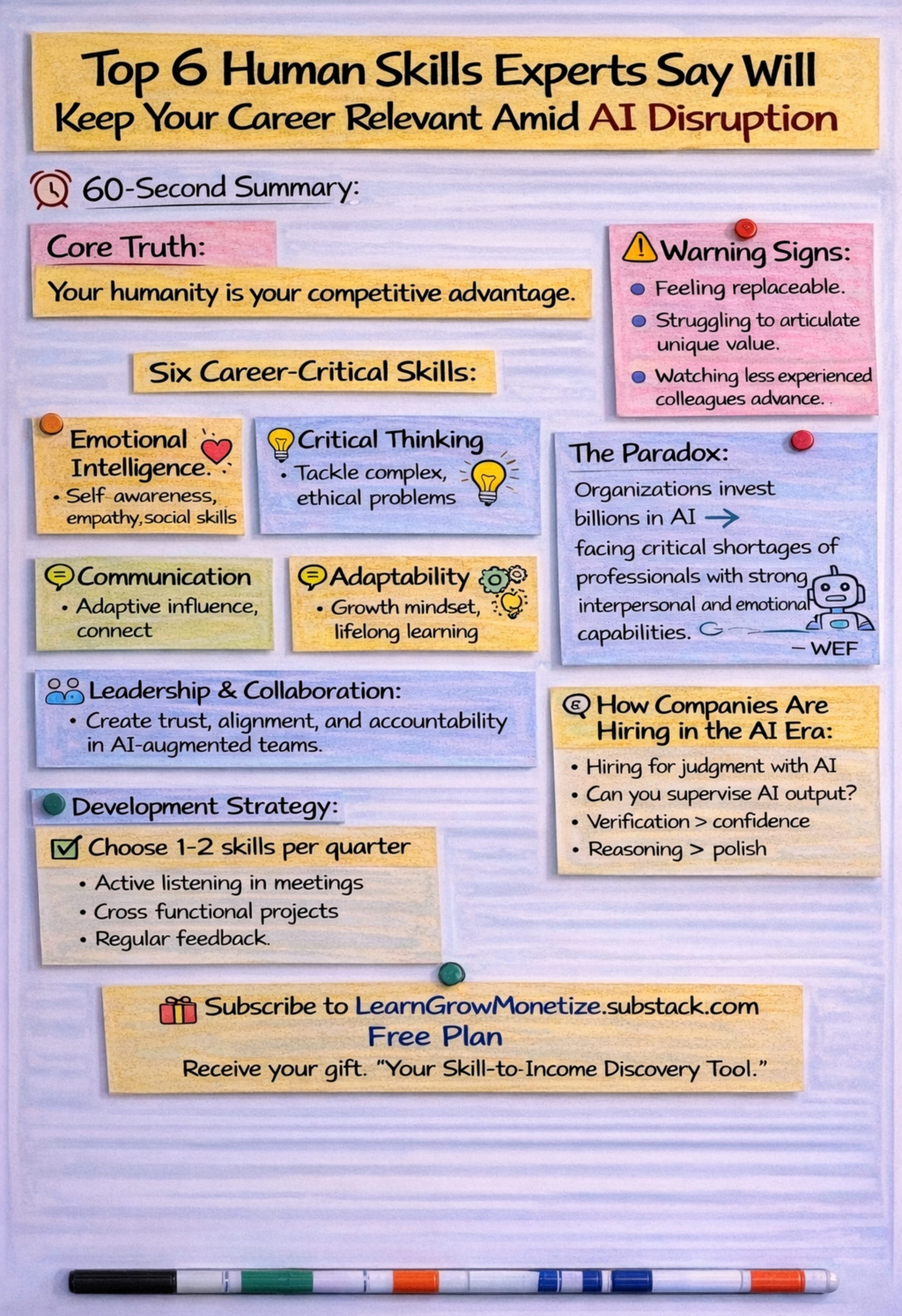
⏰ 60-Second Summary:
Core Truth: AI isn’t the threat—it’s failing to develop uniquely human capabilities machines can’t replicate. Your humanity is your competitive advantage.
The Paradox: Organizations invest billions in AI while facing critical shortages of professionals with strong interpersonal and emotional capabilities. By 2027, uniquely human skills will dominate core skills required across industries.
Six Career-Critical Skills:
1. Emotional Intelligence: Self-awareness, empathy, social skills. Outpredicts IQ for career success. Unlike IQ, it develops throughout your career through practice and feedback.
2. Critical Thinking: AI optimizes within rules; humans tackle ill-defined problems, conflicting priorities, and ethical questions requiring context, intuition, and moral reasoning.
3. Creativity: AI generates variations; humans make intuitive leaps to breakthrough innovations, connect disparate ideas, and imagine possibilities that never existed.
4. Communication: Adaptive storytelling, active listening, persuasion, reading nuance. AI drafts emails; humans create genuine connection and inspire action.
5. Adaptability: Skills half-life is five years and shrinking. Embrace growth mindset, commit to lifelong learning, experiment fearlessly, update mental models, stay curious.
6. Leadership & Collaboration: Orchestrate human-AI collaboration, maintain team cohesion, provide vision and psychological safety technology can’t supply, build trust through consistency.
Development Strategy: Choose one or two skills per quarter. Integrate practice into existing work—active listening in meetings, cross-functional projects for adaptability, regular feedback for emotional intelligence.
Warning Signs: Feeling replaceable, struggling to articulate unique value, watching less experienced colleagues advance. These signal it’s time to pivot toward human strengths.
Career resilience depends on adding irreplaceable human value in any context. Let AI handle routine tasks; focus on creativity, emotional intelligence, judgment, and connection.
The future belongs to those who embrace humanity as competitive advantage.
According to research from leading institutions like MIT Sloan and McKinsey, professionals who invest in specific human skills today will find themselves increasingly valuable as automation advances, while those who don’t will face mounting career uncertainty.
Career experts, organizational psychologists, and industry leaders across sectors are remarkably aligned on one conclusion: artificial intelligence isn’t the threat most people imagine.
The real risk is failing to develop the uniquely human capabilities that machines cannot replicate.
Like many, I got swept away with the idea of doom and gloom when looking towards the future of jobs until I recognized a fundamental truth that experts have been signaling for years: your humanity is your competitive advantage.
The human skills for career growth that matter most have nothing to do with competing against algorithms and everything to do with developing the soft skills for professionals that AI cannot master.
As a career professional myself, I am keen to explore the future of skills in the AI Age.
Today I want to share what career development experts, future of work researchers, and organizational leaders identify as the six essential human abilities that will keep you relevant, valuable, and professionally secure as AI disruption in the workplace accelerates.
These aren’t abstract concepts. They’re practical capabilities you can develop starting today, and they represent the difference between career resilience and career vulnerability.
Why Experts Say Human Skills Are Your Greatest Career Asset
There’s a consensus emerging among workforce analysts and business leaders that initially seems counterintuitive. As organizations invest billions in automation, artificial intelligence, and machine learning, they’re simultaneously experiencing critical shortages of professionals with strong interpersonal and emotional capabilities.
The World Economic Forum’s Future of Jobs Report indicates that by 2027, uniquely human skills will account for the majority of core skills required across industries.
Career strategists explain this paradox clearly: when technology handles routine cognitive tasks, data analysis, and process optimization, the premium shifts entirely to what remains distinctly human.
Think of it like this: calculators didn’t make mathematical thinking obsolete; they freed humans to focus on complex problem-solving rather than computation. AI is doing the same across knowledge work, and experts emphasize that professionals who recognize this shift early will capture disproportionate opportunities.
Learn. Grow. Monetize. Personal and Professional Growth + Sell Your Skills.
Want to future-proof your income? Time to make your skills pay and earn your worth.
Research from Deloitte’s Human Capital Trends and Harvard Business Review consistently highlights that employers aren’t struggling to find people who can use AI tools. They’re desperate for professionals who bring emotional intelligence at work, creative problem-solving abilities, adaptive communication skills, and collaborative leadership.
These capabilities transform data into insights, transactions into relationships, and teams into high-performing units. Workforce experts are clear: this is where career longevity lives.
Here’s what I’ve learned from both personal experience and studying career trajectories across industries: the skills that seemed soft or secondary early in professional journeys become the exact capabilities that open doors to leadership, consulting, entrepreneurship, and high-value roles later.
Leadership experts consistently emphasize that the ability to read nuance, synthesize conflicting perspectives, inspire trust during uncertainty, and navigate ambiguity without clear algorithms represents the new currency of career advancement.
Industry analysts tracking the future of work point to a striking pattern. Professionals with strong technical skills but weak human capabilities hit ceiling effects in their careers, finding themselves replaceable despite expertise.
Meanwhile, those who combine competence with exceptional emotional intelligence, creativity, and adaptability consistently advance, command premium compensation, and build careers resistant to technological disruption.
The Top Six Human Skills Experts Identify as Career-Critical
Let’s take a closer look and explore in more detail what these six human skills truly entail and why they are considered essential for career success.
Emotional Intelligence: The Skill Psychologists Say Predicts Success
Organizational psychologists and leadership experts have spent decades researching what distinguishes high performers from average ones.
Their conclusion is remarkably consistent: emotional intelligence outpredicts IQ and technical skills in determining career success, particularly as professionals advance.
Daniel Goleman’s research, now validated across countless studies, demonstrates that self-awareness, self-regulation, motivation, empathy, and social skills form the foundation of professional effectiveness.
Career coaches consistently emphasize that emotional intelligence at work separates those who merely execute from those who influence, lead, and drive meaningful outcomes.
Workplace psychologists explain that emotional intelligence encompasses recognizing your own emotional states and how they affect decision-making, managing emotional responses under pressure, understanding what motivates yourself and others, sensing others’ emotions and perspectives, and building genuine relationships that create trust.
These aren’t abstract concepts. They’re practical capabilities that determine whether you can navigate conflict constructively, motivate diverse teams, rebuild trust with dissatisfied clients, or make sound judgments in ethically complex situations.
Based on personal experience, for any professional at any career stage, developing emotional intelligence starts with ruthless self-honesty. I’d suggest keeping a reflection practice and noting when you felt triggered, reactive, or particularly connected during interactions.
Notice your patterns. As a career development expert, I recommend seeking feedback from trusted colleagues specifically about emotional blind spots.
Practice active listening where you’re genuinely curious about others’ perspectives rather than simply waiting to respond. These practices aren’t optional extras for career success. Research from Yale’s Center for Emotional Intelligence shows they’re foundational.
What we’ve all got to realise is that these skill areas can be worked on and developed.
Neuroscience researchers studying workplace performance emphasize something crucial: unlike IQ which remains relatively fixed, emotional intelligence can be developed throughout your career.
This is backed by brain plasticity research means that practicing empathy, self-awareness, and emotional regulation actually strengthens neural pathways.
This makes emotional intelligence one of the most powerful investments you can make in your professional future, particularly as career experts predict it will become the primary differentiator for leadership roles.
Critical Thinking and Problem-Solving: What Innovation Experts Prize Most
Innovation consultants and strategic thinkers often point out that complex problem-solving is the human skill least affected by automation.
A recent review on human strategic innovation notes that our ability to reason abstractly lets us create entirely new strategies that exploit AI’s limits, something AI can’t do with simple pattern recognition.
This is beacuse although AI performs well at optimizing within defined rules and spotting patterns in existing data it struggles with ill-defined problems, conflicting priorities, ethical questions, and situations that require context.
Research confirms these limits. One 2024 study found that AI often outperforms humans on closed-ended problems, yet falls short on tasks that demand originality — a key part of open-ended, ambiguous problem solving.
However, humans, on the other hand, rely on intuition, context, tacit knowledge, and moral reasoning — skills that remain hard for AI to copy.
This gap isn’t a weakness — it’s an opportunity. Professionals who build critical thinking, creative reasoning, and contextual judgment are the ones least likely to be disrupted by automation, and best placed to take advantage of it.
So cultivate your critical thinking by regularly challenging your own conclusions. When you reach a decision, force yourself to argue the opposite position convincingly. Then seek perspectives from people with completely different backgrounds and experiences. When you remain open to learning you can always evolve and develop competences at any stage of your carrer.
Then read beyond your industry and professional echo chamber. The goal isn’t paralysis through overthinking but building mental flexibility to see problems from multiple angles.
Creativity: What Design Thinkers Say Drives Breakthrough Value
Creativity researchers and innovation experts are adamant: creative thinking has shifted from a nice-to-have artistic quality to an essential professional competency.
AI can generate variations on existing themes and optimize within known parameters.
What it fundamentally cannot do is make the intuitive leaps that lead to breakthrough innovations, connect disparate ideas in ways that feel both surprising and inevitable, or imagine possibilities that have never existed.
Innovation strategists emphasize that this is distinctly human territory.
Think of it like this, as design thinking experts often frame it: machines can tell you what has worked based on historical patterns. Human creativity imagines what could work that has never been tried.
The AI tools provide valuable inputs through data analysis, market trends, and customer behavior patterns. But the creative leap from information to innovation still requires human imagination.
Creativity experts identify several capabilities that future-proof careers:
Brainstorming beyond obvious first-draft solutions
Combining ideas from unrelated fields in novel ways
Asking “what-if” questions that challenge conventional wisdom
Prototyping concepts that don’t yet have supporting data
Recognizing patterns or opportunities that others miss.
These capabilities not only enhance individual problem-solving but also equip professionals to adapt, innovate, and thrive in rapidly changing work environments.
Research from Adobe’s Future of Creativity study emphasizes these creative skills because they drive entrepreneurship, product innovation, marketing effectiveness, and the strategic pivots that keep organizations competitive.
So to protect your creative capacity I’d advise building space for undirected thinking into your routine. Practices like walking without devices, journaling without specific objectives, and deliberately exposing yourself to ideas outside your domain really can help develop your creativity skills.
Communication Skills: What Influence Experts Say Separates Leaders
Communication specialists and executive coaches are clear about something many professionals miss: we’re drowning in information while starving for genuine connection.
This creates enormous opportunity for those who master adaptive communication, cutting through noise, conveying complex ideas clearly, and influencing human behavior effectively.
AI can draft emails and generate reports. What it cannot do is read nuance, adjust approach mid-conversation based on subtle cues, or craft narratives that inspire meaningful action.
Interpersonal communication experts explain that effective workplace communication encompasses far more than speaking and writing clearly.
It includes storytelling that makes abstract concepts tangible, active listening that uncovers unstated concerns, persuasion that respects others’ autonomy, cultural intelligence that navigates diverse contexts, and the ability to adapt your message and delivery based on your audience.
Research from LinkedIn’s Workplace Learning Report emphasizes these communication skills because they represent some of the most automation-resistant capabilities in any professional toolkit.
I hold the view, reinforced by leadership experts across industries, that the communication gap between good professionals and great ones is widening.
As digital communication tools multiply, the ability to create genuine human connection becomes simultaneously rarer and more valuable.
Executive coaches consistently observe technically brilliant colleagues who struggle to advance because they cannot articulate their ideas compellingly, build coalitions around their vision, or influence stakeholders effectively.
From my perspective, and this aligns with what communication specialists teach, improving your impact starts with clarity of thinking. You cannot communicate clearly what you haven’t thought through thoroughly.
Before important conversations or presentations, force yourself to articulate the core message in one sentence.
It is also important to note that communication skills have always mattered exponentially more as you advance professionally.
Individual contributors can sometimes succeed despite weak interpersonal abilities, but leaders cannot.
The capacity to inspire teams, negotiate effectively, resolve conflicts constructively, present ideas persuasively, and build relationships across organizational boundaries determines whether you progress or plateau. That’s not opinion. It’s what workforce data demonstrates consistently.
Adaptability: What Futurists Say Determines Career Survival
Adaptability might be the most critical human skill for staying relevant because it determines how quickly you acquire every other capability.
And we are all going to have to be adaptable when it comes to learning skills. Future of work researchers and career strategists have sobering news: the average half-life of skills is now estimated at five years and shrinking according to research from Deloitte.
Workforce analysts emphasize that career resilience increasingly depends on adaptability and agility, your capacity to learn continuously, pivot when necessary, and maintain effectiveness through disruption.
It’s about maintaining what I call confident flexibility: deep knowledge combined with openness to new approaches.
As professionals go through these transitions, I would emphasize that successful pivots require letting go of established identity and comfort while building new capabilities. Each expansion creates more opportunity than staying put ever would.
Adaptable professionals share key traits that drive professional longevity:
Embrace a growth mindset – see challenges as opportunities, not threats.
Commit to lifelong skill-building – learning doesn’t stop after formal education.
Experiment and learn from failure – treat setbacks as lessons, not shame.
Update mental models – adapt thinking based on new evidence.
Stay curious about emerging trends – anticipate change and innovate.
Carol Dweck’s research on growth mindset at Stanford shows that these adaptability traits increasingly influence who is chosen for high-visibility projects and leadership roles.
Quick tip: conduct a personal skills audit quarterly. List the capabilities that currently drive your value. Identify which ones might decline in relevance over the next two years based on industry trends.
Choose two emerging skills to develop proactively before they become table stakes in your field. This approach positions you ahead of disruption rather than reacting to it.
Future of work trends show a clear pattern: professionals who see change as something happening to them face far more career anxiety than those who view themselves as active agents shaping their own path.
The difference comes down to mindset and consistent skill development.
You don’t need to predict which exact roles will exist in ten years.
What matters is becoming the kind of professional who can create value in any context through continuous learning and flexible thinking.
Leadership and Collaboration: What Management Experts Say Defines Modern Success
In today’s AI-driven world, leadership is no longer just about managing people — it demands a fundamentally new paradigm.
Leadership development experts and organizational psychologists emphasize that effective leadership in the AI era requires a fundamentally new paradigm. You’re not just managing people anymore.
You’re orchestrating collaboration between humans and AI tools, maintaining team cohesion in hybrid and remote environments, providing the vision and psychological safety that technology cannot supply, and navigating constant change while keeping teams focused and motivated.
Research on successful digital transformations highlights specific qualities that set effective leaders apart.
They embrace uncertainty rather than pretending to have all the answers.
They involve teams in shaping how technology is implemented, rather than imposing top-down mandates.
And they protect time for the human connections that build trust, even when efficiency metrics might suggest otherwise.
I am of the opinion, supported by extensive leadership research from the Center for Creative Leadership, that collaborative leadership will separate managers from true leaders over the next decade.
Management can be partially automated through project management platforms, performance dashboards, and workflow optimization tools. Leadership cannot.
The ability to inspire people toward shared purpose, resolve conflicts constructively, recognize and develop potential in others, and create environments where innovation flourishes remains firmly in human territory.
If you’re developing leadership capabilities, focus on building high-trust environments before anything else.
Organizational behavior experts are clear that trust is the foundation that makes everything else possible, including honest feedback, productive conflict, shared accountability, and innovation. Research from Google demonstrates that trust develops through consistency between words and actions, through admitting mistakes openly, and through advocating for your team even when it’s uncomfortable.
Leadership experts also studying career advancement patterns emphasize that collaborative skills matter regardless of whether you have formal authority. The ability to influence without power, build cross-functional relationships, facilitate effective team dynamics, and guide colleagues through ambiguity represents valuable capabilities at every career stage.
With this in mind, organizations increasingly will promote people who demonstrate these leadership qualities informally before giving them formal leadership roles.
How Career Experts Recommend Building These Skills
Career development specialists emphasize that developing human skills for career growth doesn’t require returning to school or massive time investment. It requires intentional practice woven into your existing work and life.
The key I think, as a professional career coach, is moving from passive awareness of these human skills to active development. From knowing these capabilities matter to systematically strengthening them through deliberate practice.
Skill development experts recommend starting by assessing which capabilities represent your natural strengths and which need deliberate attention.
Most people have two or three skills they’ve developed well and several they’ve neglected. I, like many career coaches stress there’s no shame in that. It’s simply data to inform where you focus energy. Rather than attempting everything simultaneously, workforce development specialists suggest choosing one or two skills to emphasize each quarter.
For emotional intelligence development, psychologists recommend seeking regular feedback and maintaining a reflection practice.
For critical thinking, innovation experts suggest challenging your assumptions systematically and exploring diverse perspectives.
For creativity, design thinkers advise building unstructured thinking time into your schedule and cross-pollinating ideas from different domains.
For communication, influence specialists recommend studying effective communicators and practicing style adaptation.
For adaptability, change management experts suggest taking on projects outside your comfort zone and reframing failure as learning.
For leadership, executive coaches emphasize finding mentors and creating opportunities to guide others.
The real benefit, as career strategists frequently note, of investing in these capabilities extends far beyond career security. These skills improve every dimension of life including relationships, parenting, community involvement, and personal projects.
They make you more effective, more fulfilled, and more resilient regardless of what professional changes unfold. Career experts emphasize that this represents beautiful alignment between being more human and being more professionally valuable.
What Workforce Analysts Warn About Neglecting Human Skills
Workforce researchers and career strategists won’t sugarcoat the risks. Professionals who don’t develop strong human capabilities face increasing vulnerability as automation advances.
Labor economists at MIT note that the roles most at risk aren’t just manual labor anymore. They include positions requiring routine cognitive tasks, basic analysis, and limited interpersonal interaction.
The truth is blunt: if your job can be reduced to an algorithm, eventually it will be.
Employment specialists identify several warning signs of career vulnerability: feeling replaceable in your role, struggling to articulate your unique value proposition, watching younger or less experienced colleagues advance while you stagnate, and sensing that your expertise matters less than it used to.
However, I don’t believe these aren’t reasons for panic. They’re signals to pivot your development focus from pure technical skills toward the uniquely human strengths that compound over time.
It seems to me, and workforce analysts confirm this observation, that the professionals experiencing the most career anxiety right now aren’t necessarily those in roles being actively automated. They’re those who’ve built their identity entirely around expertise that’s becoming commoditized or capabilities that AI can now perform more efficiently.
As a career strategist, I suggest that the antidote isn’t resisting change or doubling down on obsolete skills.
It’s expanding your skill portfolio to include the human abilities that increase in value as technology handles more routine work.
Future of work researchers also note something encouraging: it’s rarely too late to develop these capabilities.
Human skills often improve with age and experience when developed intentionally.
Emotional intelligence, judgment, communication, and leadership typically strengthen over careers as professionals accumulate diverse experiences.
The key is maintaining a growth mindset and actively practicing rather than assuming capabilities are fixed.
Expert Consensus: Your Humanity Is Your Competitive Advantage
Career strategists, workforce researchers, and business leaders across industries are remarkably aligned on one fundamental insight: we’re in a unique moment where the future of work is being written but not yet determined.
The professionals who will thrive, according to expert analysis from organizations like McKinsey Global Institute and BCG Henderson Institute, aren’t necessarily the most technically skilled or the most credentialed. They’re the ones who recognize that being human, deeply and skillfully human, represents their greatest professional asset.
So instead of viewing AI as competition, reframe it as liberation from tasks that don’t require your uniquely human gifts.
Let automation handle the data entry, routine analysis, and repetitive communications. Save your energy for the work that needs creativity and problem-solving, emotional intelligence, nuanced judgment, and human connection.
This is where I beleve that your professional growth lives, not in competing with machines but in doing what only humans can do exceptionally well.
The human skills experts identify as career-critical aren’t complete overhauls of who you are. Career coaches stress they’re amplifications of capabilities you already possess but may not have consciously developed. Start with one skill this week.
Practice it deliberately. Notice the difference it makes in your effectiveness and confidence. Then build from there methodically, consistently, without pressure for perfection.
In Conclusion
Career resilience experts are clear: your long-term professional security doesn’t depend on predicting exactly which roles will exist in ten years.
It depends on becoming the kind of professional who adds irreplaceable human value in any context.
That’s not just a strategy for surviving disruption. It’s a foundation for thriving through it, for building a career that’s fulfilling, financially rewarding, and secure regardless of technological change.
The future, according to workforce analysts and business leaders alike, belongs to the humans who embrace their humanity as their competitive advantage. Make sure you’re one of them.
FAQs
What do experts say are the most important human skills for career growth?
Career researchers and workforce analysts consistently identify six critical capabilities: emotional intelligence, complex problem-solving, creativity, adaptive communication, agility, and collaborative leadership.
These represent automation-resistant strengths that increase in value as AI handles routine tasks. Career development experts recommend focusing on developing skills where you have natural aptitude first, then expanding to areas needing more attention.
How can I develop soft skills while working full-time according to career coaches?
Professional development specialists recommend integrating skill-building into existing work rather than treating it as separate. Practice active listening in every meeting, volunteer for cross-functional projects that build adaptability, seek feedback regularly to develop emotional intelligence, and block small amounts of time weekly for creative thinking.
Career coaches emphasize that skill development doesn’t require massive time investment when practiced consistently within your current role.
Will AI replace jobs that require human skills according to workforce experts?
Labor economists and future of work researchers predict AI will augment rather than replace most knowledge work, handling routine aspects while humans focus on judgment, creativity, and relationship-building.
Roles requiring strong interpersonal skills, ethical decision-making, strategic thinking, and emotional intelligence remain highly automation-resistant. Workforce analysts emphasize the key is positioning yourself where human capabilities matter most.
How do career strategists recommend prioritizing skill development?
Career coaches suggest assessing which capabilities drive value in your industry and role, then identifying your gaps.
Research job descriptions for positions you aspire to and note recurring requirements. Seek feedback from mentors about which skills would most accelerate your advancement.
Career development experts generally recommend prioritizing skills that compound over time and transfer across roles rather than narrow technical abilities.
Can experienced professionals still develop these human skills?
Organizational psychologists and career experts emphasize that human skills often improve with age and experience when developed intentionally.
Emotional intelligence, judgment, communication, and leadership typically strengthen over careers as professionals accumulate diverse experiences.
Researchers stress that maintaining a growth mindset and actively practicing are key, noting that many professionals experience their most significant skill development mid-career and beyond.
Related Articles
AI Automating Your Job? Here’s What To Do...
25 Essential Skills on the Lifelong Skills List for Success
Mastering High-Income Skills: Boost Earnings for Financial Success
Personal and Professional Growth
Next Steps
Networking Opportunity in the Comments!
Want to grow your followers and subscribers? Introduce yourself in the comments—let me know who you serve and what you write about. Share your Substack or newsletter link, and let’s connect!
“The best way to predict the future is to create it.” — Peter Drucker