
Future Skills Every Professional Should Know (Up to 2030)
Discover the top future skills every professional should know, including digital literacy, emotional intelligence, critical thinking, and adaptability for 2026 career success.


Your degree won’t save your career. Neither will years of experience.
The skills that got you hired three years ago?
They’re already outdated.. and you probably don’t even know it yet.
But what not everyone has realized is that the real job security comes from your ability to keep learning and creating value in ways that evolve with market demands.
Understanding the future skills every professional should know gives you options, leverage, and the ability to pivot when everything around you changes (which it will).
The workplace shifted faster than anyone predicted. According to the World Economic Forum, 94% of business leaders now expect employees to pick up new skills on the job—up from just 65% in 2018.
That’s not a gentle suggestion. That’s employers telling you that what you know today won’t be enough tomorrow.
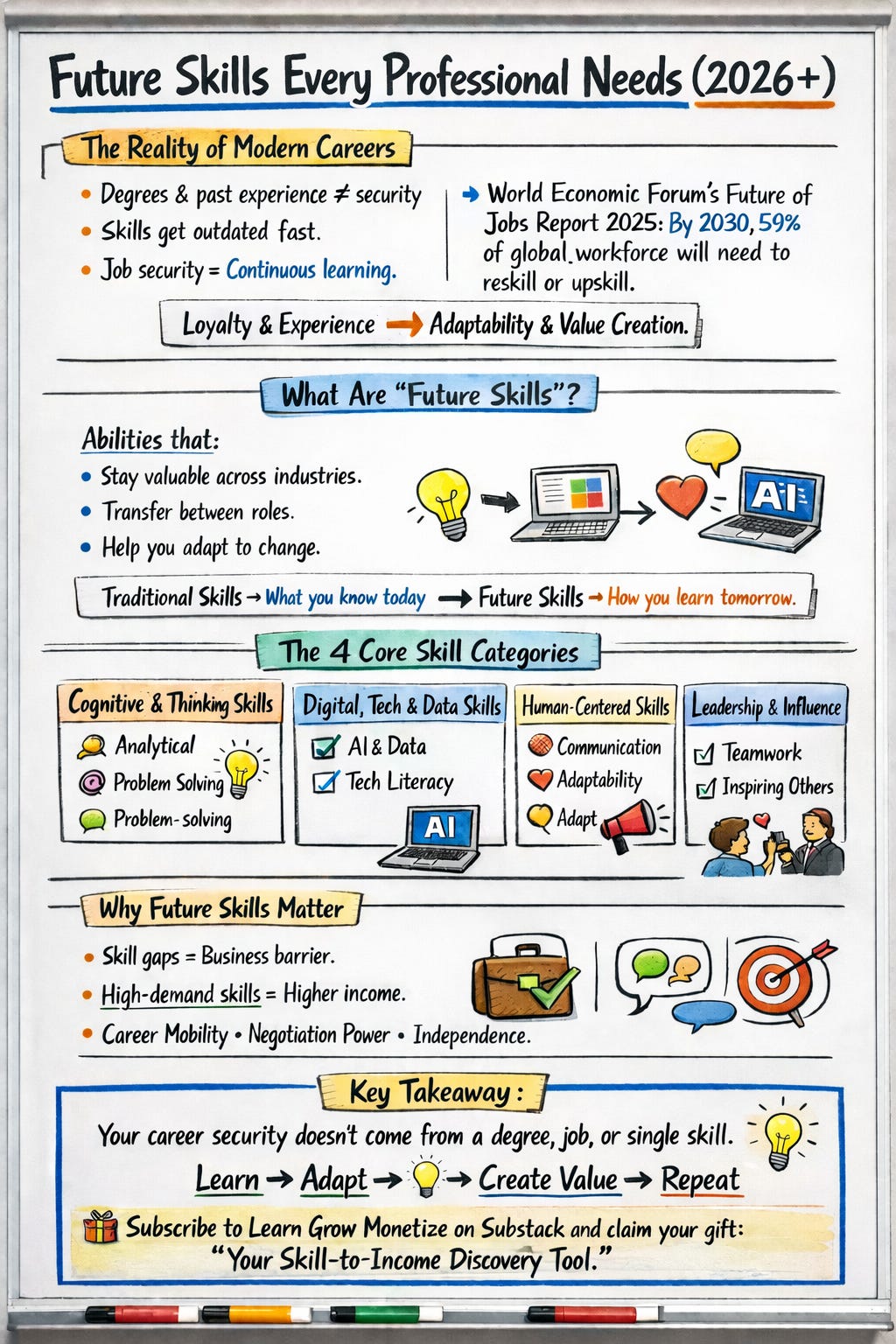
Then again, according to the World Economic Forum’s Future of Jobs Report 2025, by 2030, 59% of the global workforce will need to reskill or upskill to adapt to changing job demands… that’s nearly 6 in 10 workers.
The economy isn’t rewarding loyalty or seniority anymore. It’s rewarding adaptability.
🎁Subscribe to the Free Plan and claim your gift: “Your Skill-to-Income Discovery Tool.” Uncover your highest-value skills and get your personalized roadmap to monetizing them.
What Are Future Skills?
Future skills are the competencies that matter both now and five years from now. They’re different from traditional technical knowledge because they focus on capabilities that transfer across roles, industries, and economic shifts.
The stark reality is that being good at your current job isn’t enough because the half-life of professional skills keeps shrinking… you need to adopt a mindset of life-long learning to be able to thrive in your career long-term.
Research shows that a skill you spent years mastering might lose significant value within 18 months because of new technology or changing business models.
Future skills fall into four categories:
Cognitive abilities (how you think, analyze, and solve problems)
Digital and technical fluency (how you work with technology and data)
Human-centered competencies (how you collaborate, communicate, and adapt)
Leadership and influence (how you drive results through and with others).
Traditional skills are what you know today. Future skills are how you’ll learn, adapt, and stay valuable tomorrow.
As I see it, professionals who understand this distinction build careers that thrive, while those who don’t may face more challenges along the way.
Why Future Skills Are Critical for Your Career
The numbers don’t lie. Skill gaps are categorically considered the biggest barrier to business transformation, with 63% of employers identifying them as a major barrier over the 2025-2030 period.
Companies aren’t looking for specialists who can do one thing exceptionally well anymore.
They want professionals who can think critically across disciplines, communicate clearly with diverse teams, and adapt when priorities shift… which happens constantly now.
Salary potential follows skill development. Professionals with high-demand workplace skills like data literacy, emotional intelligence, and strategic thinking earn significantly more than those who rely solely on technical expertise from five years ago. But beyond money, these competencies give you freedom—the ability to negotiate better terms, switch industries, or build something of your own.
As a Career Advisor, I’d say that if you’re waiting for your employer to tell you which skills to build, you’re already behind.
The professionals who advance fastest identify gaps themselves and start filling them before anyone asks.
Career resilience doesn’t come from any single employer, credential, or skill set. It comes from your capacity to keep learning and adding value in ways that matter to the market right now. That’s the difference between professionals who thrive and those who survive.
Learn. Grow. Monetize. Personal and Professional Growth + Sell Your Skills.
Want to future-proof your income? Time to make your skills pay and earn your worth.
Top Future Skills for Professionals
These aren't aspirational nice-to-haves… they're the capabilities that separate professionals who advance from those who plateau, and mastering them gives you a competitive edge no automation can replicate.
Cognitive & Thinking Skills
Analytical thinking remains the top core skill for employers, with seven out of 10 companies considering it essential. This isn’t about being smart. It’s about evaluating information systematically, spotting patterns others miss, and making sound decisions when the path forward isn’t obvious.
I’ve watched professionals with impressive credentials struggle because they could execute tasks perfectly but couldn’t think through complex problems independently.
They waited for instructions instead of figuring things out.
Critical thinking and problem-solving help you question assumptions, evaluate evidence, and arrive at conclusions that hold up under scrutiny. In a world drowning in information, your ability to separate signal from noise determines your value.
Creative thinking and strategic thinking work together differently than most people realize. Creativity isn’t about wild ideas—it’s about connecting existing concepts in new ways. Strategic thinking means seeing how today’s decisions create tomorrow’s outcomes.
Based on personal experience, developing an innovation mindset means getting comfortable with uncertainty. You learn to ask better questions instead of rushing to answers. You test ideas quickly. You stay curious even when you think you already know the solution.
Here’s what I’ve learned: the best problem-solvers don’t have more knowledge… they have better thinking processes. They break complex challenges into manageable parts. They consider multiple angles.
Then they update their views when new evidence appears.
Digital, Tech & Data Skills
You don’t need to become a developer, but you absolutely need digital literacy and tech fluency. Understanding how technology works, what it can accomplish, and where it falls short helps you use it effectively rather than being intimidated by it.
The WEF Future of Jobs Report 2025: the insight report shows AI and big data as the fastest‑growing skill category overall.
So what I’d say is that AI and machine learning basics aren’t just for tech roles anymore.
Marketing professionals use AI for content recommendations. HR teams use machine learning for candidate screening. Finance departments use algorithms for forecasting. You don’t need to build these systems, but you need to understand their capabilities and limitations well enough to ask smart questions and interpret results.
As a Career Guidance professional, I have seen that data analytics skills have surged in global job postings, highlighting data literacy as one of the most in-demand yet underrated skills today.
Every role now involves some level of data-driven decision making—whether you’re tracking campaign performance, analyzing customer behavior, or measuring team productivity. Being able to read data, question its quality, and draw meaningful insights separates professionals who make informed decisions from those who guess and hope.
I think that a really powerful point to note is that technology fluency isn’t about mastering every new tool. It’s about building confidence in your ability to learn new platforms quickly and adapt your workflow as tools evolve.
The specific software you use today will change. Your comfort with technological change is what lasts.
Even basic UX/UI design fundamentals help. Understanding how people interact with digital products makes you more valuable in almost any role—from creating better presentations to designing internal processes that people actually want to use.
Human-Centred Skills
This is where most professionals drop the ball. They focus so much on technical skills that they neglect the interpersonal skills that actually determine career progression.
Resilience, flexibility and agility rank second in core skills, along with leadership and social influence, underscoring that technical knowledge alone won’t carry your career.
Emotional intelligence (real EQ, not just being nice) means understanding your own reactions and reading others accurately. It’s noticing when a colleague is frustrated before they say anything. It’s managing your own stress without dumping it on your team. It’s having difficult conversations without making them personal.
According to a BusinessWire report on global workforce skills trends, business communication demand increased by 19%, alongside other professional skills like strategy and leadership, reflecting how communication is becoming increasingly prioritized by organisations.
These stats just confirm what we already know; communication and collaboration are foundational to everything else.
You can have brilliant ideas, but if you can’t articulate them clearly or work effectively with others, those ideas stay stuck in your head.
The future workplace demands professionals who can collaborate across time zones, cultures, and communication styles without defaulting to frustration. As many as 86% of employees and executives cite the lack of effective collaboration and communication as the main cause of workplace failures.
Adaptability and resilience aren’t buzzwords—they’re survival skills. Things change constantly. Projects get canceled. Priorities shift. Teams reorganize. Professionals who stay flexible and recover quickly from setbacks build careers that last. Those who resist change or take every pivot personally... well, they don’t.
A growth mindset and commitment to lifelong learning separate people who peak early from those who keep getting better. When you believe you can develop new capabilities rather than being limited to what you already know, you approach challenges differently.
You’re less defensive about feedback.
You experiment more.
You see setbacks as information rather than failure.
As a Career Advice professional, the most successful professionals I know don’t have fewer problems… they just handle uncertainty better. They’ve trained themselves to stay productive when things get messy, which is most of the time now.
Leadership & Collaboration Skills
Leadership skills matter for everyone, not just managers. Influence isn’t about authority—it’s about inspiring people to move in a direction because they want to, not because they have to. That requires clarity, empathy, and the ability to connect your ideas to what others care about.
Leadership skills will be the focus of four in 10 corporate skills strategies, making it a top priority across industries.
Teamwork and remote collaboration present entirely new challenges. Building trust through screens, managing asynchronous communication, and maintaining team cohesion without physical proximity require deliberate effort and new approaches. The professionals who figure this out first will have significant advantages.
Cross-disciplinary collaboration—working effectively with people from different departments, backgrounds, and expertise areas—becomes increasingly valuable as problems get more complex. No single person has all the answers anymore. Your ability to bridge knowledge gaps and facilitate collaboration between diverse team members determines what you can accomplish.
Think of it like this: technical skills might get you noticed, but leadership and collaboration skills determine how far you go.
You can be the smartest person in the room, but if people don’t want to work with you, your impact stays limited.
How to Develop Future-Ready Skills
The good news? You don’t need to go back to school or invest years before you see results. Skill-building today is more accessible than ever—if you’re intentional about it.
Professional development strategies that actually work:
Online learning platforms offer courses in everything from data analytics to emotional intelligence. Look for programs that balance theory with application. The best courses make you practice skills immediately rather than just consume information.
Side projects and volunteer work build capabilities faster than passive learning. Identify one skill you want to develop, find a project that requires it, and learn by doing rather than waiting until you feel ready.
Micro-credentials and professional certifications signal to employers that you’re actively developing relevant competencies. They’re not replacements for experience, but they demonstrate commitment to growth—which matters when hiring managers choose between candidates with similar backgrounds.
Mentorship accelerates learning in ways self-study can’t match. Find people who’ve developed the skills you’re building and learn how they think, not just what they know. Pay attention to how they approach problems, handle setbacks, and make decisions under uncertainty.
I love this strategy: create a personal upskilling plan.
So you identify three skills that would make you significantly more valuable in your current role or desired position.
Dedicate focused time each week to building those specific competencies. Track your progress. Then adjust based on what’s working.
Practical skill-building approaches:
Consider investing in AI literacy programs if you’re not already comfortable with how AI tools work. Understanding basic prompting, when to use AI assistance, and how to verify AI-generated content will matter across almost every role.
Look for workplace projects that stretch your abilities. Volunteer for cross-functional teams. Take on assignments that require skills you haven’t fully developed yet. Real-world practice beats theoretical knowledge every time.
Set up regular learning time—even 30 minutes daily makes a difference when you’re consistent. The professionals who advance fastest treat skill development like brushing their teeth: non-negotiable and part of their routine.
Reskilling sometimes means letting go of skills you spent years developing because market demand shifted.
That’s hard. But holding onto obsolete capabilities out of emotional attachment doesn’t serve you. It keeps you stuck while the market moves forward.
Future Skills in Practice: Career Impact
High-demand skills directly influence earning potential. So professionals who combine technical expertise with strong interpersonal abilities consistently command higher salaries and better opportunities than those who focus exclusively on one area.
In my experience, career growth follows what I call, “capability development”.
The most employable professionals I know share similar traits: they’re curious, they learn constantly, they adapt quickly, and they can communicate their value clearly.
Their specific job titles change, but their careers keep moving forward because they’ve built a foundation of transferable skills that work across contexts.
Professional success comes from being valuable in ways that matter right now, not in ways that mattered five years ago. The job market rewards current relevance, not past accomplishments.
Common Mistakes to Avoid
Even the most ambitious professionals stumble when learning new skills—here are the most common mistakes to watch out for…
Waiting for perfection before starting
You don’t need to be an expert before you begin applying new skills. Start messy. Improve as you go. Perfectionism is just procrastination wearing a better outfit.
Building skills in isolation
The best learning happens through application. Take on projects that require the skills you’re developing. You’ll learn faster and retain more when there are real consequences for getting things wrong.
Ignoring soft skills
Technical abilities get you interviews. Human-centered skills get you hired, promoted, and trusted with bigger opportunities. Don’t make the mistake of thinking emotional intelligence and communication are “nice to have” skills—they’re essential.
Expecting linear progress
Skill development doesn’t follow a straight line. You’ll plateau. You’ll struggle. You’ll occasionally feel like you’re moving backward. That’s normal. Keep showing up.
Finally
If you’re still reading, you recognize that building future skills isn’t optional—it’s how you protect your career in an unpredictable economy.
The professionals who thrive over the next five years won’t be the ones with the most impressive past credentials.
They’ll be the ones who commit to continuous growth, who build both technical abilities and human-centered competencies, and who start where they are with what they have.
Your career security doesn’t come from any single employer, credential, or skill set. It comes from your ability to keep learning, adapting, and adding value in ways that matter to the market right now.
Your New To Do LIst
First, conduct an honest skill inventory. What are you genuinely good at? Where do you struggle? What skills would make you significantly more valuable? Don’t just list what’s on your resume—think about what you can actually do well under pressure.
Then create a professional roadmap. Pick two or three skills that would have the biggest impact on your career and commit to building them over the next six months. Not ten skills. Not everything on this list. Just the ones that matter most for where you want to go.
Track your progress. Set specific milestones. Notice what’s working and what isn’t. Adjust your approach based on results, not intentions.
And here’s the part most people miss: building future skills isn’t a one-time project. It’s a career strategy. The learning never stops. The moment you think you’ve arrived is usually the moment you start falling behind.
So... what skill are you going to build first?
Want more insights on building skills that actually translate into income? Subscribe to Learn Grow Monetize for weekly strategies on turning your expertise into real career leverage.
FAQs
What are the most important future skills for career growth?
Analytical thinking, digital literacy, emotional intelligence, and adaptability consistently rank as top skills. But the “most important” skill depends on your industry and career goals. Focus on skills that complement your existing strengths while addressing clear gaps in your capabilities. Look at job descriptions for roles you want—what skills appear repeatedly? That’s your answer.
How long does it take to develop future-ready skills?
Depends entirely on the skill and your starting point. Basic digital literacy might take weeks of focused practice. Deep expertise in data analytics could take months. According to research, some mastery skills in emerging professions can be acquired in one to two months through focused learning. The key is starting with deliberate practice rather than waiting for perfect conditions. You’ll see progress faster than you expect if you’re consistent.
Can I build future skills while working full-time?
Absolutely. Most professionals build new capabilities through a combination of online courses, workplace projects, and intentional practice during existing work. You don’t need to quit your job—you need to be strategic about how you use your time and what projects you take on. Even 30 minutes of focused learning daily compounds into significant progress over months.
Are soft skills or technical skills more important for the future?
Both matter, and the distinction is becoming less useful. The most valuable professionals combine technical competence with strong interpersonal abilities. You need enough technical knowledge to do your work and enough soft skills to collaborate effectively. Neither alone is sufficient. The market rewards the combination.
How do I know which skills to prioritize?
Look at job descriptions for roles you want in the future. What skills appear repeatedly? Talk to people doing work you admire—what capabilities do they use most often? Pay attention to what your industry rewards. Then choose skills that align with both market demand and your natural strengths. Don’t try to be good at everything. Focus on becoming excellent at a few things that matter.
What if the skills I invest in become obsolete?
That’s why you focus on transferable skills—analytical thinking, emotional intelligence, adaptability—that work across contexts. Technical skills might change, but the ability to learn quickly, communicate clearly, and solve complex problems stays valuable. Build a foundation of capabilities that transfer, not just specialized knowledge that expires.
How can I measure progress in skill development?
Set specific benchmarks. If you’re building data literacy, can you now interpret a dashboard that confused you last month? If you’re developing emotional intelligence, are your conversations producing better outcomes? Track concrete applications of your skills, not just completion of courses. Real progress shows up in what you can do, not just what you know.
Related Articles
Skills for Career Growth in the AI Era: What You Really Need to Learn Now
Top 6 Human Skills Experts Say Will Keep Your Career Relevant Amid AI Disruption
AI-Era Skills for Freelancers: Your Competitive Edge in Today’s World
The 1-Hour Annual Skill Review: Plan Next Year With Clarity
Next Steps
🎁Subscribe to the Free Plan and claim your gift: “Your Skill-to-Income Discovery Tool.” Uncover your highest-value skills and get your personalized roadmap to monetizing them.
❤️ Loved it? Restack 🔁 and share ✅
Links you will love
💰The Sell Your Skills System your complete roadmap for transforming expertise into income—even if you’re starting from scratch.
🎯Career Pivot Playbooks read the real stories behind modern careers… the backstories, the how and the why behind successful Substackers.
💎Join the Paid Tier for Monthly Group Mentorship get clarity, accountability, and momentum—every month.
✨Upgrade for Personalized Career Coaching get clarity on your next step with personalized strategy to future-proof your career and income.
I absoloutely loved this!
Its really helpful to know all of the skilla of the future, especially during the era of AI
This is phenomenal, Katharine!!! one of my new favorite articles on substack!
these skills are real, solid skills we need to know and learn. not hacks, tricks, and quick tips. real skills that take practice to build! like you said these skills separate astute professionals from the rest!